
From the Toysit archive
Baby Basketball
A small hoop, three colored controls and surprising ball arrivals make Baby Basketball a lively floor-play scene, with an original greeting game.
The play at a glance
A tiny basketball court with more than one arrival
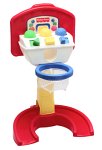
The red backboard rises over a blue hoop, while a white tray puts three colorful controls within the little court. A ball can become the star of the scene: waiting above, disappearing for a moment, then arriving somewhere a watching child can greet it.Watch the ball’s little journey
Baby Basketball brings the hoop and the ball-return area into one compact scene. The yellow upright connects the curved red base to the backboard; the blue rim and light fabric net mark the central destination. The pictured tray gives the controls their own row above the hoop.
Mattel’s product description explains that pressing the middle button makes a squeak as the ball goes into the basket. Toysit’s original account also describes side buttons sending balls down chutes to the base. That makes an appealing story shape for ordinary play: a ball waits, a control moves, and everyone watches for its arrival.
A caregiver can put words around the action without turning it into a lesson. “There it goes” and “Here it is” leave room for a child to look, reach or simply enjoy the repeat. Use the toy’s supplied balls and its normal controls; an adult should assemble and check the connections as the matching guide directs.
Original activity: Which exit’s greeting?
During an ordinary turn, let the ball’s actual destination choose its welcome. A ball through the hoop might hear “Welcome to the basket!” A ball arriving at the base might get “Hello, side-door traveler!” Wait for it to finish moving before collecting it for another turn.
Repeat a favorite greeting, change the voice, or let a companion supply the welcome. There is no need to predict the route or keep score. The little pause before the ball appears can be part of the fun.
An older child can draw a picture afterward: the waiting place, a curved journey line and a friendly face at the arrival. This is an original Toysit storytelling suggestion for normal supervised play, not an added operating mode.
The historical record
Original Toysit coverage
The original product account and commentary are preserved below as historical coverage.
Young superstars will love to dunk the three brightly colored balls through the hoop or press one of the buttons to see where the ball comes out.
There is a headboard and a net, but the rest of the game differs from the NBA version to become more baby-friendly. Attached to the headboard is a plastic contraption with three slots, where you set three balls. Tots press the buttons just below the slots to send the balls downward. The buttons to the sides send the balls not through the basket but down a secret chute and out the base. The button in the center, which squeaks when pressed, is the swish control--the ball goes straight through the hoop. Of course, older toddlers may wish to bypass the buttons and go directly to slam-dunk, one of the many advantages of a 13-inch net. We do have one caveat: while Baby Basketball was easy to assemble, it was quite difficult to take apart again. Young superstars will love to dunk the three brightly colored balls through the hoop or press one of the buttons to see where the ball comes out. Squeaking center button makes a basket every time! Realistic fabric net.
Benefits of Introducing Young Children to Mini Basketball
Introducing young children to a scaled-down version of basketball can be more than just a playful activity. Mini basketball offers a range of developmental, physical, and social benefits, making it an excellent choice for early sports engagement. Let's delve into the multifaceted advantages of introducing youngsters to mini basketball:
1. Physical Development
Playing mini basketball aids in enhancing gross motor skills. It involves running, jumping, and hand-eye coordination. As children dribble, shoot, and pass the smaller-sized basketball, they develop muscular strength, agility, and balance.
2. Cognitive Growth
Beyond physical skills, mini basketball also challenges a child's cognitive abilities. They learn to strategize, understand game rules, and make quick decisions, fostering problem-solving and critical thinking.
3. Social Skills Enhancement
As a team sport, mini basketball introduces children to concepts of teamwork, cooperation, and sharing. They learn the importance of playing together, encouraging peers, handling wins and losses gracefully, and communicating effectively on the court.
4. Boosted Self-esteem
Scoring a basket, making a pass, or just being part of a team can boost a child's confidence and self-worth. Celebrating small achievements and milestones in the game can have lasting positive effects on their self-esteem.
5. Introduction to Discipline
Like all sports, mini basketball teaches children about discipline and commitment. Regular practice, adhering to game rules, and listening to coaches instill a sense of responsibility and dedication.
6. Safe Engagement
A smaller version of basketball, with its reduced-size hoops and balls, is tailored for younger kids, ensuring safety. This allows children to enjoy the game without the risks associated with standard basketball equipment.
7. Lifelong Love for Activity
Engaging in sports from a young age can cultivate a lifelong love for physical activity. Mini basketball can be the stepping stone that encourages children to stay active and explore other sports as they grow.
Mini basketball is a holistic development tool, blending physical, cognitive, and social growth elements, setting the foundation for a healthy, active, and collaborative future.
Sources and editorial notes
Mattel’s 71042 description confirms three balls, control buttons, a squeaking center basket and a fabric net. Both complete two-page assembly guides were read and their diagrams compared with the image; they do not document every ball route. Side chutes, the 13-inch wording and old assembly experiences remain attributed to the preserved review. The later benefits essay is historical commentary, not evidence of guaranteed outcomes. No physical testing was performed.
- Original Toysit image — Existing same-site photograph reviewed and retained unchanged.
- Mattel Baby Basketball 71042 — Manufacturer model record and product description; product dates are not Toysit publication dates.
- Baby Basketball US assembly guide — Complete two-page manufacturer PDF reviewed, including assembly diagrams.
- Baby Basketball international assembly guide — Complete two-page multilingual manufacturer sheet reviewed; diagram comparison supports the model match.
- Original Toysit coverage — Complete original product account and historical commentary preserved.

Images and descriptions are retained as historical material. How Toysit covers toys.
Created for Toysit by Tabbloza — the artwork in our header.