
From the Toysit archive
Barbie Horse Adventures: Blue Ribbon Race — GBA
Explore the cover and historical account of Barbie Horse Adventures: Blue Ribbon Race for Game Boy Advance, then draw a ribbon-route comic.
The play at a glance
A rider, a horse and a ribbon to imagine
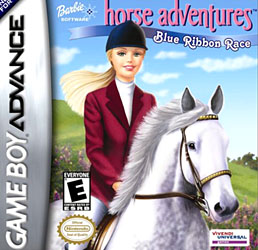
Barbie’s red riding jacket stands out beside the white horse on this Game Boy Advance cover. The Blue Ribbon Race title gives the scene a destination: somewhere beyond the picture is an event to reach. The earlier Toysit account describes riding challenges and exploration, a combination that also makes a lively starting point for an invented journey on paper.
Looking beyond the finish line
Look first at the pairing on the cover: a rider dressed for an event and a horse filling much of the frame. Imagine what might lie outside that close view—a gate with a painted sign, a bend in a country lane, or spectators waiting beside a ribbon-decorated post. Each detail could become a stop in a story of your own.
The historical account introduces a main game involving show jumping and exploration. For the paper activity below, let those two ideas suggest different moments: a purposeful route toward the event, and a pause to notice something along the way. A reader can enjoy inventing the landscape as much as choosing the ending.
Try a ribbon-route comic
Divide a sheet into four panels: orchard, bridge, meadow and finish. Draw an invented horse and rider in the first panel. Give the horse a name and a marking you can repeat, then choose a small visual detail for the rider, such as a star on a jacket.
- In the orchard, add a sign that sets the destination and a clue to something the pair might find.
- At the bridge, show the next landmark from a new angle. The bridge might curve toward a meadow or have a painted flower on its rail.
- In the meadow, hide a tiny bird for the reader to spot. Add a speech bubble when the rider notices it.
- At the finish, invent a ribbon for careful observation. Write the discovery on it and draw someone asking to hear the story.
A partner can change one landmark, then you redraw the route to include it. Or swap the final ribbon for one celebrating a thoughtful greeting or a funny story. These are fictional drawings and storytelling awards.
The earlier horse-game account
The original commentary follows in full, including the attributed introductory paragraph and the broader discussion of exploration, customization and horse-themed play.
The historical record
Original Toysit coverage
The complete earlier product account and commentary are preserved below as historical coverage.
Blue Ribbon Race
Art Director: This game is challenging on all levels and, in my humble opinion gives great value for money with a large main game based on showjumping and exploration skills, four great one or two-player minigames to be found and a unique horse sponsorship section, which contains fun horse facts to be learned. What other game could tell you the name of the largest horse in the world, or what a red ribbon tied into a horse's tail means?
Games centered around horse show jumping and exploration tap into a captivating blend of adventure, sportsmanship, and the timeless bond between humans and horses. The appeal of such games runs deep, offering a combination of skill-based challenges and the beauty of virtual equestrian experiences. Let's delve into the magnetism of these games:
- Connection with Nature: Such games allow players to immerse themselves in virtual natural landscapes—from lush meadows to serene forests. This offers a sense of escape and connection with the natural world.
- Grace and Skill: Horse show jumping requires precision, timing, and strategy. Perfecting a jump or completing a challenging course gives players a sense of accomplishment and mastery.
- Building Bonds: As players spend time training, caring for, and exploring with their virtual horses, they form bonds with these digital companions, understanding the nuances and personalities of each horse.
- Adventure and Discovery: Exploration elements allow players to venture into new terrains, uncover hidden trails, or even find wild horses, adding layers of excitement and discovery.
- Social Interaction: Many of these games have multiplayer modes, enabling players to compete against or collaborate with others, join equestrian clubs, or even trade and showcase their horses.
- Creative Expression: Players often get to customize their avatars, horse breeds, saddles, tack, and riding attire, allowing them to express their unique style and preferences.
- Learning and Growth: These games can be educational, teaching players about different horse breeds, equestrian terminology, horse care, and the intricacies of show jumping techniques.
- Empowerment and Responsibility: Managing stables, training horses, and participating in competitions instill a sense of responsibility in players while empowering them to take charge and make decisions.
Games about horse show jumping and exploration provide a wholesome blend of challenge, relaxation, and education. They offer a digital space where players can live out equestrian dreams, learn about the world of horses, and revel in the sheer joy of riding and exploring.
Sources and editorial notes
The retained cover identifies Blue Ribbon Race for Game Boy Advance. A matching full operating booklet was not recovered. The unnamed “Art Director” passage is preserved as the original account; its four minigames, one/two-player wording and sponsorship section were not independently verified. The broader horse-game essay describes a genre, not a verified feature list for this cartridge. No control, saving, link-cable or real horse-care guidance is inferred. The comic is an original editorial activity; no gameplay testing was performed.
- Original Toysit image — Existing same-site image reviewed and retained unchanged.
- Original Toysit coverage — Complete historical account retained, including its original claims and wording.

Images and descriptions are retained as historical material. How Toysit covers toys.
Created for Toysit by Tabbloza — the artwork in our header.