
From the Toysit archive
Imaginext Battle Castle
Plan an entrance, courtyard and exit for the Imaginext Battle Castle, then give the layout a purpose with a short arrival or rescue story.
The play at a glance
Build somewhere for the story to happen
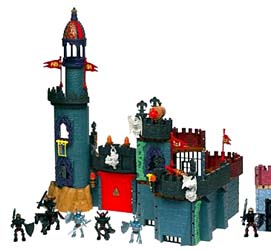
A castle becomes a useful play setting when a figure has somewhere to arrive, a reason to enter and a way to leave. The older Imaginext Battle Castle uses panels and platforms that can be arranged into different structures.
Begin with one route through a modest layout. A small courtyard with a reachable gate can support a richer story than a tall model whose rooms are difficult to reach.
Identify the castle and its bonus
The headline in Toysit’s older account names a bonus mini dungeon. Mattel identifies that combination as B2498: the 78333 Battle Castle packaged with an Enemy Dungeon addition. Keep the two structures distinct when checking the pieces in a stored or secondhand box.
The separate dungeon instructions show a compact barred enclosure. It can become another destination in a story, but the route activity below does not require it. Missing bonus pieces should not be confused with missing parts of the main castle.
Plan three places before adding height
For this original activity, choose an entrance, an open meeting place and an exit. Sketch them on paper or point them out in an assembled layout. Imagine one figure carrying a message from outside to someone waiting in the courtyard.
Follow the matching assembly booklet for the actual panel and platform connections. Keep the intended route visible while building. Leave room for a hand to move the figure, and check that a nearby wall does not prevent the gate from opening normally.
A useful first test is simply to move the figure through the planned journey. If you must lift it over a wall that was supposed to be a doorway, decide whether to revise the layout or explain that detour as part of the story.
Add one decision to the visit
Try this beginning: a visitor arrives with news, but the person who needs it is on the other side of the courtyard. The builder chooses where the visitor enters; a second player decides who comes to meet them.
Now introduce one change. Perhaps the meeting moves to another room, or a figure needs help finding the exit. Give the characters a route and an ending rather than activating every feature at once. The story can be cooperative even though the product is called Battle Castle.
- Build
- Make the entrance and meeting place easy to see and reach.
- Try
- Move one figure through the same short journey.
- Change
- Rearrange one section using the intended connections.
- Retell
- Explain what the change lets the visitor do.
Keep features tied to the actual edition
The manufacturer record combines references to lights and sounds with a note that a 2003 version has no batteries. Do not assume that every surviving Battle Castle has the same electronics, or use a missing sound as proof that something is broken.
Use the model markings and matching instructions when checking a set. This activity needs only the structure and figures; it does not require firing accessories or an electrical effect. Keep special parts with their own set, and save a quick drawing of a successful layout before taking it apart.
The historical record
Original Toysit coverage
The original product description and complete medieval-play essay remain below. Their developmental claims are historical commentary, not outcomes established by testing this set. The setting is a toy fantasy, not a reconstruction of a particular historical castle.
Imaginext Battle Castle with Bonus Mini Dungeon
Imagine a medieval world filled with dungeons and drawbridges, catapults and cannons, and exciting battles between brave knights. Now let the Imaginext Battle Castle help bring that adventure to life-with a system of building pieces kids can quickly snap together almost any way they imagine. Includes two white knights, two black knights with interchangeable helmets and weapons.
A medieval-themed building set holds a captivating allure due to its unique blend of historical fascination, imaginative play, and creative exploration. This type of playset offers a range of factors that contribute to its appeal:
- Historical Intrigue: The medieval era is filled with stories of knights, castles, and epic battles. Children are naturally curious about the past, and a medieval-themed building set allows them to explore this intriguing period of history while constructing their own version of that world.
- Immersive Storytelling: Building sets centered around medieval themes encourage imaginative storytelling. Children can create their own narratives involving knights, kings, queens, dragons, and quests. This type of play fosters creativity and language development as they bring their imaginative scenarios to life.
- Architectural Exploration: Medieval architecture, characterized by castles, turrets, drawbridges, and walls, offers unique design elements that intrigue young builders. As children assemble these structures, they engage in spatial reasoning, problem-solving, and fine motor skill development.
- Character Empathy: Exploring the roles of knights, royalty, and peasants in a medieval-themed playset encourages children to consider different perspectives and empathize with characters from different social backgrounds. This can promote social understanding and empathy in an engaging context.
- Customization and Creativity: Medieval-themed building sets often feature modular pieces that can be customized and rearranged. This allows children to design their own medieval landscapes, castles, and villages, fostering creativity and critical thinking as they experiment with different arrangements.
- Sense of Adventure: The medieval world is associated with quests, exploration, and the unknown. Children are drawn to the sense of adventure that this theme offers, as they imagine embarking on heroic journeys, solving mysteries, and encountering mythical creatures.
- Symbolism and Honor: The chivalry, honor, and code of conduct associated with medieval knights can introduce valuable concepts to children. Discussions about values like bravery, loyalty, and fairness can emerge naturally through play and exploration.
- Collective Play: Medieval themes often involve knights, royalty, and various characters. Children can collaborate with friends or siblings to create expansive medieval worlds, fostering teamwork, negotiation, and shared storytelling.
The allure of a medieval-themed building set lies in its ability to transport children to a captivating historical era, encourage imaginative storytelling, promote architectural exploration, nurture creativity, encourage empathy, and provide a platform for adventurous and educational play that resonates with both their interests and developmental needs.
Sources and editorial notes
Reviewed October 16, 2026 against the original image, Mattel B2498 and 78333 records, both 12-page 78333 US booklets and the two-page B2498 Enemy Dungeon sheet. The B2498 package pairs the base castle with a bonus dungeon, figure and horse. The support record also links a B2499 Paramedic Station sheet; that unrelated sheet was inspected and excluded. The 78333 record distinguishes battery revisions, so the archive image is not used to assign electrical features. No physical assembly or mechanisms were tested; the route activity is editorial.
- Mattel: Battle Castle with Bonus Playset, B2498 — Identifies the base castle and Enemy Dungeon bonus package.
- Mattel: Battle Castle, 78333 — Base-set record with revision-dependent feature and battery information.
- Mattel: Battle Castle instructions (PDF) — Illustrated base-castle assembly and alternative layouts.
- Mattel: Enemy Dungeon instructions (PDF) — The separate bonus structure; do not confuse it with the unrelated Paramedic Station link.
Images and descriptions are retained as historical material. How Toysit covers toys.
Created for Toysit by Tabbloza — the artwork in our header.