
From the Toysit archive
Rugrats Bounce and Babble Dil
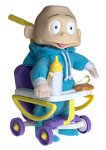
Dil sits in a colorful wheeled seat with pretend snack accessories, inspiring an original picture-card conversation game.
The play at a glance
A little snack-time scene with a big personality
A tuft of hair, a teal outfit and a cheerful purple-and-yellow seat make Dil easy to pick out. A pale tray stretches in front of him, with a toy bottle and biscuit-shaped prop nearby. The photograph suggests a miniature household moment: everyone is trying to work out what the baby wants next.
A tray becomes the center of the story
Dil’s small accessories give the scene familiar roles: someone offers a pretend snack, someone makes a funny sound, and someone tries a new explanation. The earlier account describes a comic mixture of baby noises and a spoken refusal. Its full description, including the original reviewer’s reservations, is preserved below.
A player can give the scene a gentler turn. Imagine that Dil is pointing toward a storybook, or that the toy bottle belongs on a pretend picnic tray. The next event comes from what the people playing decide his expression might mean.
Try snack-time translator
Draw three large picture cards: a pretend snack, an open book and a resting place. Set them beside a drawing of Dil. One player makes a short, silly baby sound; another acts as the friendly translator and chooses a card.
“That sounded like a request for the story about the purple bus!” The first player can agree with a happy sound or point to a different picture. Then narrate a small response: opening the imaginary book, setting out a paper snack or making the pretend room quiet.
Swap roles and invent a different interpretation for the same sound. A third player can draw a fourth card, perhaps a window with a bird outside, and introduce it as the afternoon’s surprise. Finish by placing the cards in the order of Dil’s imagined day.
Keep this a paper-and-voice activity while the exact toy’s instructions are unavailable. Any snack or drink in the story stays pretend; real food and liquid belong away from the doll and its accessories.
A small part of the Rugrats household
The appeal of the scene lies in a familiar contrast: a baby’s small gesture becomes a very large event for everyone around him. A missing biscuit-shaped prop might launch a search, while a quiet book can bring the whole cast back together. The preserved historical commentary places Dil within that larger cast of characters.
The historical record
Original Toysit coverage
The complete earlier product account and commentary are preserved below as historical coverage.
Dil is cute and loveable.
Fans of the Rugrats and Rugrats in Paris: The Movie might want to add Bounce and Babble Dil to their collection of Rugrats toys. Made of hard plastic and measuring 12 inches tall, Dil sits in his highchair just waiting to be fed a cookie. However, he isn't often very appreciative. Dil's three AA batteries (included) enable him to blow raspberries, to rudely pass gas (when the mood suits him), and to say, No - A role model, Dil is not.
Rugrats is a popular animated television series that has captured the hearts of audiences worldwide. The show, created by Arlene Klasky, Gábor Csupó, and Paul Germain, originally aired in 1991 and quickly became a cultural phenomenon. Rugrats follows the humorous and imaginative adventures of a group of babies—Tommy, Chuckie, twins Phil and Lil, and later additions Dil and Kimi—as they navigate the world from their unique perspective. Set in the backdrop of everyday life, the show combines delightful innocence with wild imagination, bringing to life the babies' whimsical interpretations of the ordinary. With its iconic characters, clever storytelling, and themes of friendship and curiosity, Rugrats continues to leave a lasting impression on multiple generations of viewers.
Sources and editorial notes
The original image and complete earlier account are the evidence for this particular seat version. An exact package and operating sheet were not recovered; collector listings use Bounce and Babble for different forms. The earlier twelve-inch size, hard-plastic construction, highchair description, batteries and sound claims remain attributed historical details. The photograph shows wheels but does not establish how any bouncing or feeding response works. The activity is original editorial play, not an included toy mode. No physical testing was performed.
- Original Toysit image — Existing same-site image reviewed and retained unchanged.
- Original Toysit coverage — Complete historical account retained, including its original claims and wording.

Images and descriptions are retained as historical material. How Toysit covers toys.
Created for Toysit by Tabbloza — the artwork in our header.