
From the Toysit archive
BRIO Wooden Blocks
Try a low tower, a small bridge and a repeating pattern with the natural-finish wooden blocks pictured in Toysit’s BRIO archive.
The play at a glance
Let the shape suggest the next move
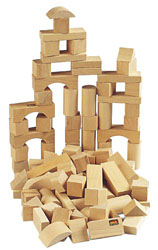
The original BRIO entry describes assorted wooden blocks in a natural finish. The photograph shows a useful variety of forms: flat-sided pieces, arches and roof-like shapes that invite different arrangements.
Start with a small construction question rather than a finished model to copy. Which pieces make a steady base? What can span a gap? How does turning one block change the space around it?
Start with the faces that touch
Put a few suitable blocks on a level play surface and look at the faces available for support. A long rectangular piece can be laid flat or stood on end; those choices give it different heights and footprints. A curved or sloping face asks a different question from a flat one.
For this editorial activity, make a tower only a few pieces high. Pause after each addition and notice whether the next piece has a broad, level place to rest. If it wobbles, rebuild lower or change the base before adding more. There is no target height to reach.
Compare two arrangements using the same pieces. Describe the change precisely: “I put the long face down” tells another builder more than “I made it better.”
Make a bridge with a useful opening
Choose two supports of equal height and a longer piece that can rest securely across them. Begin with a narrow gap. The point is to leave an opening while still giving both ends of the spanning piece a place to sit.
Use a small toy figure as an imagined visitor. Can it pass through without moving the supports? If the opening is too low, change the supports; if it is too narrow, consider a different span. Do not assume that widening the gap will leave enough support for the same top piece.
Keep this a small model. The experiment does not test how much weight the blocks can carry, and a toy bridge is not a step or seat.
Change one thing and look again
- Orientation
- Turn one rectangular block onto a different face. Compare its height and the space it covers.
- Support
- Move the two bridge supports closer together. Notice how much of the top piece rests on each one.
- Pattern
- Arrange a repeating sequence of two or three shapes. Ask another person to continue it and explain the repeat.
- Purpose
- Give the structure one job, such as making an entrance for a figure, and judge the next change against that job.
A sketch or a short note can preserve an idea before rebuilding. “Narrower gap; more block resting at each end” records an observation without turning one attempt into a universal rule.
Sort for the next idea
At the end, group blocks by a feature that mattered during play: long spans, flat supports, arches or roof shapes. Another session might use a different sorting rule. The useful arrangement is the one that makes the next choice easy to see.
For an older set, keep any surviving box or label with it so the actual model and intended users can be checked. A photograph of natural wood does not establish the finish or condition of an individual block. Set aside damaged pieces rather than treating the archive’s general praise of beechwood as a guarantee about every surviving set.
The historical record
Original Toysit coverage
The original product paragraph and complete beechwood essay remain below. Its broad claims about safety, perfect fit, sustainability and environmental impact are historical assertions, not findings established for this particular set.
Wood building blocks by Brio.
Classic building blocks in assorted shapes and sizes provide variety and change. Made of beechwood, in natural finish.
Beechwood stands out as one of the preferred materials for building blocks due to its unique combination of durability, aesthetics, and tactile qualities. Here's what makes beechwood ideal for this purpose:
- Durability: Beechwood is known for its robustness and resilience. This hardness ensures that the blocks remain in good shape over time, resisting dents and wear that can occur during play.
- Smooth Grain: Beechwood boasts a fine grain, giving blocks a smooth finish. This ensures safety as children are less likely to get splinters when handling them.
- Consistent Texture: The even texture of beechwood allows for precision in crafting, ensuring that blocks are consistent in size and fit together perfectly.
- Natural Aesthetics: Beechwood's light color and subtle grain make for beautiful blocks. Its natural appearance is visually pleasing and can be left untreated or can be easily stained or painted.
- Eco-friendly: Beech trees are commonly found in sustainable forests, making beechwood an environmentally responsible choice. Furthermore, wooden blocks, being biodegradable, have a lesser environmental impact compared to plastic alternatives.
Beechwood's blend of durability, beauty, and tactile qualities make it a top choice for building blocks, providing both a safe and engaging play experience for children.
Sources and editorial notes
Reviewed October 16, 2026 against the original Toysit source and 158 × 250 photograph. A matching BRIO model number, contents list and original manufacturer sheet were not established. The beechwood identification comes from the earlier account; the photograph alone cannot confirm species, coating or certification. Modern BRIO sets were not used to assign a piece count or age range. The activities are original editorial suggestions, not physical tests of the pictured blocks.
Images and descriptions are retained as historical material. How Toysit covers toys.
Created for Toysit by Tabbloza — the artwork in our header.