
From the Toysit archive
Candy Land
Color-card movement, taking turns and a winding path to the finish, with the older Candy Land edition kept distinct from later rules.
The play at a glance
Draw a card and follow the color
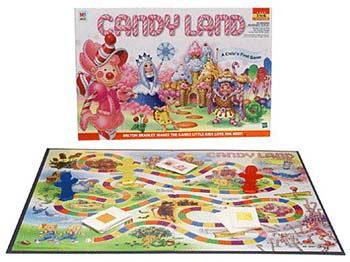
Candy Land makes a board-game turn easy to see: draw a card, find the matching color and move a gingerbread pawn along the path. The original Toysit page describes a card-based edition with King Kandy, Queen Frostine and a Molasses Swamp.
In the basic card game, the draw determines the move. The pleasure comes from following the journey together, watching the positions change and taking another turn.
What happens on a turn?
The 2004 Hasbro rules use a single colored block to send a pawn to the next matching space and a double block to send it to the second matching space. A picture card sends it to the corresponding picture location, which can be behind the pawn. The goal is the rainbow finish by the castle.
That basic pattern gives the group something concrete to follow together. An adult can help locate the next matching space without choosing a strategy for the child. For a game where the player makes a decision each turn, compare Guess Who?.
Match the rules to the board
The old Toysit description mentions getting stuck in Molasses Swamp until a red card appears. The linked 2004 rules instead describe licorice spaces that cost one turn. These are different instructions; use the rule sheet that belongs to your board.
Check the special-space names, pictures on the cards and finish before beginning. A familiar title does not mean a newer edition has the same shortcuts or penalties.
Before the first round
- Contents: check that the deck and pawns belong to the pictured board, especially in a secondhand set.
- Turns: agree who draws next and make room for the used-card pile.
- Expectations: basic movement follows the cards, so a backward move is not a mistake by the player.
- Variants: agree on any optional rules before starting, using the matching instructions.
The core experience is sharing a simple sequence. This page does not promise a particular learning outcome or a fixed playing time.
The historical record
Original Toysit coverage
The complete earlier description remains below. Its special-place names and movement claims belong to the edition described then. The later general discussion makes broad claims about learning, accessibility and benefits; those are historical commentary, not measured findings from this review.
Candy Land game - the classic one.
Captivated by the story of a kidnapped king and eager to help find him, little ones move their gingerbread pawns along a rainbow path and through a land of candy characters, all subjects of King Kandy's realm. Playing cards thoughtfully designed for non-readers are coded with colorful squares matching the jeweled stepping-stone path or an occasional token matching one of the characters' symbols: draw a blue card, move to the nearest blue stepping-stone; draw a snowflake and earn a visit to Queen Frostine's iceberg. There are occasional pitfalls, too: land on the wrong square and you might be stuck in Molasses Swamp until a red card is drawn. With all these enticing, sugarcoated images (and King Kandy plainly visible at path's end), children can't help but be delighted by Candy Land. It's delicious. Instructions are in both Spanish and English. Candy Land is for two to four players)
For generations, boys and girls have enjoyed Candy Land as their first board game. The color-themed game requires no reading on the part of the players and is easy for even the youngest of children to follow. Players move their primary-colored gingerbread people around the rainbow path, moving through the Peppermint Stick Forest by matching the color spaces to the colors on the pick deck. The player who reaches the Candy Castle first wins. This game is suitable to two to four players, children and adult and children can even play it alone. As a primary learning game, Candy Land fosters a child's exposure to following directions, taking turns, color recognition and count skills. The game promotes thinking as well as patience in the form of waiting one's turn to play. By play games with others, children are encouraged to socially interact in a more controlled manner, which helps develop character for future endeavors.
The Candy Land board game is a beloved classic that has captured the hearts of generations with its colorful and whimsical world of sugary delights. Designed for young players, this delightful game takes participants on a journey through a vibrant candy-themed landscape filled with excitement and anticipation. Let's dive into the enchanting realm of Candy Land and discover what makes this game a timeless favorite:
Colorful Game Board: The Candy Land game board is a visual feast, adorned with a rainbow of vibrant colors that evoke the essence of a candy wonderland. The winding path of squares leads players through various candy-themed regions, promising surprises at every turn.
Simplicity and Accessibility: Candy Land is known for its simplicity, making it an ideal choice for young players and families. The game mechanics involve drawing colored cards and moving along the corresponding colored path on the board, eliminating the need for reading or complex rules.
Imaginative Theme: The candy-themed world of Candy Land is a feast for the imagination. Players journey through locations like Peppermint Forest, Gumdrop Mountains, and Lollipop Woods, igniting creativity and conjuring visions of a delectable adventure.
Easy Setup: Setting up the Candy Land game is a breeze, ensuring that players can jump right into the sweet escapade. The game board unfolds, the color cards are shuffled, and players are ready to embark on their sugary quest.
Exciting Card Draws: The heart of the game lies in drawing color cards that determine the player's moves. The anticipation of drawing a card and discovering where it will lead adds an element of surprise and excitement to each turn.
Short Gameplay: Candy Land is designed for quick gameplay sessions that suit the attention spans of young players. The game's brevity ensures that rounds can be completed within a manageable timeframe, making it an ideal choice for family game nights.
Shared Fun: Candy Land fosters shared enjoyment as players move along the path together, encountering colorful characters and charming landmarks. The game encourages friendly competition while also promoting a sense of camaraderie and teamwork.
Visual Appeal: The candy-themed illustrations and characters on the game board and cards are visually appealing and engaging. Young players are drawn into the whimsical world, sparking their imagination and curiosity.
Learning and Skill Development: While Candy Land is a game of chance, it offers opportunities for young players to practice color recognition, turn-taking, and simple decision-making. These foundational skills contribute to early childhood development.
Endless Nostalgia: For many adults, Candy Land holds nostalgic memories of childhood play. Sharing the game with the next generation fosters a heartwarming connection and the joy of passing down cherished traditions.
The Candy Land board game is a delightful journey into a world of sugary enchantment. With its simple rules, vibrant visuals, and accessible gameplay, Candy Land provides young players and families with a magical experience filled with laughter, excitement, and shared moments of sweet delight.
Sources and editorial notes
No original publication date is recorded. Hasbro’s downloadable 04700-I rules, copyright 2004, were inspected on October 15, 2026. They document a related card-based edition, but the named places and special-space rules differ from the Toysit description. They are identified below as a comparison, not an exact replacement rulebook. No physical game was tested.
- Hasbro: Candy Land 04700-I rules (PDF) — Card-based edition, copyright 2004; useful for the basic movement system, with edition differences noted.
Images and descriptions are retained as historical material. How Toysit covers toys.
Created for Toysit by Tabbloza — the artwork in our header.