
From the Toysit archive
Cube It Up
Revisit Cube It Up as a listening-and-movement game, distinguish spoken prompts from speech recognition, and try a separate color-command activity.
The play at a glance
Hear a prompt, choose a movement
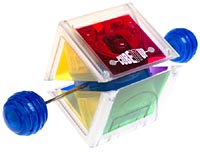
Cube It Up’s original Toysit description asks players to rotate a colored cube in response to the toy’s voice prompts. A period USPTO record describes an electronic skill toy with a multicolored cube that rotates and pivots around two handles. Together, those sources point to a listening-and-movement challenge.
Who speaks, and who responds?
In the original product lead, the toy supplies spoken prompts and the player moves the cube. That differs from a toy listening for a player’s spoken command. The later essay reverses those roles and describes hands-free interaction; it is not reliable evidence of this product’s mechanism.
A useful way to describe the experience is a short sequence: hear a cue, choose a response, move, then notice feedback. That explains the reported play idea without inventing a microphone or a conversation system.
The handles are an identifying feature
The original photograph shows a translucent cube between two blue handles. The period trademark description helps distinguish this physical toy from unrelated apps and puzzles sharing a similar name.
It does not tell us which motion answers each prompt. Find instructions matched to a surviving unit before attempting a control sequence; the name alone is insufficient to select a different electronic cube’s manual.
Keep speed separate from understanding
When inventing a listening game, first agree what each cue means. Let the responder finish before adding another instruction. A faster pace can be a later choice, rather than the measure of whether the idea was understood.
The archived player count, five-game claim and scoring description remain available below. No undocumented speed levels, cooperative modes or rules have been added to this profile.
Listen, point, then swap roles
Draw three large colored areas on a sheet and label each with its color name or a distinct symbol. One person names a color; the other points to it. Repeat slowly, then swap caller and responder.
Try a two-color sequence only when both people want another challenge. If color is not a useful cue, call the symbols instead. This independent Toysit activity is a simple listening game, not a recreation of Cube It Up’s modes, scoring or controls.
The historical record
Original Toysit coverage
The full original description and later voice-command essay remain below. The lead reports one to eight players, five games and automatic scoring. Those details lack a matched operating guide. The later essay’s speech-recognition, hands-free and adaptive-learning claims are not established for this toy and conflict with the lead’s movement-based account.
Great game gift.
Exciting game challenges you to rotate the mulit-colored cube in sync with its voice commands. You score points as you get it correct. 1-8 players, 5 different games and automatic scoring.
A voice-command toy that measures responses offers an exciting and dynamic play experience that combines technology and interaction, providing a range of enjoyable experiences and benefits:
Futuristic Interaction: The voice-command feature immerses users in a futuristic play environment where their spoken commands lead to engaging responses from the toy.
Hands-Free Play: The voice-activated nature of the toy allows for hands-free interaction, freeing up children's hands to engage in other activities while playing.
Engaging Challenges: Voice commands often come with built-in challenges or games, encouraging children to respond quickly and accurately to the toy's prompts.
Cognitive Stimulation: Responding to voice commands and prompts sharpens cognitive skills such as listening, comprehension, and quick thinking.
Feedback and Rewards: The toy's response measurement provides instant feedback and rewards for correct responses, motivating children to continue playing and learning.
Social Play: Voice-command toys that support multiplayer modes enable children to play with friends or family members, fostering social interaction and cooperation.
Language Development: Engaging in conversations with the toy, listening to its prompts, and responding to commands contribute to language development and vocabulary expansion.
Problem-Solving Challenges: Many voice-command toys include puzzles, riddles, and problem-solving tasks that encourage critical thinking and analytical skills.
Multisensory Experience: Some toys combine voice commands with visual cues, lights, and sound effects, creating a multisensory play experience that captivates the senses.
Personalized Learning: Voice-command toys adapt to individual performance levels, gradually increasing the complexity of tasks to match the child's progress.
Role Play: Certain toys allow children to take on roles, such as a detective, explorer, or scientist, as they follow voice-guided missions and quests.
Entertaining Challenges: The interactive nature of voice-command toys makes challenges and activities more entertaining and engaging, ensuring hours of playtime fun.
Technology Exploration: Voice recognition technology introduces children to cutting-edge innovations, fostering an early interest in technology and its applications.
Boost in Confidence: Successfully completing challenges and tasks set by the toy builds children's confidence and encourages them to explore new experiences.
Active Participation: Children actively participate in the play process by offering voice commands and receiving real-time responses, making them protagonists in their play adventure.
A voice-command toy that measures responses adds an exciting layer of interaction and engagement to playtime. It offers a blend of technology, cognitive challenges, and entertainment that captivates young minds and encourages them to explore, learn, and have endless hours of imaginative fun.
Sources and editorial notes
The USPTO Official Gazette of June 5, 2001, page TM 398, names Marvel Enterprises and describes CUBE IT UP as a rotating/pivoting colored cube with two handles. The downloaded page was visually checked and corresponds to the form in the retained photograph. This is identity/design evidence, not a game manual. Exact controls, mode rules, scoring and speech-recognition hardware were not verified. No device was tested.
- USPTO Official Gazette, June 5, 2001 — Page TM 398: CUBE IT UP design description and Marvel Enterprises attribution; not operating instructions.
Images and descriptions are retained as historical material. How Toysit covers toys.
Created for Toysit by Tabbloza — the artwork in our header.