
From the Toysit archive
Deluxe Scrabble
Use the rotating board, compare scoring choices and try an open-rack teaching activity with the older Deluxe Scrabble set.
The play at a glance
Turn the board toward the next word
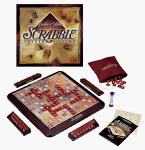
Deluxe Scrabble keeps the familiar word-building game and changes the physical experience around the table. The original set’s swivel base lets players face the letters, while its grid helps hold the tiles in position.
The useful decision remains the same: which playable word makes good use of both the rack and the board? A short word in a helpful position can be worth comparing with a longer one.
Agree on the words before the first turn
Choose a word reference and challenge procedure together. The older booklet makes challenges consequential: an invalid challenged play is removed and loses its turn; an unsuccessful challenger loses the next turn. Consult your matching rules before deciding a dispute.
Players draw seven tiles. The first word crosses the center; later plays connect to existing words. Count every word formed, announce the score, then replenish the rack. Blanks score zero and keep their declared letter for the rest of the game.
Rotate the board gently between turns so each player can read it. The grid helps retain positions, but it does not determine whether a word is valid. Keep the score record separate from the working area.
See what a premium changes
Letter premiums affect their tile; word premiums multiply the word after letter premiums are applied. A premium applies only when its tile is first placed. Existing letters still contribute their ordinary values when a later word uses them.
Here is an original first-turn example using CAT. Put A on the center star, C immediately to its left and T immediately to its right. With ordinary English tiles, C is 3, A is 1 and T is 1. The total is 5, doubled by the center word premium to 10.
If a later player adds S to make CATS, those four tiles total 6 on these squares. The center does not double the word again. If the first player had used a blank for C instead, that opening CAT would have scored 4: (0 + 1 + 1) × 2.
These examples isolate one decision. A real move can form crosswords too; check each new word rather than scoring only the longest line.
Try an open-rack teaching round
This is an optional learning activity, separate from competitive play. Two people place their racks where both can see them and discuss a possible move before committing it. Looking up words in advance is allowed for this activity if both agree.
- Find a connection
- Point to an existing letter or word that the new tiles could use.
- Check the whole play
- Read every word the placement would create, including short crossing words.
- Compare two choices
- Work out the scores aloud and notice what letters would remain on the rack.
- Record the reason
- Write a brief note such as “used a double letter” beside the score.
End after a few turns if that suits the group. The purpose is to make decisions visible, not to demand a tournament-length game or a particular vocabulary level.
Finish with the rack adjustment
Under the booklet’s standard ending, subtract each player’s unplayed tile values. If one player has used every tile, add the opponents’ remaining values to that player’s score. Check the full sheet for end conditions and ties.
Before packing away, keep the board, racks, tiles, pouch and rules together. The archived photograph identifies the older table-based Deluxe style; a newer Deluxe label alone does not establish the same construction or rule sheet.
The historical record
Original Toysit coverage
The complete original product description and historical timeline remain below. The timeline’s dates, organizational claims and corporate history have not been adopted as verified chronology in this guide.
Classic excellent scrabble board game.
It's still hard to get a triple word score, the tiles are still made of wood, there's only one X in the whole box, and family feuds are increasing exponentially. But after 50 years, Scrabble has had a face-lift: a swivel base allows the board to turn so players don't have to work upside down, a plastic grid helps keep tiles in line, and a handy bag stores the letters when they're not in use. The premise hasn't changed at all--two to four players battle it out to make high-scoring words from seven little letters--so choose a dictionary before play begins to avoid ugly confrontations.
The history of the game of Scrabble traces a fascinating journey from its humble beginnings to becoming a beloved word game that has captured the hearts and minds of players worldwide:
1931 - Birth of an Idea: The game's origins can be traced back to architect Alfred Butts, who created a word game called "Lexico." This early version of the game had a complex scoring system and an initial lack of popularity.
1948 - Transformation into Scrabble: James Brunot, along with his wife Norma, discovered the game and saw its potential. They bought the rights to "Lexico," renamed it "Scrabble," and made some refinements to the rules and scoring system.
1952 - The Selchow & Righter Era: The Brunots sold the rights to Selchow & Righter, a game company. This partnership helped Scrabble gain widespread exposure and availability in stores across the United States.
1953 - A Slow Start: Initially, Scrabble faced challenges in gaining traction. However, a positive review by the president of Macy's led to increased sales and sparked public interest.
1954 - National Scrabble Association: The National Scrabble Association was founded, marking the beginning of organized Scrabble tournaments and competitive play.
Late 1950s - International Expansion: The game's popularity extended beyond the United States, reaching international markets and earning fans around the world.
1960s - Game Evolution: The game's design and rules continued to evolve, including changes to the point values of certain letters, to enhance gameplay and balance the scoring system.
1970s - The "Scrabble Boom": The 1970s witnessed a surge in Scrabble's popularity, driven by increased television exposure and widespread adoption in schools as an educational tool.
1980s - Endorsement and Adaptations: Scrabble received the endorsement of the National Association of Elementary School Principals and was adapted into various languages, further solidifying its global appeal.
1990s - Digital Frontier: Scrabble found a new platform with the rise of personal computers and video games, introducing digital versions that allowed players to challenge opponents online.
2000s - Online and Mobile Play: The digital revolution continued with online platforms and mobile apps, enabling players to enjoy Scrabble anytime, anywhere, and compete against opponents from around the world.
Present - Enduring Legacy: Scrabble remains a cultural touchstone, beloved by players of all ages for its blend of vocabulary skills, strategy, and friendly competition. It continues to be played in homes, schools, and competitive tournaments globally.
Scrabble's journey from its early days as "Lexico" to its present status as a timeless word game classic illustrates its enduring appeal and the way it has woven itself into the fabric of popular culture, providing generations of players with endless wordplay enjoyment.
Sources and editorial notes
Reviewed October 16, 2026 using the original image and ASIN B00000IWH9 and Hasbro’s older Deluxe Edition guide booklet, hosted as Scrabble_Deluxe_(1989).PDF. Its turntable board, racks and pouch correspond to the construction described in the archive; the small image does not establish an exact packaging revision. Printed pages 3–7 cover setup, play and scoring. The scoring illustration below is independently constructed, and the open-rack activity is editorial. No physical set was tested.
- Hasbro: older Deluxe Scrabble guide booklet (PDF) — Turntable edition, with standard rules and scoring on printed pages 3–7; not the later folding carry-case edition.
Images and descriptions are retained as historical material. How Toysit covers toys.
Created for Toysit by Tabbloza — the artwork in our header.