
From the Toysit archive
Disney Charades
A silver tin, a clapboard timer and Disney character cards turn familiar faces into spoken clues, single words and silent performances.
The play at a glance
One cast of characters, three ways to give a clue
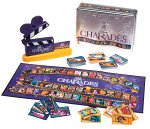
The silver tin opens onto a little movie-making scene: a purple clapboard, a board patterned like a strip of film, and a scattering of Disney faces. Players take turns bringing those characters to life for their teammates.
The changing clue style gives the game its shape. A character first introduced through a description returns as a one-word clue, then as a silent performance. By the last round, a small gesture can recall an idea the whole table heard earlier.
Set the scene for a team game
Mattel’s rules start with two teams and a chosen set of 12 cards. Yellow-bordered easy cards and blue-bordered general cards let the group choose familiar characters. The clapboard dispenses cards and provides a 30-second musical turn; the two Mickey Mouse-feet markers record progress on the board.
That small shared cast matters. The same chosen cards return in every round, so listening during an early turn can become part of a later guess.
From description to gesture
Round one allows spoken descriptions, with the character’s name and sound-alike words excluded. Round two reduces the clue to one word; the sheet allows a short phrase for younger players. Round three uses acting alone. Teams alternate turns, and each correctly guessed card earns one board space in the first round, two in the second and three in the third. The leading marker after round three wins.
Imagine a player choosing a broad, sweeping gesture that everyone associates with a character’s entrance. The fun is in finding a clue that this particular group will recognize.
Try it: three clues, one imaginary character
For an original Toysit warm-up, draw a friendly character together and agree on its name and one favorite activity. Perhaps it is a tiny dragon who delivers umbrellas.
- Describe the character in one sentence while a partner looks at the drawing.
- Choose a single clue word, such as “umbrella,” and have the partner recall the character.
- Put the drawing aside and mime the character doing its favorite activity.
Swap roles with a new drawing, then talk about which gesture was easiest to recognize. This shared invention is a separate warm-up for enjoying clues together.
The historical record
Original Toysit coverage
The original product account and commentary are preserved below as historical coverage.
Wonderful World Of Disney Charades
Think of all things Disney, and think fast! This fun charades game involves Disney characters, both new and old. In the first round, say anything as a clue. In the second round, say one thing as a clue, and in the last round, actions only. Includes 200 general cards, 50 easy cards, so the whole family can play. For 4 or more players, ages 4 and up. Made in USA and imported. Editorial Review How well do you know your Disney characters? Find out with this family game based on the old Charades parlor game. This version has a rectangular game board and comes packaged in a sturdy, silver, metal tin. A pathway of famous Disney characters is arranged across the board like a reel of film, with Mickey Mouse-feet markers for each of two teams of players. There are 250 character cards showing both famous and not-so-famous characters (such as Dumbo, Donald Duck, Hercules, and Mulan) from movies, original videos, and old cartoons. There are 50 color-coded cards with easier-to-guess characters (such as Winnie the Pooh and Cinderella), so younger children will have an opportunity to act out their character assignments. The game is played in three rounds--say anything, say just one thing, and say nothing--with each team member drawing character cards and acting out the names as quickly as possible. A two-piece, electronic musical timer keeps track of each round, and Mickey's voice tells you when the time is up. The rules can be easily adapted for younger children, and the set of cards can be used for sorting or matching games of your own invention.
History of Charades
Charades, a classic and beloved party game, has a rich history that spans centuries and cultures. The game's origins can be traced back to ancient times, showcasing its enduring appeal and universal entertainment value:
Ancient Roots: The roots of charades can be found in ancient Greek and Roman theater, where performers used gestures and body language to convey emotions, actions, and concepts to the audience.
Middle Ages and Renaissance: The game evolved during the Middle Ages and Renaissance, becoming a popular form of entertainment at royal courts and social gatherings. Participants used mime and non-verbal communication to guess words, phrases, or scenes.
18th Century Parlor Game: Charades as we recognize it today gained prominence in the 18th century as a parlor game. It became a favorite pastime in English society, spreading across Europe and beyond as an engaging social activity.
Victorian Era Elegance: The Victorian era embraced charades as a refined and sophisticated amusement. The game was often a part of formal parties and gatherings, with participants employing elaborate gestures and expressions.
Modern Twists and Variations: Charades continued to evolve in the 20th century, with various variations and adaptations emerging. Board games, television shows, and movies incorporated charades into their formats, introducing the game to new generations.
Party and Pop Culture: Charades remained a staple at parties and gatherings, cherished for its ability to bring people together in laughter and shared fun. Its inclusion in popular culture, including sitcoms and game shows, further solidified its status as a beloved pastime.
Global Appeal: The game's simplicity, interactive nature, and cross-cultural communication make it universally appealing, transcending language barriers and engaging people of diverse backgrounds.
Modern Tech and Digital Age: In the digital age, charades has found new life through mobile apps and online platforms, enabling players to enjoy the game virtually with friends and family around the world.
Continued Relevance: Despite the passage of time, charades remains a beloved and timeless game, cherished for its ability to promote creativity, teamwork, and laughter among participants of all ages.
Charades' journey through history reflects its enduring charm and adaptability. From ancient theater to modern social gatherings, the game has maintained its status as a source of amusement, fostering connection and enjoyment across generations and cultures.
Sources and editorial notes
Mattel’s complete four-page sheet 42298-0920 matches the pictured clapboard and board format. It lists 250 cards total: 200 general and 50 easy, resolving the ambiguity in the original review. The silver tin is described in that review and visible in the photograph. The historical charades-origin narrative below is preserved but was not independently established. The activity is an original editorial warm-up; no physical testing was performed.
- Original Toysit image — Existing same-site photograph reviewed and retained unchanged.
- Mattel Disney Charades instructions (PDF) — All four pages reviewed; product 42298, contents, setup, three rounds and scoring.
- Original Toysit coverage — Complete original product account and historical commentary preserved.

Images and descriptions are retained as historical material. How Toysit covers toys.
Created for Toysit by Tabbloza — the artwork in our header.