
From the Toysit archive
Dusty the Talking Vacuum Cleaner
Meet Dusty’s smiling vacuum and tethered brush, with rolling sounds and a swirling display, then invent a two-character room report for pretend housekeeping.
The play at a glance
A housekeeping team with two faces
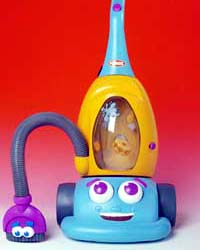
Dusty’s blue base wears a broad smile, while a smaller purple brush looks out from the end of a curved hose. Above them, a yellow housing frames the swirling display and a tall handle completes the upright silhouette. The pair makes pretend housekeeping feel like a conversation: one character surveys the room, and the other has a comment about every stop.
Watch the small performance as it rolls
Hasbro’s guide describes speech and vacuum sounds activated by rolling, with moving eyes and a spinning display inside the body. A button also starts speech and sounds. Those details make a short trip across an open floor into a little performance, with the vacuum and brush presented as two personalities.
The brush remains tethered and clips onto the vacuum for storage. Its separate face gives a player a second part to voice. Treat the display as the toy’s own effect: an imaginary cleanup needs no added crumbs, powder, loose scraps or liquid.
Try Dusty’s room-report duet
- Choose three clear stops. Name a pretend sitting room, a hallway and a workshop within an open, dry play area. The locations can be imagined rather than marked on the floor.
- Let the vacuum make a report. Guide Dusty to the first stop and supply a sentence such as, “The sitting room is ready for visitors.” Pause for any toy sounds, then add your own narration.
- Give the brush a reply. In a second voice, answer, “I will check the welcome corner.” Keep the brush attached and use only its normal reach.
- Add a different job at each stop. The hallway might need a clear route for guests; the workshop might need a pretend end-of-day inspection. Describe the task instead of scattering anything to collect.
- Finish with a shared report. Have the two characters name one thing they noticed. Return the brush to its clip and announce that the team’s rounds are finished.
The invented lines are the players’ voices, separate from Dusty’s recorded phrases. Two people can divide the characters, or one storyteller can alternate them. A pair of drawn smiling faces can perform the duet without the toy.
Give tomorrow’s round a new reason
Perhaps the rooms are getting ready for a puppet show, a visiting teddy bear or a pretend museum opening. Keep the three stops and change the occasion. Dusty can report what is ready while the brush asks one helpful question. The small routine gains a beginning, a purpose and a cheerful closing conversation.
The historical record
Original Toysit coverage
The original product account and commentary are preserved below as historical coverage.
Dusty the Talking Vacuum Toy
This friendly talking vacuum loves to help out around the house. Push him along the carpet and he comes to life with 15 fun phrases. The vacuum and the brush attachment are two different characters that talk to one another.
Children's fascination with vacuum cleaner toys stems from their innate curiosity, a desire to imitate real-world activities, and the sensory experiences these toys provide. Here's why vacuum cleaner toys capture children's imagination:
Imitative Play: Children love to imitate activities they observe in their daily lives. Vacuum cleaner toys allow them to mimic the actions of adults, fostering a sense of accomplishment and making them feel grown-up.
Sensory Exploration: Vacuum cleaner toys often produce sounds, lights, and movement that engage children's senses. The hum of the motor, the suction effect, and the visual components provide a multisensory experience that's both intriguing and stimulating.
Role-Playing: Engaging with a vacuum cleaner toy invites children to role-play scenarios where they take on the role of a responsible caretaker, cleaning up their environment and keeping their play space tidy.
Problem-Solving: Operating a vacuum cleaner toy requires coordination and control. Children learn to navigate the toy around obstacles and make adjustments to successfully "clean" various surfaces, enhancing their motor skills and spatial awareness.
Empowerment: Using a vacuum cleaner toy provides children with a sense of autonomy and responsibility. They experience a feeling of empowerment as they take charge of their surroundings and contribute to the household chores.
Curiosity About Machines: Children are naturally curious about how things work. Vacuum cleaner toys offer a simplified representation of real vacuum cleaners, satisfying their curiosity about mechanical devices.
Pretend Play: Vacuum cleaner toys can be incorporated into various pretend play scenarios, from running a cleaning service to conducting scientific experiments. These imaginative narratives add depth to their playtime.
Parental Imitation: Children often observe their parents or caregivers using vacuum cleaners at home. Playing with a vacuum cleaner toy allows them to imitate this activity and emulate the actions they've seen adults perform.
Learning Through Play: Vacuum cleaner toys encourage cognitive development as children figure out how to operate the toy, explore cause and effect relationships, and engage in creative problem-solving.
Positive Associations: Many children associate vacuuming with positive outcomes, like a clean and organized space. Vacuum cleaner toys tap into this positive association, making the play experience enjoyable and satisfying.
Overall, vacuum cleaner toys offer a captivating blend of imitation, sensory engagement, empowerment, and imaginative play. They allow children to explore the world around them, learn valuable skills, and enjoy a sense of accomplishment—all while having fun "cleaning" their play spaces.
Sources and editorial notes
Hasbro’s four-page instructions for model 06506 match the original photo’s vacuum-and-tethered-brush design. They describe wheel- and button-activated speech/sounds, moving eyes, an internal swirling “lint” display, a pivoting body and brush storage clip. The leaflet does not confirm the original 15-phrase count or real suction; those are not adopted as new specifications. Its two personalities are prerecorded, not conversational AI. Adult assembly and battery work belong with the matching instructions. Wider developmental and durability claims remain historical commentary. The room-report dialogue is invented by players; no physical testing was performed.
- Original Toysit image — Existing same-site photograph reviewed and retained unchanged.
- Hasbro: Dusty the Talking Vacuum Cleaner instructions (PDF) — All four pages read and visually reviewed; model 06506, 2003 copyright. Feature diagram enlarged and matched to the original image.
- Original Toysit coverage — Complete original product account and historical commentary preserved.

Images and descriptions are retained as historical material. How Toysit covers toys.
Created for Toysit by Tabbloza — the artwork in our header.