
From the Toysit archive
Fishin’ Around
A colorful motorized pond, an orange bridge and fish-catching cards invite a lively tabletop game, followed by an original pond-postcard activity.
The play at a glance
A little pond with a moving catch
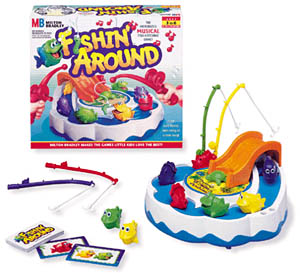
A bright orange bridge rises above Fishin’ Around’s blue-and-white pond. Purple, red, yellow and green fish gather around its center, with matching rods and illustrated cards spread beside the game. It makes a miniature fishing spot for a tabletop expedition.
The motorized, musical play brings the fish around to the players. A catch has a small moment of suspense: watch a fish approach, guide the hook toward its mouth and lift it clear of the pond.
A card gives the catch a purpose
In the reviewed two-player rules, one face-up card gives both players a shared target: catch the colors and number of fish it shows. The first to complete that catch keeps the card. The fish return to the pond for another round, and three collected cards win.
The same guide includes two card-free games for three or four players: collect the most fish, or catch two fish matching your rod’s color. Choose the rules for your edition before starting so everyone knows what makes a successful catch.
Try a pond postcard
Give the tiny pond a place in an imaginary world. This original Toysit activity happens after a round, when the fishing has paused.
- Draw a postcard-sized pond with a bridge. Give it a name such as Rainbow Bend or Little Lantern Lake.
- Add one fish from your catch. Draw its color, a bubble trail and somewhere it might be traveling.
- Tell a one-sentence story: perhaps the fish is delivering a letter beneath the bridge or visiting a neighbor beside a lily pad.
- Ask a partner to name a color to watch for in the next round. Keep the game’s ordinary scoring, then add that color to your postcard afterward.
For a fully pretend version, draw fish on large cards and move them across a paper pond by hand. Turn one fish over to reveal a message, then let another player draw its reply.
Set out the fishing spot
Use a flat play surface and have an adult prepare the rods, lines and battery compartment according to the matching instructions. The reviewed guide specifies three C-size batteries. Keep the pond dry and use the supplied toy pieces for the catching game.
The historical record
Original Toysit coverage
The original product account and commentary are preserved below as historical coverage.
Fishin' Around
Eight colorful fish swim up, down, and around a stream, wiggling from side to side and opening and closing their mouths. Kids take turns picking cards and using their different-colored fishing poles to hook and catch the fish pictured on the card that they've chosen. The first player to catch three, wins. Two to four preschoolers through first graders can play this motorized musical fish-catching game without knowing how to read.
A fishing game is a delightful and engaging activity that captivates both children and adults with its combination of skill, excitement, and friendly competition. This entertaining game simulates the experience of fishing, offering a range of benefits and moments of enjoyment for players of all ages. Here's why a fishing game is so much fun:
- Hand-Eye Coordination: Playing a fishing game requires precise hand-eye coordination as players aim to catch fish using a fishing rod or magnetic fishing poles. This challenge enhances motor skills and dexterity as players develop their aim and timing.
- Interactive Play: A fishing game often involves multiple players, creating opportunities for social interaction, cooperation, and healthy competition. Players can engage with friends or family members as they take turns trying to catch the most fish.
- Sensory Stimulation: Fishing games often incorporate colorful fish, water-themed designs, and tactile sensations. Players engage their senses as they feel the thrill of "reeling in" a fish, enhancing their sensory exploration and engagement.
- Focus and Concentration: Successfully catching fish requires players to pay close attention to the movement of the fish and the timing of their actions. This level of concentration helps improve focus and attention span.
- Problem-Solving: Players strategize and adapt their approach based on the behavior of the fish and the gameplay dynamics. They learn to adjust their techniques to improve their chances of catching the fish they want.
- Competition and Rewards: Fishing games often involve a competitive element as players vie to catch the most fish or accumulate points. This friendly competition adds excitement and motivation to the gameplay, making every catch a rewarding achievement.
- Learning Opportunity: Many fishing games include educational elements such as numbers, colors, or shapes associated with the fish. This provides a subtle learning experience as players identify and match fish based on different criteria.
- Imagination and Pretend Play: Fishing games inspire imaginative scenarios, allowing players to envision themselves as skilled anglers on various fishing expeditions. As they explore the pretend world of fishing, they exercise their creativity.
- Portable Entertainment: Fishing games are often compact and portable, making them ideal for on-the-go entertainment. Whether at home, in the park, or during travel, players can enjoy the game anywhere.
- Shared Memories: Playing a fishing game can create memorable moments shared among friends and family. Whether it's laughter over a particularly tricky catch or celebrating each other's successes, these moments foster bonding and togetherness.
A fishing game offers a blend of skill-building, interaction, and enjoyment that makes it a favorite pastime for people of all ages. From honing motor skills to fostering social connections, this game delivers hours of fun while offering valuable developmental benefits.
Sources and editorial notes
Hasbro’s four-page 1997 guide, 4807-I, was reviewed in full and matches the bridge-and-pond arrangement. The exact printing of the photographed box remains unconfirmed. Its two-player game awards cards, with three cards winning; that clarifies the earlier “catch three” wording. The historical benefit claims remain attributed commentary. The postcard activity is an original Toysit idea; no physical testing was performed.
- Original Toysit image — Existing same-site photograph reviewed and retained unchanged.
- Milton Bradley / Hasbro: Fishin’ Around instructions — 1997, 4807-I; all four pages visually reviewed, including the two-player card game and three/four-player variants.
- Original Toysit coverage — Complete original product account and historical commentary preserved.

Images and descriptions are retained as historical material. How Toysit covers toys.
Created for Toysit by Tabbloza — the artwork in our header.