
From the Toysit archive
Glow-in-the-Dark Solar System
Arrange a planetary display, give Pluto a clear label and separate a room decoration from a model of real distances.
The play at a glance
Give each world a name and a place
A set of hanging planets can make the names of distant worlds familiar. Before mounting anything, lay out the models, identify them with the included guide and decide what the arrangement should explain.
The old Toysit description calls this a nine-planet set. Keep that historical wording in context: today’s planetary lineup has eight planets, while Pluto is classified as a dwarf planet. Pluto can still have a clearly labeled place in the display.
Build the order before choosing the spacing
Use a paper Sun marker and arrange the eight planets outward: Mercury, Venus, Earth, Mars, Jupiter, Saturn, Uranus and Neptune. Check the model labels or guide rather than relying on color alone. NASA’s planet overview provides a reference for the names.
If the set includes Pluto, add a separate label reading Pluto — dwarf planet. The activity can preserve the older package’s extra world while using current terminology.
Keep Pluto in the story
NASA explains that Pluto was reclassified in 2006. The change concerns how astronomers group objects, not whether Pluto still exists or is worth exploring. A small note beside its model can explain why an older box says nine planets.
For a simple ordering activity, put Pluto beyond Neptune and explain that this is an introductory lineup, not a precise map of the objects’ orbits.
State what the display does not show
Even spacing on a ceiling is a decorating choice, not a statement about real distances. Likewise, the supplied spheres do not establish a common scale for planet sizes. A short label such as Order shown; sizes and distances not to scale helps viewers read the model correctly.
Choose one job for this display: remembering names, comparing the models or finding Earth among its neighbors. A separate scale-model activity would need its own measurements and enough space.
Plan the display together
Sketch the arrangement first, then have an adult handle installation using the package’s own hardware and directions. The old reference to string and adhesive stars does not establish a mounting method for every ceiling or wall.
Follow the maker’s directions for charging the glow material. Once installed, try naming the models with the room lights on, then compare what remains visible with them off. No particular glow duration or night-light performance is promised here.
The historical record
Original Toysit coverage
Both original paragraphs are retained below, including the nine-planet wording, package quantities and promotional claims about glow and learning. Those statements describe the old offering; they are not a verified inventory or performance guarantee for every edition.
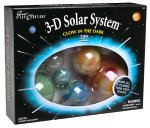
3-D Solar System - Boxed Glow In The Dark Stars and Planets
Recreate the cosmos in your room! Comes with nine 3-D glow-in-the-dark planets, 25 ft. of string, 200 glow-in-the-dark adhesive stars and a planetary guide booklet. Each planet contains a special glow formula that'll give your universe long life!
A glow-in-the-dark solar system kit that can be hung from the ceiling offers a fun, educational, and magical experience for children. Assembling and hanging the planets fosters a sense of accomplishment and provides a hands-on way to learn about our cosmic neighborhood. When paired with glow-in-the-dark star stickers, the kit transforms a regular room into a personal planetarium, sparking curiosity and wonder about astronomy and space exploration. Once the lights are turned off, the glowing celestial bodies create an enchanting environment that can make bedtime something to look forward to. It's not just about the visual spectacle; it's also a unique educational tool that promotes scientific inquiry and imaginative thinking. Kids can drift off to sleep under their very own stars and planets, dreaming of space adventures and future discoveries.
Sources and editorial notes
The retained box image and original text were reviewed on October 15, 2026. NASA provides the current planet list and Pluto classification. An exact instruction sheet and production revision for the pictured package were not established, so mounting hardware, material, glow duration and an age recommendation are not inferred. No physical set was installed or tested.
- NASA: About the Planets — Current planet list and distinction between planets and dwarf planets.
- NASA: Pluto — Pluto’s place in the solar system and its reclassification in 2006.
Images and descriptions are retained as historical material. How Toysit covers toys.
Created for Toysit by Tabbloza — the artwork in our header.