
From the Toysit archive
Guess Who?
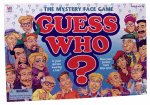
A two-player game of yes/no questions and elimination, with the original card-count claim clarified and the small archive image preserved.
The play at a glance
Ask a question that narrows the possibilities
Guess Who? turns a conversation into a process of elimination. Each player keeps a character secret; the other asks questions and rules out faces that cannot match the answer.
The interesting choice is the question. A clear question about a visible feature can remove several possibilities, while a guess commits to one character.
Turn an answer into an elimination
Ask about a feature both players can see in the illustrations. If the answer rules out a face, lower that face; keep the possible matches standing. An example question might be whether the character wears a hat. Use features that are clear on the actual cards rather than guessing personality or other invisible traits.
In the C2124 instructions, a player names the suspected character on a turn instead of asking a question. A wrong guess loses that game. Check the rules for your edition before deciding how guesses work.
48 face cards does not mean 48 frames per board
The original page says each board has 48 frames. The later C2124 manual lists 48 face cards for the two boards together, with a separate deck of 24 mystery cards. The number of loose cards and the number of frames are different things.
The small historical box image does not settle the original model number. Treat its frame count as unverified, and check an older set against its own contents list.
Make the comparison fair
- Matching characters: both boards need the appropriate character set, and the secret cards must correspond to those faces.
- Working frames: faces should stay upright or folded down as intended.
- Clear answers: agree how to describe ambiguous artwork before it causes a dispute.
- Thoughtful questions: look at the remaining faces before asking; a question that separates them is more useful than one they all answer the same way.
After a round, discussing which question helped most can be part of the play. It is a suggested conversation, not a claim of a measured educational benefit.
The historical record
Original Toysit coverage
The complete original text remains below, including its repeated claim of 48 frames on each board. That count is not established for the pictured edition and should not be used as a parts checklist. The clarification above the archive distinguishes face cards, mystery cards and board frames.
Using game boards with 48 frames apiece and an equal number of cards displaying character faces, players ask one another yes or no questions that help narrow the pool of possibilities.
A wonderful blend of deduction with a form of 20 Questions. Two players try to deduce the identity of their opponent's Mystery Person. Using game boards with 48 frames apiece and an equal number of cards displaying character faces, players ask one another yes or no questions that help narrow the pool of possibilities. Through process of elimination, the identity of the Mystery Person slowly becomes evident. As kids' skill levels grow, their questions become more strategic, allowing them to solve the mystery faster and faster. The faces on the cards are cheerful and clever and designed to give subgroups among the 48 characters just enough similarities to challenge players.
The "Guess Who?" game is a classic board game that taps into the innate human love for mysteries and deductive reasoning. It's essentially a 20 Questions-style game where each player selects a character and the opponent has to guess who it is by asking yes-or-no questions. This encourages not just logical thinking but also strategic questioning. Each query a player makes has to be carefully considered to rule out the maximum number of options, making the game intellectually stimulating. The fun lies in whittling down the pool of suspects through clever questioning and in the joy of the "aha!" moment when you've gathered enough clues to make an educated guess. It's a game that can be quickly understood but takes time to master, making it appealing for both children and adults. Additionally, the game is socially engaging, offering a blend of competition and cooperation that keeps players hooked.
Sources and editorial notes
No original publication date is recorded. Hasbro’s C2124 rules, copyright 2017, were inspected on October 15, 2026. They explain the question-and-elimination system and list 48 face cards shared across two boards, plus 24 mystery cards. They show a later edition, not an exact match to the old box photograph. No set was physically counted or tested.
- Hasbro: Guess Who? C2124 rules (PDF) — Later edition used to explain play and distinguish the different card sets; not an identification of the old photographed box.
Images and descriptions are retained as historical material. How Toysit covers toys.
Created for Toysit by Tabbloza — the artwork in our header.