
From the Toysit archive
Hot Wheels Raptor Blast
Explore Hot Wheels Raptor Blast through its circling loop, release lever and spinning target, then try a paper timing game that separates waiting from movement.
The play at a glance
Choose when the car leaves the loop
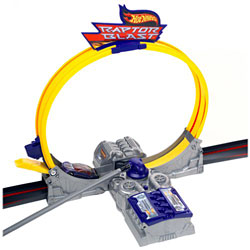
Raptor Blast places a release decision between two parts of a track. Mattel’s 56974 guide shows the car circling an upright loop until a lever opens the ramp onto the longer route. Farther along, spinning raptor heads provide the encounter and can pop off when struck.
The illustrated loop, booster and two-headed target match Toysit’s original photograph. Timing the transition is the central idea: the player chooses when to leave the repeated circuit.
A loop can hold a decision open
The small repeated circuit gives the player a waiting stage before the car enters the longer path. In the guide, the release lever changes which route is available. The question is therefore not only where the car goes, but when it is sent there.
A simple drawing can show this with a circle, an exit and a path to a target. Mark the exit clearly so a reader can see the decision point.
Keep the target and the car in the same account
The guide describes timing the release to pass the spinning heads or strike them. A useful explanation follows both moving elements: where the car is in its journey and what the target is doing when it arrives.
This does not supply a measured speed or a guaranteed way to hit the target. For a surviving set, follow the matching preparation and reset instructions rather than changing the launcher or adding projectiles.
Use a sequence to explain a result
If an instruction-following attempt is observed, describe it in order: the release, the approach and the encounter. A single result does not reveal every cause, but the sequence gives the next question a specific place to start.
The same idea can be explored without the toy. A paper game makes waiting and movement visible while leaving the powered mechanism out of the activity.
Hold, release, observe
- Draw a waiting circle and a three-space path ending at a target.
- One player alternates a paper target card between open and closed on each count.
- The other player chooses a count to leave the circle, then moves a token one space per count.
- Record the target state when the token reaches the final space.
- Repeat with a different departure count and explain the difference.
These are invented paper-game rules for exploring timing. They do not reproduce Raptor Blast’s physical speed or mechanism.
The historical record
Original Toysit coverage
The complete original description and Hot Wheels model-range paragraph remain below. Attack speed and explosion are promotional terms. The raptor is a mechanical character target; the old robotic description does not establish AI, autonomous behavior or biological accuracy.
Hot Wheels Raptor Blast Track Set
Do you have what it takes to beat the raptor? The Hot Wheels Raptor Blast Set that enables kids to race their Hot Wheels cars, catch them in the vertical speed chamber to reach attack speed, and launch them at the right time to explode the two-headed robotic raptor. The spinning raptor explodes when hit. There is a vertical speed chamber with kid controlled release gate and motorized Power Charger booster with power take-off.
The diversity of Hot Wheels models is truly impressive. From classic muscle cars to futuristic concept vehicles, Hot Wheels has meticulously recreated an array of automotive styles, satisfying the curiosity of both car enthusiasts and those eager to explore new designs.
Sources and editorial notes
Mattel’s 56974-0720 G1 guide was visually checked, including the original-style parts, head preparation and final play diagram. Its loop, release ramp and target match the retained image. A later 56974-0920 guide was also inspected as corroboration, not used to infer a publication date or different package contents. The described timing and pop-off action are documented features; no operating set, speed or successful hit was tested. The paper timing game is independent.
- Mattel Raptor Blast 56974 instructions — Original loop, release-ramp, target and reset diagrams.
Images and descriptions are retained as historical material. How Toysit covers toys.
Created for Toysit by Tabbloza — the artwork in our header.