
From the Toysit archive
LeapFrog Phonics Pond
A historical look at Phonics Pond’s letter buttons, spoken prompts and fish-themed rewards, plus a simple word-changing activity to share.
The play at a glance
Letters, listening and a pond full of responses
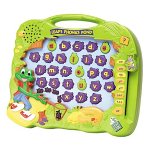
Toysit’s original account presents Phonics Pond as a progression from finding letters to working with short words. Its raised buttons and pond theme give the child something visible to choose while listening to a prompt.
Read the old description as a play sequence
The original coverage describes a child hearing a prompt, choosing a raised letter button and receiving an audible response. It says a help button offers clues and illuminated fish reward correct answers. That gives a useful outline of the intended interaction, even though an exact operating guide has not been verified.
Keep three parts separate when discussing it: the question the toy asks, the button the child chooses and the feedback that follows. A flashing reward shows that the program accepted an input; it does not explain the child’s reasoning.
What the historical numbers mean
The page repeatedly advertises six games and more than 450 words. Those figures are retained as historical claims, not a newly checked inventory. They also describe different things: a number of games is not a count of separate lessons, and a word total does not indicate how much a particular child will encounter.
The original reference to a two-year-old playing with the buttons is an anecdote, not an age grade. For an individual unit, use its label and a matching manufacturer guide to establish setup, battery requirements and intended age.
Change one letter on paper
This activity is independent of the toy’s word list. Write cat in large letters and read it together. Cover the first letter with a small sheet bearing m to make mat. Say both words and talk about what changed. If that is comfortable, replace the last letter of mat with p to make map.
Draw the three objects beside the words. Let the child move the paper, point to a drawing or ask you to read again. Stop after a few enjoyable exchanges; there is no need to recreate a score or the toy’s reward sequence.
Questions worth asking about an old unit
Ask whether the letter buttons respond individually, whether speech can be heard clearly and whether the case and battery cover are complete. Have the owner show the mode selector rather than assuming the pictured toy has every function described in mixed historical copy. A short demonstration answers practical questions that a broad claim such as “teaches reading” cannot settle.
The historical record
Original Toysit coverage
Both original paragraphs are preserved, including repeated promotional phrases, the 450-word claim and the account of a two-year-old tester. That tester is part of the earlier text and is not a participant in this renovation.
Learning games that challenge children to find letters, hear their phonetic sounds, and create more than 450 words
Six exciting learning games challenge children to find letters, hear their phonetic sounds and create more than 450 words, jumping fish light up to reward correct answers. Music adds to the fun - press a letter to hear a catch tune! Teaches letters, phonics and spelling of 3 letter words. Create more than 450 real words with six fun learning games. Teaches Letters, Phonics, Spelling of three-letter words. Create more than 450 real words with six fun learning games! Jumping fisg light up to reward correct answers. Raised letters let you feel their shapes. Musical tunes add to the fun! Easy-carry handle. Volume control. Automatic shut-off. Get hooked on letters, sounds, and words with Leap's Phonics Pond! Six fun learning games challenge children to find letters, hear their phonetic sounds, and create more than 450 words. Jumping fish light up to reward correct answers. Five correct answers gets the fish into the net! Music adds to the fun - press a letter to hear an upbeat, child-pleasing tune! Leap's Phonics Pond combines sound, music, and lights to help children learn letters, sounds, and how to spell three-letter words. Depending upon their developmental level, players choose one of six progressively challenging games. Phonics Pond motivates preschoolers to follow oral directions. If the wrong button is selected, a catchy noise lets them know to try again, and if players are stuck, they can press the help button for clues. When the correct answer is chosen, the computer voice provides praise and encouragement. A 2-year-old tester enjoyed continuously pressing the raised plastic letters while in the alphabet learning mode, and as he grows he'll be ready for the more challenging options.
The study of phonics focuses on the relationship between written symbols (letters) and spoken sounds in a language, primarily aimed at teaching reading skills. It serves as a foundational approach to literacy, enabling learners to decode words by associating individual or combinations of letters with their corresponding sounds. Phonics instruction generally starts with learning the sounds of individual letters before progressing to blends, digraphs, and more complex phonemic patterns. This systematic method is particularly effective for early readers, as it provides them with the tools to sound out unfamiliar words, thus improving reading fluency, comprehension, and spelling skills. While phonics is not the only method used to teach reading, it is widely considered an essential component of comprehensive literacy education.
Sources and editorial notes
This profile is based on Toysit’s original page and retained photograph. An exact manufacturer manual was not located during this review, so the new text attributes product counts and operation claims to the historical coverage rather than presenting a reconstructed instruction guide. No age recommendation is inferred from the old tester anecdote. The paper activity is an original Toysit suggestion; no physical testing or learning-outcome study was performed.
Images and descriptions are retained as historical material. How Toysit covers toys.
Created for Toysit by Tabbloza — the artwork in our header.