
From the Toysit archive
Radio Flyer Classic Red Tricycle
Explore the classic red Radio Flyer tricycle and plan a one-rider parade with a pause for each announcement, plus an older-model recall check.
The play at a glance
A red tricycle with its own parade announcement
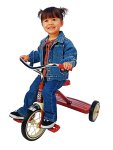
A large front wheel leads this red tricycle, followed by two smaller rear wheels and a low step. Bright metal handlebars curve toward the rider above the red frame. Imagine a small parade where the best moment is the pause: the rider stops, a friend announces a splendid invented name, and everyone pictures the next part of the procession.
Check the model, then make room for one rider
CPSC’s June 23, 1995 notice covers certain Radio Flyer 300 Tornado, PTG, PTP and PTB tricycles with 12-inch front wheels and a 1½-inch washer welded to the front fork and painted the frame’s color. A failed weld can separate the wheel assembly. The notice distinguishes a black washer as outside that particular recall; that distinction is not a general condition or safety assessment.
An adult should compare the owned tricycle with the full recall notice and consult Radio Flyer if its identity is uncertain. Keep an affected or uncertain matching tricycle away from children while resolving it. For a confirmed suitable tricycle, follow the exact model instructions: one rider, continuous adult supervision, helmet and shoes, and a clear level area away from vehicles, steps, slopes and water. The old photograph is retained as history, not a helmet demonstration.
Try the parade announcer’s pause
This original Toysit activity begins with the tricycle parked. A drawn tricycle on a paper route provides the whole game too.
- Choose a parade name together: perhaps “The Red Robin Express” or “The Sunflower Delivery.” Draw a large sign for an announcer to hold from a stationary place outside the route.
- Plan a very short, clear route with an adult. On paper, draw a start and an arrival point; for riding, let the adult choose appropriate stopping places.
- Before the start, the announcer introduces the rider and an imaginary mission. Keep signs, costumes and other props off the tricycle and out of the riding area.
- Travel to the next stop, gently moving the card in the paper version. Come to a full stop before the announcer adds a new sentence.
- Finish with a final announcement: “The sunflowers have arrived for the town picnic.” Swap speaking roles while parked, or draw another parade entry.
There is one rider at a time. The rear step helps with getting on and off; friends join the story from their own stationary place.
Keep a parade program
Write the invented name above a little picture and add the final announcement below. A few entries become a parade program, each with a different destination. The paper procession can grow as long as the players’ stories do.
The historical record
Original Toysit coverage
The complete earlier product account and commentary are preserved below as historical coverage.
Classic red tricycle.
This Radio Flyer Tricycle features classic tricycle styling with chrome handlebars and fender. It contains a sturdy steel construction, durable steel spoked wheels with real rubber tires, an adjustable seat and a 10 inch front wheel. Recommended for ages 2 to 4. A tinier version of the traditional Radio Flyer steel trike, this 10-inch classic couldn't get any cuter without an anxious toddler onboard. Wide handlebars with grips, matching red pedals, a step in back for piggybacking, and a wide two-color seat give it a distinctly retro look. But its old-fashioned style doesn't take away from its functionality--the ride is smooth.
The tricycle, a three-wheeled vehicle designed primarily for children and, in some cases, adults with balance issues, has a long history dating back to the early 19th century. The first tricycles were created almost simultaneously with the invention of bicycles and were initially built for adults as a safer and more stable alternative. Tricycles became especially popular in the late 19th and early 20th centuries, as they were considered more "appropriate" for women who wanted to maintain modesty while riding. With time, the focus shifted more towards children's tricycles, which became a staple toy in many households. Manufacturers started to introduce various designs, incorporating new materials like plastic and advanced features such as storage compartments and adjustable seating. Tricycles have not only served as a fun and educational tool for children, teaching them the basics of pedaling, steering, and balance, but they have also evolved into specialized vehicles used for commercial purposes and by adults for exercise or mobility support.
Sources and editorial notes
Radio Flyer’s two-page 34B/34G-3_14040 instructions and current Classic Red product record were reviewed as model-family references; the old photograph and ASIN B00005AM7Y do not establish that exact revision. The rear step is for mounting and dismounting, not a second rider; the preserved piggyback wording is historical, not present guidance. CPSC recall 95-139 concerns specified older models and weld construction, not all Radio Flyer tricycles. Current availability of its historical remedy was not established. No physical testing or recall clearance is claimed.
- Original Toysit image — Existing same-site image reviewed and retained unchanged.
- Radio Flyer: Classic Red 34B/34G instructions — Both large instruction pages visually reviewed; adult assembly, one rider, helmet, shoes, supervision and platform limits. Model-family comparison, not a proven revision match.
- Radio Flyer: Classic Red Tricycle — Current product page describes the rear step as help getting on and off; current specifications are not transferred to the historical edition.
- CPSC: Radio Flyer tricycle recall 95-139 — June 23, 1995 model, color, front-wheel and welded-washer identification; take affected tricycles away from children and contact the manufacturer. Historical remedy availability is not assumed.
- Original Toysit coverage — Complete historical account retained, including its original claims and wording.

Images and descriptions are retained as historical material. How Toysit covers toys.
Created for Toysit by Tabbloza — the artwork in our header.