
From the Toysit archive
Rubik’s Snake and Cube: Two Different Puzzles
Identify the shape-making Snake in Toysit’s original image and distinguish it from the familiar six-sided Rubik’s Cube.
The play at a glance
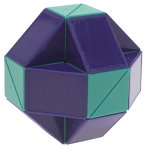
The photograph shows a folded Snake-style puzzle
This page has always lived at a Rubik’s Cube address, but its original headline and first paragraph describe Rubik’s Snake. The green-and-purple image shows joined prism segments folded into a rounded shape, rather than a conventional 3×3 Cube.
The original page later adds a general Cube description. Both passages remain below, with the difference made explicit here so that the name does not send the reader toward the wrong kind of puzzle.
Snake or Twist: make a shape
The historical Snake booklet shows a chain of 24 joined segments arranged into balls, animals and geometric forms. Its green-and-purple illustrations correspond closely to the old Toysit photograph and its Snake headline.
There are two ways to approach that activity: reproduce a chosen shape, or explore a shape of your own. The booklet offers basic bends and shape examples. It also says to stop when a joint resists, avoid forcing a twist and never pull the segments apart. A modern connector version does not establish that the old puzzle can join to another one.
Cube: restore the faces
The conventional 3×3 Cube in the second historical paragraph presents a different task. Its colored pieces remain in a cube while the faces turn; the familiar goal is a solid color on each face. A cube-solving sequence is therefore not a set of instructions for folding the Snake shown above.
This page identifies the two activities. It is not a step-by-step Cube solution, and the small original image should not be read as a photograph of a standard Cube.
Choose the challenge by the movement
- Making forms: look for a Snake/Twist-style joined chain and matching shape examples.
- Solving a cube: identify the actual cube size and use a guide for that mechanism.
- Matching lights: the electronic Rubik’s Slide is another distinct activity.
Check an older item’s joints, completeness and instructions before assuming it behaves like a newer product with a similar name.
The historical record
Original Toysit coverage
The first original paragraph concerns Rubik’s Snake; the second concerns the Rubik’s Cube. The original Snake headline and both passages are retained in their original order. The broad historical and developmental claims in the Cube paragraph are not new findings from this review.
Rubik's Snake Winning Moves.
A twisting puzzle challenge that takes the form of thousands of shapes. Solve one shape and move onto another--or devise your own creation to defy your friends. Rubik's Snake--it'll charm you.
The Rubik's Cube is a 3D combination puzzle invented in 1974 by Hungarian architect and professor Ernő Rubik. Initially, it was created as a teaching tool to help explain three-dimensional geometry. Over the years, the Rubik's Cube has come to symbolize problem-solving, complexity, and a blend of art, mathematics, and science. It gained worldwide popularity in the 1980s and has since become one of the best-selling puzzles in the world. The cube also embodies the challenges and rewards of perseverance, as it can be extremely difficult to solve, but immensely satisfying once completed. In addition, it has inspired a competitive community and a wide range of solving methods and disciplines. So, the Rubik's Cube stands for much more than just a toy; it represents a multifaceted challenge that engages both the mind and the hands, requiring spatial awareness, algorithms, and determination to solve.
Sources and editorial notes
The retained headline and photograph were compared with the Transformable Snake booklet T030-30100-02 hosted by Winning Moves, visually inspected on October 15, 2026. Its green-and-purple illustrations match the photographed style. The booklet credits Toybrokers; the exact regional packaging revision remains unconfirmed. No physical puzzle was handled, and historical website/service references in the booklet are not current support assurances.
- Winning Moves: Rubik’s Transformable Snake booklet (PDF) — Historical Toybrokers booklet with matching-style illustrations, basic moves and shape examples.
Images and descriptions are retained as historical material. How Toysit covers toys.
Created for Toysit by Tabbloza — the artwork in our header.