
From the Toysit archive
Mini Skateboard Shannen
Mini Skateboard Shannen pairs a pink board with a one-button controller and inspires a postcard tour of an imaginary skatepark.
The play at a glance
A miniature rider ready for a postcard
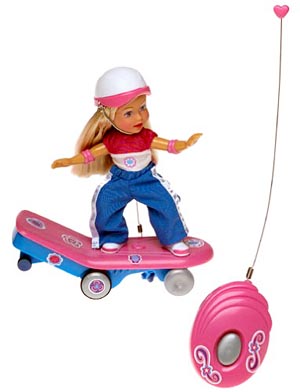
Shannen stands with her arms extended above a bright pink skateboard. Her blue jeans, red top and white-and-pink helmet make a vivid little figure, while the pink controller has one large button and a heart at the tip of its aerial. The mini model’s turning and forward movement give the rider a simple performance pattern. A player can supply the scenery and imagine the postcards she sends from each stop.One button changes the movement
The mini-model guide describes a board that turns clockwise when switched on. Holding the controller button changes that movement to a forward wheelie; releasing it returns the board to turning. Its illustrated controller matches the simple oval transmitter in the original photograph.
The guide calls for keeping hair clear of the wheels and using a suitable dry surface away from streets. Its sticker sheet decorates the board, helmet and controller. The story activity below takes those colorful details onto paper, where the player creates the route.
Open a skatepark postcard desk
Draw three imaginary places: a mural wall, a fountain and a festival gate. Give each place one memorable detail. The mural could show a dragon wearing roller skates, the fountain might be shaped like a shell and the gate could carry a row of rainbow flags.
Make a postcard for each stop. On the front, draw Shannen or an original paper character visiting the scene. On the back, write or dictate a message about something the character notices.
At the mural, she might meet the artist who painted the dragon. At the fountain, she could hear a musician practicing a new tune. At the festival gate, someone may be waiting with a welcome banner.
Follow a detail through all three cards
Choose a small motif—a star, a flower or a checkerboard pattern—and place it somewhere in every picture. Let another player find it and explain how it connects the scenes. Perhaps the artist designed the festival flags, or the same flower grows beside the fountain and the gate.
Arrange the postcards as a journey, then switch their order. A story that begins at the festival might become a trip to find the mural’s artist. Add a final card showing the character back at home, displaying a favorite picture from the day.
The postcards are independent storytelling scenery. They can sit beside an intact toy or become a complete paper adventure, with the player choosing every meeting and destination.
The historical record
Original Toysit coverage
The complete earlier coverage follows. Its opinions, promotional claims and broader historical commentary remain part of the archive; researched details and qualifications appear in Sources.
Skateboard Shannon is lots of fun.
RC controller allows girls to control Mini Skateboard Shannen's cool moves (forward, spin and pop wheelies). Each Mini Skateboard friend is dressed in a different trendy outfit and comes with her skateboard, RC controller, helmet and sticker sheet to decorate her skateboard.
The history of skateboarding dates back to the late 1940s and early 1950s, when it emerged as an offshoot of surfing culture in California. Initially dubbed "sidewalk surfing," the early skateboards were essentially wooden boards with roller skate wheels attached. As its popularity grew, so did innovations in board design and manufacturing. The 1960s saw the introduction of the first commercial skateboards, and skateboarding began to distinguish itself from its surfing roots. Skate parks started to appear in the 1970s, and the sport gained further momentum with the development of urethane wheels, which provided better grip and speed. The 1980s and 1990s saw the rise of professional skateboarding, specialized magazines, and a surge in the sport's mainstream appeal thanks in part to the X Games. Over the years, skateboarding has evolved into a complex subculture with various styles, like street, vert, and park skateboarding, and has even been included in the Olympic Games, solidifying its place as both a sport and a cultural phenomenon.
Sources and editorial notes
The complete 2002 Mattel 47999-9993 instruction sheet was recovered as filing exhibit 239091 on FCCID.io, a third-party mirror of regulatory records. Its rider, oval one-button controller and movement diagrams match the retained picture. The sheet also covers Courtney and Marli; this article centers the pictured Shannen. The broader skateboarding chronology remains preserved historical commentary. The original Shannon URL spelling and SSI values remain unchanged. The companion activity is original to Toysit; no physical toy or recorded sound was tested.
- Mattel: Mini Skateboard 47999-9993 filing manual — Complete one-sheet manufacturer manual visually reviewed; FCCID.io mirrors the 2002 regulatory exhibit and is not the FCC website.
- Original Toysit coverage — Complete original text, SSI values and historical image inspected and preserved.
Images and descriptions are retained as historical material. How Toysit covers toys.
Created for Toysit by Tabbloza — the artwork in our header.