
From the Toysit archive
Sonny the Seal
Explore the older Sonny the Seal ring-toss game through aim, release and observation, with its original Parents’ Choice attribution preserved.
The play at a glance
Aim for a moving target
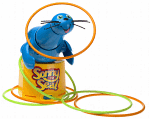
The older Sonny the Seal turns ring toss into a moving-target game. Toysit’s photograph shows a blue seal on a yellow platform with green and orange rings; the original account describes a bobbing head and a bark-and-clap response.
The useful question for a practice session is simple: where was the ring going when it left your hand, and where was the target when it arrived?
Begin with a manageable distance
First identify the actual unit and obtain instructions that match it. An adult needs those directions for preparation, power, movement and removing rings. The play suggestions here begin after that setup; they do not supply a missing operating procedure.
Choose a short, comfortable throwing position and leave clear space between the player and the target. One person tosses while the others watch from behind. Use the rings intended for the set rather than improvised objects.
Try a gentle underhand toss and watch the whole flight. Notice whether the ring traveled too far, fell short, went to one side or reached the target’s area. A miss can still give a clear answer about the next attempt.
Change one part of the toss
- Direction
- Look at the intended target area and compare it with where the ring actually traveled.
- Release
- Try letting go a little earlier or later while keeping the starting position the same.
- Distance
- Move closer if the ring rarely reaches the target area. Keep the task comfortable.
- Timing
- Watch the target’s movement before choosing the next moment to toss.
This is an optional observation activity, not an official alternate scoring system. Do not change distance, throwing style and timing all at once; one small change gives the player something specific to notice.
A partner can describe the ring’s path without judging the throw: “It went to the left” is more useful than “That was bad.” Let the thrower decide whether to repeat the same idea or try a different one.
Separate throwing from retrieval
Agree on a clear end to each short round. Stop tossing, have the adult stop the toy using its own instructions, and wait until it is still before collecting rings. Keep hands away from moving parts, and follow the matching directions for any ring caught on the mechanism.
Put the rings back with the same set so they are ready for the next session. Do not pull against a moving head or neck to free a ring, and do not keep playing with damaged parts.
For shared practice, celebrate a particular observation or a comfortable repeatable toss. The group can take turns without racing to finish a score or asking a frustrated player to keep trying.
What the historical account tells us
The original page describes six rings in two colors and says the first player to land three wins. It also preserves a Parents’ Choice recommendation attributed to Laura Spannagel in 1999. That attribution belongs to the historical account, not to a new Toysit test or a later product carrying the same name.
The small image helps identify the yellow-platform version, but it cannot establish its battery requirements or age label. Keep those questions tied to the unit’s own labeling and instructions. The original enthusiasm about indoor and outdoor play does not establish weather resistance.
The historical record
Original Toysit coverage
The full original description, Laura Spannagel / Parents’ Choice 1999 attribution and later seal essay remain intact below. Claims about confidence, coordination, outdoor suitability and universal appeal are historical wording, not new findings.
A fun game, especially for younger children.
Sonny the Seal is an amusing variation on the ready, aim, throw games that have been around forever. Sonny sits on top of a yellow platform. When activated, he moves his head and neck back and forth tempting your child to toss a ring over his head. When a ring goes over his head and past his tail, Sonny barks with joy and claps his flippers--every success is immediately reinforced. He will teach your child invaluable eye-hand coordination skills and instill confidence at the same time. Sonny's three green and three orange lightweight rings will provide hours of indoor and outdoor fun. Try to toss the rings around this motorized seal's neck as he bobs up, down and side-to-side. Succeed, and he'll bark and clap. First player to get three rings around Sonny's neck wins. NOTE: Kids as old as 8 years enjoyed this game. It became a test class's mascot. A Parents' Choice Recommendation. (Laura Spannagel, Parents' Choice, 1999).
Children are often fascinated by seals due to their playful nature, adorable appearance, and intriguing behaviors. Seals are frequently depicted in a charming and friendly manner in children's media, enhancing their appeal to young audiences. With their smooth, streamlined bodies and expressive faces, seals capture children's imagination as they perform aquatic acrobatics or simply lounge on rocks or ice. The seal's ability to thrive both in water and on land adds an extra layer of fascination, bridging the worlds of terrestrial and aquatic animals. Often found in zoo and aquarium settings, seals easily engage children by interacting with their environment in a way that appears both entertaining and endearing. Their vocalizations, sometimes akin to barks or claps, further add to their allure, making seals a universally appealing animal that resonates with the innate curiosity and sense of wonder in children.
Sources and editorial notes
Reviewed October 16, 2026 against the original image, source and ASIN B00000IWFH. A securely matched original operating manual was not established. The original three-green/three-orange ring description and first-to-three account identify the historical version; later fish-token scoring has not been substituted. The practice ideas below are editorial suggestions for an identified, properly prepared set, not setup instructions. No physical toy or developmental outcome was tested.
Images and descriptions are retained as historical material. How Toysit covers toys.
Created for Toysit by Tabbloza — the artwork in our header.