
From the Toysit archive
Little RhythmMaker Toy Drum
Tap a short pattern, leave room for a pause and take turns answering with the colorful drum from Toysit’s archive.
The play at a glance
A few taps can start a conversation
A toy drum gives each movement an immediate sound. Try two gentle taps, a pause and a second player’s reply. The important part of the game is hearing where the first turn ends and the next begins.
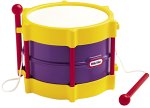
The archived photograph shows the Little RhythmMaker drum with two attached mallets. The earlier account describes a stationary instrument without a neck strap, making a small seated rhythm game a natural starting point.
Play an echo game
- Make a short call: tap twice, then stop.
- Leave a gap: give the listener time to hear the end of the pattern.
- Answer: the second player repeats the taps.
- Swap: let the listener invent the next call.
One tap is enough for a first round. Add a third tap or a longer pause when both players want a change. A spoken “your turn” can make the handover clearer than asking a young player to infer it.
Change speed without changing the pattern
Keep the same tap-tap-pause shape and try it slowly, then a little faster. Speed and loudness are different choices: a faster pattern does not need harder strikes.
Use the intended mallets and a comfortable sound level. Listen for the spaces as well as the hits. If the sound is too much for either player, pause or switch to quietly copying the rhythm with fingertips on your own knees.
Give the rhythm a simple story
Imagine a character walking, stopping to look around, then walking again. Give the steps a few taps and the looking-around moment a silence. Another player can move a toy figure along with the sound.
Try a different ending, such as one final tap or a longer silence. These choices make the pattern yours without requiring a song, notation or a particular musical skill.
Set up for the drum you have
Choose a stable play surface and leave enough room for the mallets. An adult should check an older drum and its attached cords before play and use its own labels for age and care guidance. Do not add a neck strap or treat the old chewing-resistance description as permission to mouth the parts.
At the end, give the mallets their resting places and choose one pattern to remember for next time. A short, enjoyable exchange is a useful stopping point.
The historical record
Original Toysit coverage
Both original paragraphs remain below, including the eight-inch dimension, dent- and chew-resistance language and general developmental claims. These are historical descriptions, not verified measurements, current safety assurances or tested learning outcomes.
Little RhythmMaker Toy Drum
We got the beat! Little drummer girls and boys of all musical abilities will want to thump on this dandy Little RhythmMaker Drum. Colorful dent- and chew-resistant plastic forms its 8-inch wide cylinder. The two sturdy mallets included won't get lost; they're smartly attached to the drum with medium-weight braided cord. The lack of a neck strap means your budding Ringo will be a stationary musician on this instrument. Spice up the playbill by adding the Little RhythmMaker Rhythm Set.
Drums hold a special appeal for children due to their tactile nature, simplicity, and instant gratification. Striking a drum surface produces immediate sound, offering a direct correlation between action and outcome, which is deeply satisfying for young minds. Unlike many other instruments that require a learning curve to produce a pleasing sound, drums are instantly accessible. They also cater to children's natural propensity to explore the world through touch and movement. Drumming can serve as a fundamental way to understand rhythm and tempo, foundational elements in music education. Additionally, drumming can aid in the development of motor skills, coordination, and timing. Many children find it exhilarating to be able to produce loud, resonant sounds, and this can also serve as an emotional outlet, helping children express feelings they might not yet be able to articulate. Overall, drums offer a captivating blend of sensory engagement, emotional expression, and educational potential.
Sources and editorial notes
The original image and text were reviewed on October 15, 2026. An exact manufacturer instruction sheet and production revision were not established. The activities are editorial suggestions for the pictured type of drum, not a claim that the toy teaches a prescribed curriculum. No physical instrument or learning outcome was tested.
Images and descriptions are retained as historical material. How Toysit covers toys.
Created for Toysit by Tabbloza — the artwork in our header.