
From the Toysit archive
Air Hogs Resistor
Air Hogs Resistor pairs a dark, boldly patterned airplane with a docking base and controller, inspiring an original air-show announcer activity.
The play at a glance
Give a patterned airplane its own air-show story
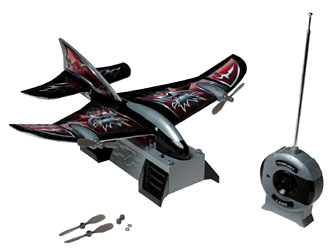
The Resistor’s dark wings carry red, white and silver graphics that seem to sweep outward from the cockpit. Beside the plane sit a docking base, a rounded controller with a long antenna and small spare propellers. Even at rest, the collection looks like the equipment for a tiny airfield preparing for its next visitor.
Build a scene around the aircraft
The original account presents the Resistor as a remote-controlled plane with Beginner and Advanced levels. Its graphic wings give the imaginary pilot something recognizable to announce: a dark aircraft arriving over the field, turning across the view and heading home.
A companion can take the part of the airfield announcer while another invents a destination. The story might begin with the opening of a new island post office or a visit from the Cloud Club. Keep the dialogue separate from what the aircraft actually does; its movements belong to the matching operating instructions, while the destination and characters belong to the players.
Try an air-show announcer’s desk
Make three paper cards headed “Departure,” “Wide Turn” and “Homeward.” Under each heading, draw a small scene and write one sentence for the announcer. “The silver-winged visitor is leaving Lantern Field with a bag of birthday letters!” is enough to launch the story.
Lay the cards beside a drawing of the Resistor or a stationary, switched-off toy. One player presents the three scenes while a second supplies a sound effect or a line from an imaginary passenger. Swap roles and let the second announcement tell a different journey using the same cards.
If an adult has separately arranged ordinary flying with the correct guide, an observer can narrate the movement they actually see, then add the invented story afterward. Keep the announcer’s desk and spectators outside the flight area, and let the pilot choose the actions.
Revisit a quick-charge flying toy
The dock and controller help place the Resistor in the era described by its earlier coverage. Match a surviving unit to its own instructions and supplied power equipment before use. The paper broadcast works as a complete activity on its own.
The historical record
Original Toysit coverage
The complete earlier product account and commentary are preserved below as historical coverage.
Radio Controlled Airplane Air Hog Resistor by SpinMaster
The resistor is the newest RC Air Hog with 50 percent more control, 2 flight levels, Beginner and advanced and our auto take off system. It is the only RC plane with replaceable propellers and comes with them. New and improved charging system for a guranteed connection every time. It is easy to Toggle for left and right direction control, and the thrust control is great if you are heading towards land. When close to out of range, use the land button to cut the power to engine and watch it automatically.
Evolution from R/C Aircraft to Modern Drones
The evolution from traditional Radio-Controlled (R/C) aircraft to modern drones represents a remarkable technological progression that has revolutionized both recreational and industrial applications. R/C aircraft, once limited to basic remote-controlled flight, gradually integrated more advanced electronics, such as gyroscopes and stabilization systems, enhancing their maneuverability and ease of control. As technology advanced, the integration of miniaturized sensors, GPS receivers, and improved battery technologies paved the way for the emergence of modern drones. These drones, also known as Unmanned Aerial Vehicles (UAVs) or Unmanned Aircraft Systems (UAS), offer unprecedented capabilities. They can autonomously navigate, maintain stable flight, and execute intricate maneuvers with remarkable precision. Additionally, the integration of high-quality cameras and real-time video transmission capabilities has transformed drones into powerful tools for aerial photography, cinematography, surveillance, mapping, and various industrial applications. The evolution from R/C aircraft to modern drones underscores the fusion of engineering ingenuity and technological progress, enabling a diverse range of users to harness the potential of unmanned aerial platforms in ways that were once unimaginable.
Sources and editorial notes
This profile uses the complete original Toysit account and image. The exact Resistor manufacturer guide was not recovered. The older copy describes two flight levels and directional, thrust and landing controls; those statements remain attributed to it, and Intruder instructions have not been transferred to this edition. Comparative claims such as “50 percent more control” and guaranteed charging remain historical promotion. The general drone essay does not establish GPS, camera or autonomous features for this toy. The announcer activity is an original suggestion; no physical testing was performed.
- Original Toysit image — Existing same-site image reviewed and retained unchanged.
- Original Toysit coverage — Complete historical account retained, including its original claims and wording.

Images and descriptions are retained as historical material. How Toysit covers toys.
Created for Toysit by Tabbloza — the artwork in our header.