
From the Toysit archive
Watercolor for the Artistically Undiscovered: paint a tiny travel journal
Meet the Klutz watercolor book with its attached palette, then paint an imaginary journey in three small scenes.
The play at a glance
A book with room for your own pictures
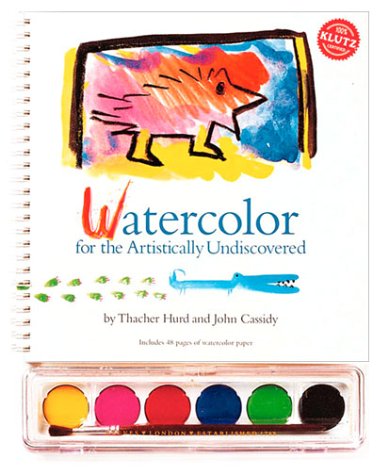
A bright pink animal fills the cover, a blue crocodile stretches beneath the title, and six paint pans sit along the bottom. Watercolor for the Artistically Undiscovered brings a sketchbook and a small paint set together. Open a page and the next part of the picture belongs to you.A little studio attached to a book
The cover credits Thacher Hurd and John Cassidy. Its spiral binding, illustrated cover and attached palette give the set the look of a portable art desk: pictures to look at, colors to choose, and paper waiting for a brush. The earlier Toysit account describes watercolor paper and a mix of storytelling and painting guidance.
Klutz’s Spring 1996 catalog shows the same cover design and describes a six-color Reeves palette and a Winsor & Newton brush. It also describes space for the reader to paint among Hurd’s illustrations and technique tips. That arrangement invites a pleasing change of roles: one moment you are looking at someone else’s artwork, and the next you are making your own.
Try a three-window travel journal
Imagine that a very small traveler has one day to explore an invented place. A seaside village, a city of roof gardens or an island with a purple hill could supply the whole adventure. Use spare watercolor paper so that this story can become a separate little gallery.
- Give the day three windows. Lightly mark three rectangles for morning, afternoon and evening. Leave a little space below each for a sentence.
- Choose a color for each stop. Morning might be mostly yellow, afternoon mostly green and evening mostly blue. Add one small detail in another color: a red boat, a pink gate or an orange lamp.
- Let something travel through all three. A tiny flag, a striped bag or a round hat can help a viewer find the traveler again.
- Add the travel notes. Once the pictures are ready for writing, caption them: “We arrived at the lemon-colored station,” “The garden had a secret gate,” or a sentence of your own.
Crayons and ordinary paper work for the same story. Invite another person to put the three scenes into words, then compare their journey with the one you imagined. A different reading can become tomorrow’s picture.
Make a page worth returning to
Give the finished journal a place name and a tiny map key. A dot might mean somewhere to rest; a zigzag could mark a surprising path. Follow the directions supplied with your art materials for use and cleanup, and keep a separate scrap for trying colors. The little journal can be complete after three scenes, or become the first day of a much longer imaginary trip.
The historical record
Original Toysit coverage
The original product account and commentary are preserved below as historical coverage.
Watercolor for the Artistically Undiscovered.
Most of the pages are actual watercolor paper, with blank space reserved for the use of the reader/painter (that's you). Complete with a palette of artist-quality watercolors, and the inspiration and encouragement of renowned illustrator Thacher Hurd. A playful guide to learning the art of watercolor painting combines storytelling with instruction and includes a complete set of watercolor paints and a brush.
Introducing a young artist to the art of watercolor can be a rewarding and enriching experience. Watercolor painting offers a unique medium that encourages creativity, exploration, and skill development. Here are some of the wonderful features and benefits of getting a young artist into watercolor:
- Encourages Creativity: Watercolor allows for free-flowing expression and experimentation. Young artists can play with colors, blending, and techniques to create their unique pieces.
- Develops Fine Motor Skills: Handling brushes and working with delicate strokes helps in developing fine motor skills and hand-eye coordination.
- Teaches Color Theory: Working with watercolors provides a hands-on understanding of color mixing, shades, and tones, enhancing the young artist's knowledge of color theory.
- Promotes Mindfulness and Focus: The process of painting with watercolors requires concentration and mindfulness, fostering a sense of calm and focus in young artists.
- Accessible and Affordable: Watercolor sets are generally affordable and widely available, making it an accessible art form for many families.
- Enhances Observation Skills: Painting from life or reference encourages young artists to observe the world around them closely, enhancing their observational skills.
- Builds Confidence: As young artists see their progress and create beautiful pieces, they gain confidence in their artistic abilities.
- Offers Opportunities for Social Interaction: Joining watercolor classes or groups can provide social interaction and peer learning, fostering a sense of community and friendship.
- Environmentally Friendly: Watercolors are typically non-toxic and can be a more environmentally friendly option compared to other art mediums.
- Provides a Lifelong Skill: Mastering watercolor techniques can provide a lifelong skill and hobby that continues to bring joy and fulfillment.
Overall, the art of watercolor offers a multifaceted and enriching experience for young artists, nurturing their creativity, skills, and personal growth. It's a wonderful way to introduce children to the world of art and set them on a path of artistic exploration and enjoyment.
Sources and editorial notes
The original photograph and Klutz’s Spring 1996 catalog support the book, palette and brush description. The catalog’s printed page 8 was reviewed alongside its cover; the complete book was not reviewed. The original August 12, 2023 update is retained. The activity is an original Toysit suggestion, with no physical testing or measured developmental benefit claimed.
- Original Toysit image — Existing same-site photograph reviewed and retained unchanged.
- Klutz Spring 1996 catalog — archived publisher document — Cover and printed page 8 reviewed visually. Supports the matching cover design, watercolor-paper format, six-color palette and brush; individual copies and later reissues can differ.
- Original Toysit coverage — Complete original product account and historical commentary preserved.

Images and descriptions are retained as historical material. How Toysit covers toys.
Created for Toysit by Tabbloza — the artwork in our header.