
From the Toysit archive
Crayon Holder: a small invention with a new picture to draw
Explore Cassidy Goldstein’s crayon-holder invention and draw an inventor’s postcard with a problem, an idea and a colorful result.
The play at a glance
A short crayon with a longer handle
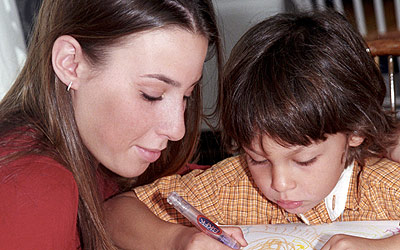
A small piece of crayon can still have plenty of color left. The Crayon Holder gives that piece a longer body to hold, with its drawing tip peeking out at the end. The original photographs show both a shared drawing moment and two clear holders among a scatter of colorful crayons.Look closely at the small invention
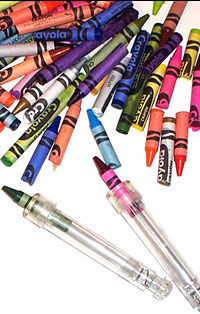
The clear body lets the crayon remain part of the picture even before it reaches the paper. In the product photograph, short green and pink pieces project from the ends of much longer transparent holders. A person grasps the holder while the colored tip makes the mark.
Toysit’s original account tells how eleven-year-old Cassidy Goldstein wanted to keep drawing with broken crayons and found inspiration in the tubes used for cut flowers. The Lemelson-MIT inventor biography also records that early problem and prototype. Her patent, filed June 29, 2000 and granted June 11, 2002, describes a body with a flexible gripping top. Its drawings show how the writing tip projects beyond the holder.
That is a satisfying starting point for a drawing game: notice a small difficulty, imagine a useful change, and give the idea a picture.
Try an inventor’s picture postcard
Use an ordinary crayon, or an identified holder with its own directions, to send a pretend postcard from your invention workshop.
- Choose a little problem. Perhaps a story character keeps losing letters on a windy delivery route, or a gardener wants to catch rain while walking.
- Draw the invention on the front. Try a parcel-sorting wagon with different colored compartments, or a rain-catching hat with a tiny garden on top. Give it a name.
- Make three boxes on the back. Label them “Problem,” “Idea” and “Picture.” Add a short explanation to the first two, then draw the machine helping its imagined owner in the third.
- Ask for a workshop reply. Let another player name one detail they understand and ask one question. Add a handle, a window or a new color to answer them.
The machines can be as fanciful as you like. Their job is to make a story visible; a rain-catching hat can have a cloud-shaped brim even if it stays entirely on paper.
Keep the next drawing in mind
Goldstein’s story begins with something she wanted to finish. For your postcard, choose a last detail worth adding: the recipient’s name, a pretend stamp or the workshop’s opening hours. Use the directions and age guidance for the actual drawing supplies you have; the historical flower-tube anecdote is an invention story, not a construction activity.
The historical record
Original Toysit coverage
The original product account and commentary are preserved below as historical coverage.
Kid-invented product uses plastic tube for grip to enable children to hold the smallest broken pieces and still draw
The Crayon Holder makes drawing easier for little hands. A simple but brilliant product, the crayon holder can hold the smallest piece of crayon and still draw.
Invented by Cassidy Goldstein at the age of eleven, The Crayon Holder solved a common problem: how to grip crayons when they are broken and too small to use. Confronted with a bucket of broken crayons, Cassidy pondered a way to make use of them to finish her drawing. Inspired by the plastic tubes used to keep roses fresh while being transported, Cassidy created a holder that would grab the small pieces of a broken crayon.
The crayon holder also benefits children who find the small crayons hard to handle, and it helps keep fingers clean. The Crayon Holder packaging features Cassidy and her story as an inspiration to other kids that they too can invent and turn ideas into profits.
"Kids have tremendous creative potential that has not been recognized for commercial application," said Daniel Gwartz of By Kids For Kids. "Ideas like Cassidy's crayon holder demonstrate the true potential of kids to innovate and we are honored to have Wal-Mart taking the lead in supporting her product.
The Joy of Crayons
Crayons have been a beloved art medium for generations, providing joy, creativity, and expression to both children and adults alike. The simple yet versatile nature of crayons has made them a timeless tool in the world of art. Here's why crayons continue to captivate artists of all ages:
- Accessibility: Crayons are widely available and affordable, making them accessible to virtually everyone. Whether in a classroom, at home, or in a professional art studio, crayons are a staple that can be found almost anywhere.
- Colorful Expression: With a vast array of vibrant colors, crayons offer endless possibilities for artistic expression. From bold and bright hues to soft and subtle shades, crayons allow artists to explore the full spectrum of color.
- Childhood Nostalgia: For many adults, crayons evoke fond memories of childhood creativity and play. The familiar scent and feel of crayons can transport people back to simpler times, fostering a sense of nostalgia and joy.
- Developmental Benefits for Children: Crayons are often one of the first art tools introduced to children. They help develop fine motor skills, hand-eye coordination, color recognition, and spatial awareness. The act of coloring and drawing with crayons encourages cognitive and emotional growth in young children.
- Therapeutic Qualities: Coloring with crayons has been recognized as a therapeutic activity for individuals of all ages. It promotes relaxation, stress relief, and mindfulness, making it a valuable tool for mental well-being.
- Creativity and Imagination: Crayons inspire creativity and imagination by allowing artists to experiment with different techniques, textures, and styles. From simple doodles to intricate masterpieces, crayons enable artistic exploration without limitations.
- Social Connection: Crayons often facilitate social connections, whether through collaborative art projects, family coloring time, or community art events. They bring people together to create, share, and celebrate art.
- Environmental Friendliness: Many crayons are made from non-toxic and environmentally friendly materials, aligning with growing concerns about sustainability and eco-conscious living.
The joy of crayons transcends age, culture, and socio-economic status. They are more than just a tool for coloring; they are a symbol of creativity, expression, and human connection. Crayons have the power to unite generations, spark imagination, and provide comfort and healing. Their enduring popularity is a testament to their universal appeal and their ability to touch the hearts and minds of artists around the world.
Sources and editorial notes
Toysit’s November 22, 2004 account and August 12, 2023 update remain intact. All seven pages of US6402407B1, including its three drawing sheets, were reviewed. The patent documents an invention, not the exact retail package or individual suitability. Original retail instructions were not recovered; the photographs do not establish the people’s identities. The activity is original editorial work, not a tested accessibility intervention.
- Original Toysit image — Existing same-site photograph reviewed and retained unchanged.
- Second original Toysit photograph — The original 200 × 314 image is retained unchanged and displayed above.
- Cassidy Goldstein patent US6402407B1 — Full seven-page patent and drawings reviewed. The primary record gives June 11, 2002 as the grant date; the Lemelson-MIT biography’s August 2002 wording differs.
- Lemelson-MIT inventor biography — Supports the childhood problem and prototype account. Historical commercialization statements are contextual, not current availability claims.
- Original Toysit coverage — Complete original product account and historical commentary preserved.

Images and descriptions are retained as historical material. How Toysit covers toys.
Created for Toysit by Tabbloza — the artwork in our header.