
From the Toysit archive
Barbie Volkswagen New Beetle
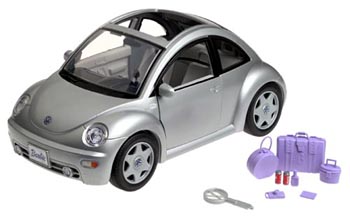
A silver Barbie New Beetle and purple luggage inspire a suitcase welcome desk, with picture clues leading to imaginary hotel rooms.
The play at a glance
A rounded little car with a suitcase story
The silver New Beetle’s round headlights and arched roof make it easy to recognize. Purple luggage and a large silver toy key sit beside the car in the original image, suggesting a journey just about to begin. Imagine a doll arriving at a small hotel where every room has a different picture on its door.
Give the arrival a destination
The car’s open roof gives a view into the cabin, while its rounded outline makes a distinctive shape on a paper town map. The luggage adds the next part of the story: someone has packed for a visit, and someone else is ready to welcome them.
A hotel can be as simple as a folded card with a name above a doorway. Choose a setting for it: beside a flower garden, near a tiny theater or on a street where every shop sells something blue.
Keep the car parked during the welcome scene. Use the openings and accessories supported by the actual set’s instructions, or represent the arrival with a drawing and paper suitcase. The guest’s greeting and the host’s reply supply the action.
Run a suitcase welcome desk
Draw three room signs: a shell, a sunflower and a crescent moon. Stand them along a folded paper hotel. Give each room one imaginary feature, such as a view of the lighthouse or a window facing the garden.
Make a luggage card for each guest using one of the same pictures. Lay the card beside a toy suitcase, or draw the whole suitcase around it. The hotel host reads the picture clue and matches the guest to a room.
Begin with a short exchange: “Welcome to Lantern House. What picture is on your luggage?” Let the guest answer in character, then have the host describe the room’s special view.
Add a gentle mix-up: two guests have exchanged their cards. They explain what they hoped to see, and the host works out the matching rooms. End with a little visitor’s note describing the best part of the stay. Change the three pictures for a new destination.
The historical record
Original Toysit coverage
The complete earlier product account and commentary are preserved below as historical coverage.
Great gift for a girl who loves Barbie.
Barbie loves to wear the latest clothes, so of course she needs a car that's just as trendy--like this flashy silver Volkswagen Beetle (other colors available). It has an open sunroof, functional doors, and working seatbelts (which a smart girl like Barbie always wears). The hatchback trunk can lift open or unlock with a large, silver plastic key with its own mini Beatle key chain. Lots of little accessories are included, such as a suitcase, a makeup case, Coca-Cola cans, and decorative stickers kids can use on the car or themselves.
The Volkswagen Beetle: Making Driving Accessible Worldwide
The Volkswagen Beetle, fondly known as the "Bug" or "Käfer" in its homeland of Germany, remains one of the most iconic and recognizable vehicles in automotive history. Its origin story, functionality, and affordability combined to make driving accessible to millions around the world. Here's how the Beetle democratized the driving experience:
- Origins in Affordability: Conceived in the 1930s, the idea behind the Volkswagen Beetle was to produce a "people's car" (Volkswagen translates to "people's car" in German). The primary goal was to create a car that was affordable for all German citizens.
- Simple Design: The Beetle's design, crafted by Ferdinand Porsche, focused on simplicity and functionality. This straightforward approach not only kept manufacturing costs down but also made the car reliable and easy to repair.
- Efficient Production: The Beetle was designed for efficient mass production. The assembly line techniques further reduced costs and increased output, allowing for economies of scale that contributed to its affordability.
- Reliability: The Volkswagen Beetle's air-cooled engine, combined with its simple mechanical design, made it notoriously reliable. This reliability meant that owners saved on maintenance and repair costs, adding to its long-term affordability.
- Global Production: While the Beetle originated in Germany, its popularity led to production in multiple countries, including Brazil, Mexico, and South Africa. Localized production often meant reduced costs and prices better suited to local markets.
- Cultural Phenomenon: The Beetle transcended its role as just a vehicle. It became a cultural icon, representing freedom and the open road in places like the United States during the 1960s. Its association with various global subcultures reinforced its popularity and boosted sales.
- Fuel Efficiency: For its time, the Beetle was relatively fuel-efficient. This efficiency meant that not only was the car affordable to purchase, but it was also affordable to run on a day-to-day basis.
- Enduring Legacy: As the Beetle's popularity grew, used models flooded the market, making it even more accessible for people on tight budgets. Its lasting appeal ensures that even today, a well-maintained Beetle can be an affordable entry into car ownership.
The Volkswagen Beetle revolutionized the automobile industry by making driving accessible to the masses. Its blend of affordability, reliability, and cultural significance positioned it as a beloved vehicle across continents, socio-economic classes, and generations.
Sources and editorial notes
Mattel’s complete two-page 27589 guide documents the related yellow New Beetle, including doors, luggage and a key-operated hatch. It is not an exact silver-edition identification; the 55998 lead remains unconfirmed and its support page was unavailable. Follow the actual edition’s instructions. The earlier essay concerns the classic Beetle, distinct from the New Beetle pictured here. Its affordability narrative omits Volkswagen’s Nazi-era origins and forced labor, documented in Volkswagen’s own history. Historical technical and price claims are retained, not newly endorsed. The welcome-desk activity is original to Toysit; no physical testing was performed.
- Original Toysit image — Existing same-site image reviewed and retained unchanged.
- Mattel New Beetle 27589 instructions (PDF) — Complete two-page guide for a related yellow edition; not proof of the silver model number.
- Volkswagen’s New Beetle history — Manufacturer history distinguishes the modern New Beetle from its classic predecessor.
- Volkswagen Group history and remembrance — Primary context for the company’s Nazi-era origins and use of forced labor omitted by the preserved essay.
- Original Toysit coverage — Complete historical account retained, including its original claims and wording.

Images and descriptions are retained as historical material. How Toysit covers toys.
Created for Toysit by Tabbloza — the artwork in our header.