
From the Toysit archive
Tyco Air Rebound
Understand Tyco Air Rebound’s two drive wheels and oversized inflatable tire, identify the original system, and compare its wheel layout on paper.
The play at a glance
Three wheels, with one very different job
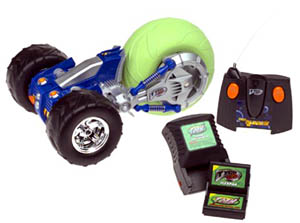
Air Rebound’s unusual silhouette comes from two smaller drive wheels and one much larger inflatable tire. The original photograph makes that contrast clear. Mattel’s 91555-0720 guide identifies the same arrangement and shows how the big tire becomes part of the vehicle’s rolling and bouncing action.
This is the large three-wheel toy in Toysit’s original coverage. The name should not be used to assume compatibility with later miniature Air Rebound products or their equipment.
Read the wheel layout
First identify the two drive wheels, then follow the outline of the much larger tire. The manual includes forward and reverse travel, wide turns and spins. The interesting question is how that arrangement differs from a car with four similar wheels.
A drawing can help separate wheel size from wheel count. Neither a large tire nor the word “Rebound” means the toy can be used on every surface or deliberately crashed into anything.
Check what belongs together
- Vehicle and transmitter: compare the exact product and radio-frequency labels, not just the color.
- Inflation equipment: the guide specifies its inflation pin, a hand pump and a tire-to-body clearance check. It warns against overinflation.
- Power equipment: match the vehicle and its battery/charger instructions as a complete system.
- Instructions: use the full-size three-wheel guide rather than instructions for a similarly named miniature.
This is an identification checklist, not confirmation that an old example is ready to run. The manufacturer excludes sand, water and snow; its dramatic stunt illustrations do not remove those limits.
Ask a question before predicting a result
What might change if three wheels were the same size? What part of the silhouette would be lower? Which parts would touch a flat line on a side-view sketch?
Those questions can be explored without inflating a tire or setting up a jump. A paper shape describes geometry; it cannot establish real traction, speed or impact behavior.
Design two wheel layouts
- Draw a simple body above a straight ground line.
- Give the first version two smaller wheels and one larger wheel, using the original photograph as a visual reference.
- Draw a second version with wheels of similar size.
- Circle what changed in the outline and mark the ground-contact points.
- Write one prediction and one question you cannot answer from the drawing.
This independent design exercise is not a modification plan. Leave an original toy’s wheels, inflation limits and power system as specified by its manufacturer.
The historical record
Original Toysit coverage
The complete original product description and extended history of RC stunt vehicles are preserved below. The broad history is background commentary, not a feature list for this specific toy. The old bundle description is historical: it does not establish what is included with a surviving example or what still works.
Remote-controlled stunt toy.
The Air Rebound is a remote-controlled stunt toy that's hard to describe but very easy to like. Imagine a futuristic 12-by-7-inch car body with no windows, no difference between top and bottom, and three tires, including one jumbo, neon green tire that measures 6.5 inches in diameter and 3.5 inches thick. Zoom it, turn it, jump it, flip it, and crash it--the Air Rebound doesn't seem to care about niceties like whether it's moving forward, backward, or upside down. Mere cars suddenly look pretty dull. The Air Rebound runs exclusively on a TMH Flexpak rechargeable battery system (included in this special bundle pack), but you'll also need a 9-volt battery (not included) to power the transmitter. The Air Rebound is available in two frequencies so you can stage races between vehicles with different frequencies. Before you can operate the vehicle, you'll need to use a pump (not included) to inflate the oversize green tire.
The Evolution of R/C Toy Stunt Vehicles
Radio-controlled (R/C) vehicles have captivated enthusiasts for decades. R/C stunt vehicles, in particular, bring an added level of excitement and dynamism, allowing users to perform tricks, flips, and jumps that typical R/C cars cannot. Here's a look at how these adrenaline-pumping toys have evolved over the years:
-
Origins:
- The earliest R/C vehicles, dating back to the mid-20th century, were basic in design and functionality, primarily geared towards forward and backward movement with simple turns.
- Stunt capabilities were not inherent but emerged as users modified their vehicles for better performance and tricks.
-
Design and Construction:
- Initial R/C cars were constructed from materials like metal and wood, making them heavier and limiting their stunt potential.
- As plastics and other lightweight materials became commonplace, the design of R/C stunt vehicles evolved, becoming more aerodynamic and flexible to withstand crashes and to perform stunts more efficiently.
-
Performance and Capabilities:
- Advancements in battery technology led to longer playtimes and greater power outputs, allowing for faster speeds and more daring stunts.
- Features like gyro-stabilization and advanced suspension systems made it easier to perform flips, wheelies, and spins.
- Some modern R/C stunt vehicles can even 'walk' on their large wheels or flip and continue driving when turned upside down.
-
Control Systems:
- Earlier R/C vehicles used basic radio frequency (RF) controls, often with limited range and responsiveness.
- Technological advancements led to the use of 2.4 GHz frequency systems, reducing interference and increasing the effective range of control.
- Some modern R/C stunt vehicles can be controlled using smartphone apps, offering customizable controls and even programmable stunts.
-
Terrain Adaptability:
- Initially, R/C cars were designed primarily for smooth surfaces or indoor play.
- Over time, R/C stunt vehicles have been equipped with durable tires, high-torque motors, and robust suspension systems, enabling them to tackle a variety of terrains, from smooth pavements to rough off-road tracks.
-
Aesthetic Appeal:
- Early R/C vehicles had a generic look. As the market expanded, manufacturers began to incorporate eye-catching designs, vibrant colors, and even LED lighting to add to the visual appeal of their stunt vehicles.
The evolution of R/C stunt vehicles showcases the blending of technology, design, and user demands. What began as simple, forward-driving toys has transformed into high-octane stunt machines capable of mesmerizing feats, providing hours of entertainment for both kids and adults.
Sources and editorial notes
The six-page PDF linked from Mattel’s 91563 record carries the printed code 91555-0720. Its English instructions and diagrams were reviewed visually and match the large three-wheel layout in the original photo. Although the catalog title says 6V international, the guide describes the TMH FlexPak arrangement; the catalog title alone was not used to specify a replacement power system. No tire, motor, battery or charger was tested. The wheel-layout exercise is independent editorial work.
- Mattel Air Rebound instructions, printed code 91555-0720 — Large three-wheel model: inflation, controls, original power arrangement and restrictions.
- Mattel Air Rebound 91563 record — Source of the linked guide; packaging and electrical variants require exact matching.
Images and descriptions are retained as historical material. How Toysit covers toys.
Created for Toysit by Tabbloza — the artwork in our header.