
From the Toysit archive
Battleball
Explore Battleball’s painted futuristic teams, colored dice and miniature football field, with an original coach’s replay notebook activity.
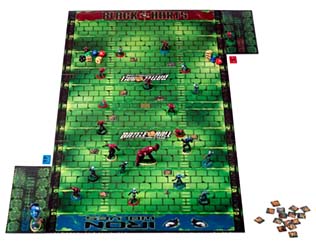
The play at a glance
Coach a miniature team from the future
Armored football figures stand across a green grid, their colored bases ready to be matched with dice. A small zinc football becomes the focus of the field. Battleball turns the tabletop into a coaching view: choose a figure, trace a route through the spaces and watch the next die roll shape the play.A color beneath every player
Each coach commands eleven figures. A figure’s base color identifies its dice: a red-based running back uses a twenty-sided die, for example, while a yellow-based tackle uses a six-sided die. During a turn, the coach selects one figure to move and rolls its matching die or dice. Routes and neighboring opponents matter as the teams work toward the end zones.
The basic game includes movement, tackles and hand-offs; the advanced game adds passing. The first team to score two touchdowns wins. Begin with the printed basic rules to follow the miniature action, then consult the advanced section when you are ready for passing. The familiar football shape gives the scene a theme, while the grid and dice give each decision a visible place on the table.
Make a coach’s replay notebook
Original Toysit activity: after a completed turn, draw a small patch of the field on paper beside the board. Mark where one figure began and where it finished. Join those spaces with an arrow following the actual route, then name the play: “The Sideline Sneak” or “Traffic at Midfield.”
After the next turn, add a second frame. Circle one thing that changed: a nearby opponent, the ball’s position or a newly blocked route. Write a short coach’s note about what you noticed. The notebook records the game as played; use the supplied rules for movement and tackles.
At the end of the game, choose two frames and narrate them as an imaginary halftime replay. One person describes the action and the other asks a question about the decision. A drawing-only version can feature invented teams on a paper grid, with the story clearly marked as your own imagined match.
The historical record
Original Toysit coverage
The original product account and commentary are preserved below as historical coverage.
Battle Ball Game by Hasbro
Experience the football game of the future. Fully painted, futuristic football players battle for total dominance. Move the collectible zinc football down the field to score touchdowns. Fast-paced, action packed, and easy to learn.
The Evolution of Tabletop Football Games
From board games to vibrating fields, tabletop football games have captivated fans for decades, bringing the thrill of the stadium to the living room. The evolution of these games reflects both advancements in technology and changing cultural tastes.
-
Origins:
- In the early 20th century, the first tabletop football games were simple, often utilizing cardboard or wooden fields, metal or wooden player pieces, and dice or spinners to determine outcomes of plays.
-
Electric Vibrating Games:
- By mid-century, the Electric Football game emerged. These games used a vibrating metal field to move player figurines, simulating play action. The unpredictable nature of the movement added an element of chance to the strategy.
- Teams were made of small plastic players mounted on bases. These bases could be adjusted, allowing players to direct movement to some degree.
-
Strategy Board Games:
- Throughout the 20th century, several strategy board games were developed, requiring players to use play cards, charts, and dice to simulate the strategic aspect of football.
- Games like "Strat-O-Matic" and "APBA Football" became popular among enthusiasts, emphasizing strategic decision-making over action.
-
Advancements in Materials:
- As plastic became more commonplace, player pieces transitioned from metal and wood to plastic, which was more malleable and allowed for more detailed player representations.
-
Integration of Electronics:
- With the rise of electronic gaming in the late 20th century, some tabletop football games began incorporating electronic components. Digital scoreboards, sound effects, and light features were added to enhance the gaming experience.
-
Digital Tabletop Games:
- Into the 21st century, as digital technology advanced, some tabletop football games transformed into interactive electronic games. These allowed players to select plays on touch-sensitive fields, merging traditional tabletop play with video game elements.
From their inception as simple board games to their evolution as electronic interactive experiences, tabletop American football games have mirrored the advancements and shifts in the broader gaming and toy industries. They remain a nostalgic favorite for many, symbolizing simpler times and offering a tactile, hands-on gaming experience in an increasingly digital world.
Sources and editorial notes
The complete five-page Hasbro PDF, containing the eight printed pages of the 2003 Milton Bradley 40898 rules, was visually reviewed. It specifies two players; the support-page summary says two to four, so this introduction follows the printed rules. The preserved football-history essay covers other tabletop formats and is not a list of Battleball features. The replay activity is an original Toysit suggestion; no physical testing was performed.
- Original Toysit image — Existing same-site photograph reviewed and retained unchanged.
- Hasbro Battleball 40898 rules — Complete 2003 printed rules visually reviewed, covering basic play, advanced passing and optional team rules.
- Hasbro Battleball support record — Product 40898; its player-count summary differs from the printed manual.
- Original Toysit coverage — Complete original product account and historical commentary preserved.

Images and descriptions are retained as historical material. How Toysit covers toys.
Created for Toysit by Tabbloza — the artwork in our header.