
From the Toysit archive
Beyblade Remote Control Top and Launcher
Explore an early Beyblade remote-control launcher and its spin choices, then create a three-beat arena commentary with drawings and team emblems.
The play at a glance
A launch, a spinning moment and a story to announce
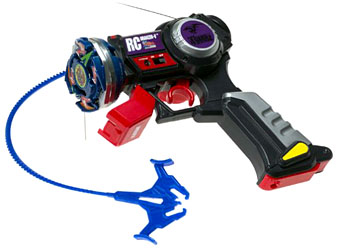
The original photograph brings the launcher into the spotlight: a black-and-red body, an angled gray grip and a long blue ripcord curling beside it. A blue top fits at the front. Together they suggest a performance with a clear beginning—the launch—and a changing middle as the top spins.
What the remote adds to a spinning top
The original Toysit account names three electronic modes: Regular, Accelerate and Counter-Spin. Hasbro’s Dranzer V record uses the same names, and its guide illustrates a trigger that influences the top’s spin after launch. The attraction is the possibility of making another choice while the performance is already underway.
Watching also becomes part of the game. A commentator can describe a broad circle, a change in rhythm or the final slowing movement. Those observations give an announcer something concrete to say, while the player invents the team identity and the crowd’s response.
Try this: Three-beat arena commentary
Divide a page into three scenes: launch, mid-spin and final rest. Draw a top in each scene and give the sequence an announcer’s voice.
- Launch: introduce the team with one short sentence. Choose a name and an emblem, then draw the emblem above the scene.
- Mid-spin: add motion lines and describe the imagined movement. Is the top circling a wide route or making a tight turn?
- Final rest: write a closing line that notices something memorable. The crowd might cheer a graceful finish or thank the visiting team.
Let a second storyteller supply the crowd response. Swap the drawings and read the captions aloud as a tiny sports broadcast. Another round can use the same team with a completely different commentary style.
Keep a real match in its intended setting
For an actual original RC set, use its matching instructions and Beystadium on the floor, keeping faces clear of the stadium. Hasbro’s guide warns against tables and other elevated surfaces. Check the specific top and launcher pairing before play. If adding real observations to the drawings, describe what happened in that session and let the captions tell the rest of the story.
The historical record
Original Toysit coverage
The complete earlier product account and commentary are preserved below as historical coverage.
RC Top from Beyblade
The Beyblade Remote Control Top features three electronic modes: Regular, Accelerate and Counter-Spin. Comes complete with remote-control launcher and ripcord.
The Long History of Spinning Tops
Spinning tops, one of the oldest recognizable toys, have a history that spans cultures and millennia. Their enduring appeal lies in their simplicity and the mesmerizing effect of their movement. Here's a brief overview of their fascinating journey through time:
-
Ancient Origins:
- Historical evidence suggests that tops existed in ancient civilizations. They have been found in archaeological excavations dating back to the times of ancient Mesopotamia, Egypt, and the Indus Valley.
- The ancient Greeks had a top known as a "strombos." Children would wind a string around it and pull to set it in motion. Pottery and artwork from this period often depict scenes of children playing with these tops.
-
Global Popularity:
- Almost every culture has its version of the spinning top. In ancient China, it was a popular pastime, often crafted from bamboo or bone. Japanese tops, known as "koma," have been integral to traditional games and rituals.
- Spinning tops were also prevalent in the Americas. Native American tribes had their variants, often used in games and spiritual ceremonies.
-
Material Evolution:
- Over time, as craftsmanship evolved, so did the materials used for tops. While early tops were made from natural materials like clay, bone, and wood, later versions were crafted from metal, plastic, and other synthetic materials, allowing for more durability and varied designs.
-
Symbolism and Rituals:
- In some cultures, tops held religious or ritualistic meanings. For example, during the Jewish festival of Hanukkah, the dreidel (a type of spinning top) is used in a traditional game that commemorates a significant historical event for the Jewish people.
-
Modern Resurgence:
- The late 20th and early 21st centuries saw a resurgence in the popularity of tops, particularly with the advent of games like Beyblade, which combined the traditional mechanics of top spinning with modern design, customization, and competitive play.
Spinning tops have persisted through ages, continually adapting and finding relevance with each generation. They stand as a testament to the universal appeal of simple, kinetic play, transcending boundaries of time, culture, and geography.
Sources and editorial notes
Hasbro’s official Dranzer V 82622 record and all four scanned guide pages were reviewed visually. The launcher arrangement matches the photographed family, but the image alone does not conclusively identify its top or radio channel, so the title remains generic. The guide supports electronic spin control and floor-stadium precautions, not precise position steering. Complete earlier top history is preserved. No physical testing was performed.
- Original Toysit image — Existing same-site image reviewed and retained unchanged.
- Hasbro Dranzer V RC product record — Official model 82622 record identifies the three electronic modes and provides its guide.
- Hasbro Dranzer V radio-control instructions (PDF) — All four scanned pages read visually; launcher, charging, spin-control diagrams and floor-stadium guidance reviewed. Edition and radio-channel matching are still required for an owned set.
- Original Toysit coverage — Complete historical account retained, including its original claims and wording.

Images and descriptions are retained as historical material. How Toysit covers toys.
Created for Toysit by Tabbloza — the artwork in our header.