
From the Toysit archive
Flavas Dolls: Happy D and Fashion Play
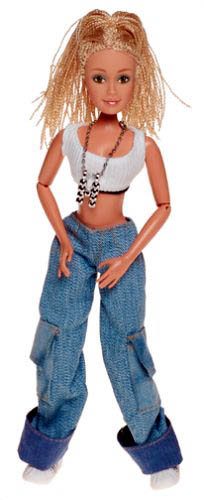
Explore the Flavas doll pictured in Toysit’s archive: Happy D’s high ponytail, cropped top and wide denim trousers, with an original three-scene fashion story activity.
The play at a glance
A high ponytail, wide denim and a pose with personality
Happy D’s blonde hair rises into a high ponytail, with fine strands framing her face. A long necklace falls over her white cropped top. Wide denim trousers, large pockets and deep cuffs give the lower half of the outfit a roomy shape.
Mattel’s original Happy D instructions identify this Flavas character and show her alongside the rest of the crew. Clothing, poses and a backdrop work together to give each doll a place in a small scene.
Read the outfit from top to bottom
The close-fitting top and broad trouser legs create a clear contrast in shape. The necklace adds a long vertical detail, while the pockets and cuffs draw attention to the denim. Happy D’s bent arms give the photograph a relaxed, ready-to-talk pose.
A player might imagine her arriving at a rehearsal or meeting a friend outside a neighborhood shop. Choose one detail to carry into the story: perhaps the necklace is a gift, or a pocket holds an imaginary invitation. These small reasons turn an outfit into part of a character’s day.
A backdrop for the Flavas crew
Happy D’s C1957 instruction sheet illustrates an extra hooded top and trousers, shoes, a bag, a brush and a miniature boombox. It also shows the package display and its hook. The display folds into a standing corner that supports the doll.
A lineup picture places the characters’ displays beside one another to form a longer mural. That suggests a useful scene-making idea: start with one character’s corner, then add another meeting place. A paper wall with a window, a poster or a shop sign can supply a setting for a player-created conversation.
Make a three-scene fashion story
- Draw three panels labeled Getting ready, Meeting up and Heading home.
- Choose an outfit detail to appear in each panel, such as a necklace or a bright top.
- Photograph a doll in a comfortable supported pose, or draw a character, for each moment.
- Add a setting and one line of dialogue to every panel.
- Give the story a title and explain how the character’s plans changed during the day.
This original Toysit activity works with a fashion doll or entirely on paper. The player supplies the events, dialogue and personality.
The historical record
Original Toysit coverage
The original product account and commentary are preserved below as historical coverage.
Fashions that you decorate
The Flavas are a crew of individual, multi-cultural dolls with attitude. Each doll represents authentic Hip-Hop style. In this assortment P. Bo gets dressed to party. P. Bo keeps it real with her two distinct styles - check her out in party and denim and diamonds looks. Ten points of articulation allow kids to give the dolls real attitude and self-expression. Every doll in the Flavas crew is a different height and comes with a fun fashion decal feature, allowing you to customize the look. From theme to theme, each character changes hairstyle, eye color and make-up, while keeping the same face, really allowing their Flava to show.
Sources and editorial notes
All three pages of Mattel’s C1957-0920 G3 Happy D guide and all three pages of the C1952 P. Bo guide were visually reviewed. The labeled lineup and Happy D contents image support identifying the blonde figure in Toysit’s photograph as Happy D. The older paragraph discusses P. Bo, Party and Denim and Diamonds; those words remain in the historical section. Flavas is a Mattel line; the original Bratz-named URL and SSI metadata are preserved. Accessory lists below are attributed to the C1957 guide, whose printed fashions may vary. The storyboard is an original activity; no physical testing was performed.
- Mattel Happy D C1957 instructions (PDF) — All three pages reviewed: named character, contents, display and crew lineup.
- Mattel P. Bo C1952 instructions (PDF) — All three pages reviewed to distinguish the character discussed in the old account.
- Original Toysit coverage — Original photograph, product account and historical commentary preserved.
Images and descriptions are retained as historical material. How Toysit covers toys.
Created for Toysit by Tabbloza — the artwork in our header.