
From the Toysit archive
K’NEX Burnout Dragster
Revisit the K’NEX Burnout Dragster as a buildable radio-control vehicle, with a route-planning and observation notebook that keeps claims separate from tests.
The play at a glance
Build a vehicle, then notice how it responds
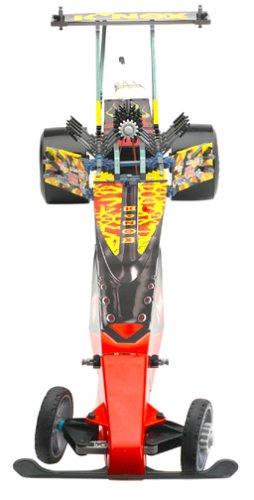
Toysit’s original Burnout account describes a radio-controlled K’NEX vehicle assembled from snap-together pieces. The retained photograph shows a long dragster form, with a narrow front end and larger rear wheels. The appeal joins two activities: making a model and controlling its movement.
A useful way to explore that combination is to record a prediction, observe one simple action and compare the result with the prediction.
Keep the structure and controls in view
The original review emphasizes that steering has to be connected correctly even when the surrounding model changes. That is a useful distinction: decorative choices and working mechanisms do different jobs.
For an actual surviving set, identify the model and controller and use matching instructions before assembly or operation. The old article is not a substitute for its wiring, power or steering directions. No replacement charger or battery pack is recommended here.
Ask a smaller question than “How fast?”
A simple observation might be whether a vehicle follows a planned line or where it starts to turn. Draw the intended route first. After an ordinary, manual-approved run, mark what happened rather than relying only on memory.
Keep the vehicle configuration and surface the same when comparing route attempts. Change a route marker or starting position, not the motor or power supply. A difference in one attempt can suggest another question; it does not establish a performance improvement.
A dragster shape is also a design choice
The long body and rear spoiler make the photographed model recognizable as a racing-inspired vehicle. Ask which parts define that silhouette and which are needed for movement. A sketch lets you explore another outline without changing an old mechanism.
The retained motorsport essay is separate background writing. Its real-world race distances, historical milestones and named series do not define rules or safe operating conditions for this toy.
Make a one-change route notebook
Draw a start, one turn and a finish on paper. Add three headings: my prediction, what I observed and one change to the route. Move a drawn vehicle token along the path and record where the route becomes awkward.
Redraw just one turn or starting position and try again. The same notebook can accompany an appropriate vehicle used according to its own instructions, but the paper version needs no powered toy. This is an independent planning activity, not a Burnout speed test or tuning procedure.
The historical record
Original Toysit coverage
The full original product description and drag-racing essay remain below. Alternate builds, steering performance, frequencies, battery requirements and rechargeable-system compatibility are historical claims, not newly verified operating specifications. The motorsport essay includes dated names and unverified historical or safety generalizations.
Radio Controlled Burnout Dragster by K'NEX.
Design high performance racing models, then take control with r/c action. Full steering, peel out wheels, and protective nose. Instructions to build three models. The beauty of this radio-controlled vehicle is that you assemble it yourself with snap-together pieces. The vehicle can be assembled in any number of different ways, including a dune buggy shape and a scorpion. The great thing about this is that, since you need to build it before you can play, it engages your child actively in the process. In the course of assembling the car, you (or your kid) will learn the rudiments of how a steering system works, since no matter how creative you want to get with the rest of the vehicle, the steering has to be hooked up properly for the thing to work. This dragster comes in two frequencies, 27 MHz and 49 MHz, so if you want to get two and race them, you can do so without the signals conflicting. Requires one 9-volt battery and eight AAs (also compatible with a 9.6-volt rechargeable battery system).
Participate in the feel of Drag Racing
Drag racing, a high-speed motorsport that pits vehicles in a straight-line acceleration contest, has a rich history that spans over a century. From its humble beginnings on back roads to its transformation into a professional sport, drag racing has evolved into a captivating and adrenaline-fueled spectacle. Let's take a closer look at the key milestones and developments in the history of drag racing:
Early Beginnings (1900s-1920s): The origins of drag racing can be traced back to the early 20th century when informal races took place on roads and highways. As automobiles gained popularity, enthusiasts would challenge each other to short, straight-line races to test their vehicles' speed and performance.
Legitimization and the Birth of NHRA (1950s): The 1950s marked a turning point for drag racing as organized events began to take shape. The National Hot Rod Association (NHRA) was founded in 1951 by Wally Parks, providing a platform for enthusiasts to race legally and safely. The first official NHRA event took place at an abandoned airstrip in 1953, solidifying the organization's influence on the sport's growth.
Quarter-Mile Standard: The quarter-mile distance (1,320 feet) became the standard length for drag racing tracks. This distance allowed for thrilling acceleration and intense competition while ensuring safety for drivers and spectators.
Golden Era (1960s): The 1960s saw the drag racing scene explode in popularity. Muscle cars and dragsters gained prominence, and iconic rivalries like the Ford vs. Chevy battles captured the imagination of fans. The sport's televised coverage further contributed to its widespread appeal.
Top Fuel and Funny Cars: The introduction of Top Fuel dragsters and Funny Cars added new dimensions to the sport. Top Fuel dragsters featured enormous engines and incredible speeds, while Funny Cars combined sleek bodies with powerful engines, resulting in impressive displays of speed and spectacle.
Professionalization (1970s): The 1970s marked the transition of drag racing from grassroots events to a professional sport. Corporate sponsorships, prize money, and professional drivers elevated the sport's status. The NHRA's expansion and the rise of the International Hot Rod Association (IHRA) contributed to its global reach.
Modernization and Safety Innovations: The 1980s and beyond saw advancements in safety measures, track improvements, and technological innovations. Modern drag racing tracks are equipped with state-of-the-art safety features, including advanced barrier systems and track preparation techniques that optimize traction.
Professional Series and Records: Professional drag racing series, such as the NHRA Mello Yello Drag Racing Series, showcase the world's fastest cars and most skilled drivers. Records for elapsed time and speed continue to be broken, pushing the boundaries of what is physically and technologically possible.
Electrification and Innovation: In recent years, drag racing has seen innovations in electric and alternative fuel vehicles. Electric dragsters, known for their instant torque, are gaining attention as technology evolves and sustainability becomes a focus.
The history of drag racing is a thrilling narrative of speed, innovation, and community. From its origins as impromptu races on open roads to its status as a professional motorsport with dedicated tracks and safety measures, drag racing has grown into a dynamic and captivating pursuit that continues to capture the hearts of enthusiasts worldwide.
Sources and editorial notes
This profile preserves Toysit’s original Burnout text and image. Research located a period manufacturer circuit-document lead associated with model 15128, but no matched consumer operating and assembly guide was secured. A circuit diagram does not establish the exact photographed edition or provide suitable owner instructions. The original frequency, power and alternate-build details remain attributed. No vehicle, controller, speed or learning outcome was tested.
Images and descriptions are retained as historical material. How Toysit covers toys.
Created for Toysit by Tabbloza — the artwork in our header.