
From the Toysit archive
Complete Art Supply Case
Explore the Imaginarium art caddy through its portable case and spread of colorful supplies, then plan a small studio for making illustrated postcards.
The play at a glance
A little workshop packed into a carrying case
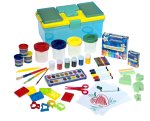
A green case with a yellow handle sits behind a spread of colorful art supplies in Toysit’s photograph. Paint containers stand in rows, brushes lie beside drawing tools, and small shapes fill the foreground. The whole arrangement suggests an afternoon of choosing, making and packing away.
The original account names the Deluxe Art Caddy by Imaginarium and describes crayons, markers, paints, chalk, brushes, sponges and dough. Its portable-studio idea begins with a simple question: which few materials would you bring out for the picture you want to make?
Choose a project, then choose the tools
Imagine making a postcard of a garden. A pencil can mark the path, a green crayon can build a patch of leaves, and a bright color can pick out three flowers. Set those tools beside the paper so the picture has room to grow.
A different postcard might call for a different selection. A night sky could use a dark background and a few bright dots. A street scene could begin with repeated rectangles for doors and windows. The subject gives the maker a reason to choose particular colors and marks.
Give the supplies a home
Draw a simple map of an imaginary art case. Make one space for long drawing tools, another for color containers and a flat area for paper. Add a small symbol to each space: a pencil, a paint pot or a sheet with a folded corner.
Picture the end of the session, too. The finished postcard can go beside the case while the tools return to their places. Keeping one drawing nearby gives the next session a starting point: another view of the garden, or a reply from the person who received it.
Plan a portable postcard studio
- Choose a place to draw on a postcard, real or imagined.
- Sketch the picture using a few large shapes.
- List or draw three tools you would use to finish it.
- Draw a case with a place for each tool and for the paper.
- Add a short message to the postcard and give the case its own studio name.
This original Toysit activity uses paper and ordinary drawing materials. For a physical art session, choose supplies suited to the maker and follow their own use and cleanup labels.
The historical record
Original Toysit coverage
The original product account and commentary are preserved below as historical coverage.
Deluxe Art Caddy by Imaginarium
An arts and crafts extravaganza! Poster paints, crayons, markers, paint brushes, paper, non-spill pots, plastic art caddy and more are included. Take a big, sturdy plastic case, pack it with interesting art supplies, and see the perfect solution for rainy-day doldrums. This 148-piece kit includes 64 crayons, six markers, a box of colored chalk, some watercolors, six poster paints with non-spill paint pots, and a collection of brushes and sponges. Twelve small sheets of paper and a pair of not-so-sharp safety scissors are included as well. When kids have had enough of drawing and painting, they can try out the three tubs of play dough, which come with a dough knife, four cutting shapes, and some miniature molds. Though the materials seem mainly geared toward preschool and early elementary-aged children, the colorful caddy itself--with its easy-open clasp, sturdy carrying handle, and three bonus compartments built into the lid--makes a terrific storage box for art supplies of all kinds. The case is not intended for kids under the age of 3 because of small parts.
Benefits of Keeping Children Stocked with Art Supplies
Providing children with a steady supply of art materials goes beyond simply keeping them occupied—it nurtures their creativity, cognitive development, and emotional well-being. Keeping art supplies readily available offers a host of valuable benefits:
Stimulates Imagination: Art supplies become a gateway to a world of imagination. Children can transform simple materials into endless possibilities, encouraging imaginative thinking and creative play.
Expressive Outlet: Art provides a safe and expressive outlet for children to communicate feelings, thoughts, and experiences that might be challenging to express verbally. It allows them to process emotions and gain a better understanding of themselves.
Enhances Motor Skills: Engaging with art supplies—whether drawing, painting, or sculpting—supports the development of fine motor skills, hand-eye coordination, and manual dexterity. These skills are crucial for various everyday tasks and academic pursuits.
Promotes Problem-Solving: Art encourages children to experiment, make decisions, and find solutions. They learn to approach challenges with an open mind and develop critical thinking skills as they navigate through different artistic processes.
Fosters Confidence: The ability to create something unique boosts children's self-esteem. Completing an art project gives them a sense of accomplishment, reinforcing their belief in their capabilities and encouraging them to take creative risks.
Cognitive Development: Engaging in art activities enhances cognitive functions such as spatial reasoning, pattern recognition, and memory. It contributes to well-rounded brain development and prepares children for academic success.
Social Skills: Sharing art supplies with peers or siblings encourages cooperation, negotiation, and collaboration. Group art projects teach children how to work together, share ideas, and respect differing perspectives.
Attention and Concentration: Immersing themselves in art requires sustained focus and concentration. Practicing mindfulness while creating art can help children develop these skills, which are valuable for academic learning and beyond.
Catharsis and Relaxation: Art provides a therapeutic outlet for stress and anxiety. Engaging in artistic activities allows children to unwind, express their emotions, and experience a sense of relaxation and inner calm.
Cultural Appreciation: Exploring different art materials and techniques exposes children to diverse cultures and art forms. They learn to appreciate and respect various artistic traditions and viewpoints.
Valuable Life Skills: Art fosters adaptability, resilience, and a willingness to experiment—a mindset that extends beyond the art studio into other areas of life. These skills equip children to approach challenges with creativity and confidence.
Keeping children stocked with art supplies is a meaningful investment in their holistic development. It nurtures their creativity, emotional expression, cognitive skills, and social interactions, fostering a lifelong appreciation for the power of imagination and self-expression.
Sources and editorial notes
This profile draws on Toysit’s original photograph and Imaginarium product account. The 148-piece count, full inventory and original age guidance remain attributed to that account; matching packaging and complete directions were not recovered. This is a separate recorded product from the Totally Me caddy on Art Supply Kit. The postcard-studio activity is an original editorial idea. No physical testing occurred.
- Original Toysit image — Existing same-site photograph reviewed and retained unchanged.
- Original Toysit coverage — Complete original product account and historical commentary preserved.

Images and descriptions are retained as historical material. How Toysit covers toys.
Created for Toysit by Tabbloza — the artwork in our header.