
From the Toysit archive
Cootie Jitterbug
Meet Cootie Jitterbug, the lively bug game with colored balls and catchers, and imagine its next outing with an original picnic-report activity.
The play at a glance
A bug with a very busy back
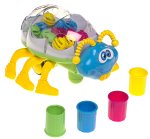
Cootie Jitterbug looks ready to scamper into a cartoon picnic: a blue face, curly yellow antennae and a round shell dotted with openings. Players collect their colored balls and drop them into the bug’s back while its lively movement sends balls tumbling out again. The round is a chase between gathering, dropping and watching what stays inside.Catch a color and watch the shell
The game’s little cylindrical catchers give each player a color to follow. The matching guide describes twelve balls, three in each of four colors, and an objective of getting all three of your color into Cootie’s back. The first player to do that and stop the bug wins.
A ball that has just gone in may soon be out again. That repeating catch-and-drop action gives the toy its comedy: the bug seems determined to rearrange everyone’s work. Its motion is the game’s mechanism; any mischievous thoughts or picnic plans are a story the players can supply.
Report from the bug picnic
Original Toysit activity: when a round is finished, switch the bug off and gather its pieces. Imagine that each catcher’s color represents a place Cootie hopes to visit. Green might be a meadow, blue a shady pond path, yellow a sunny garden and pink a flower patch.
Each player supplies one sentence for a picnic report: “At the meadow, Cootie tried to balance a leaf-shaped sandwich.” Draw the destinations on a shared paper page and connect them with a wandering dotted trail. Add a funny explanation for why the picnic kept bouncing around.
Keep pretend food and paper on the drawing page. The toy uses its own game balls. For a quiet version, draw a bug with three spots and invent a short story about three visitors arriving for lunch; no powered toy is needed.
Give the bug a clear play space
The matching guide calls for adult supervision and cautions that hair can become caught in moving wheels. Keep hair clear, use the supplied balls and leave water and other objects out of the toy. Follow the original guide’s age and small-ball warnings. An uncluttered floor area makes it easier to see where the pieces go and to collect them when the game ends.
The historical record
Original Toysit coverage
The original product account and commentary are preserved below as historical coverage.
Cootie Jiggerbug is a great toy.
This fast-paced game will have players of all ages scrambling to scoop up bright plastic balls and drop them into Cootie's back. The catch is that Cootie will be scrambling just as hard to toss them back out. Pop in two C batteries (not included), make sure you have plenty of room, scatter the colored balls on the floor, turn Cootie on, and let the fun begin. Variations on how the balls are gathered can be determined for different ages. Easy assembly only requires the jitterbug's six legs to be slipped into place before play. Instructions in English and Spanish are included.
Toys shaped like bugs have a special allure for children, capturing their curiosity and sparking imaginative play. These insect-inspired toys offer a range of reasons why they're so appealing and captivating:
Natural Curiosity: Children are naturally curious about the world around them, including insects. Toys shaped like bugs allow them to explore these creatures up close, satisfying their curiosity and prompting questions.
Unique Aesthetics: Insects come in a dazzling array of shapes, colors, and patterns. Toys that replicate these features intrigue children by presenting them with the intricate and visually captivating world of insects.
Adventure and Exploration: Bug-themed toys encourage children to embark on imaginary outdoor adventures, fostering a connection to nature and inspiring role-playing scenarios where they can be bug explorers or scientists.
Hands-On Learning: Bug toys often come with educational elements that teach children about different insect species, their habitats, behaviors, and the role they play in ecosystems.
Textured Sensations: Many bug-themed toys have tactile features like raised patterns or soft textures that engage children's sense of touch, adding an interactive dimension to play.
Imaginative Storytelling: Bugs have a place in countless stories and myths. Bug-shaped toys invite children to weave imaginative narratives that involve magical insects, heroes, and daring quests.
Development of Empathy: Through bug toys, children can develop empathy and a sense of care for the natural world. They might create scenarios where they help injured toy insects or build bug habitats.
Cognitive Exploration: Bug-themed toys introduce children to concepts like categorization (identifying different bug types), counting (how many legs does a spider have?), and cause-and-effect (what happens when bugs interact with their environment?).
Outdoor Connections: Bug toys can inspire children to venture outdoors and observe real insects, connecting their playtime with real-life exploration and sparking a fascination with the natural world.
Collectibility: Some bug-themed toy lines offer a variety of insect figures to collect, encouraging children to learn about different species and engage in imaginative play that incorporates their growing collection.
Sense of Adventure: Bugs evoke a sense of adventure and mystery, making them perfect companions for imaginative play where children can go on bug-hunting expeditions or create bug-themed stories.
Curious Science: Playing with bug toys can spark an interest in entomology—the study of insects—and foster a lifelong fascination with the scientific world.
Toys shaped like bugs tap into children's innate curiosity about nature, their sense of adventure, and their boundless imagination. These toys offer a gateway to learning, storytelling, and exploration, making them cherished play companions that inspire both fun and fascination.
Sources and editorial notes
The complete three-page Spanish Hasbro/Milton Bradley guide, marked 41383-IS and ©1999, was visually reviewed. Its bug, catchers and shell diagrams match the original design; it supports the color-matching objective and play described here. An English guide was not recovered. The preserved insect-toy essay contains broader nature and developmental commentary. The picnic story is an original Toysit suggestion; no physical testing or developmental outcome is claimed.
- Original Toysit image — Existing same-site photograph reviewed and retained unchanged.
- Hasbro Cootie Jitterbug instructions, Spanish — Complete three-page manufacturer guide visually reviewed; 1999 copyright, shell and catcher diagrams, color objective and practical cautions.
- Original Toysit coverage — Complete original product account and historical commentary preserved.

Images and descriptions are retained as historical material. How Toysit covers toys.
Created for Toysit by Tabbloza — the artwork in our header.