
From the Toysit archive
Crazy Legs Learning Bug: a rolling character with shapes to match
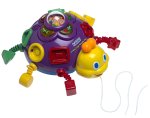
A purple bug with springy-looking legs, colorful shaped feet and a cheerful yellow face invites a little journey between shapes.
The play at a glance
A character with shapes at its feet
A yellow face peeks out from a rounded purple shell. Red, green and yellow legs spread around it, ending in differently shaped pieces. A pale cord trails in front, while the shell carries colorful controls and a small figure on top.
Toysit’s original account presents it as a rolling pull toy with six shape-sorter feet and four light-up letter buttons. That combination gives the bug two kinds of attention: looking closely at a foot’s outline, then choosing where the character will go next.
A small journey with a shape at each stop
The bug’s outline makes a useful starting point for a shared look: a broad shell in the middle, a face at the front and colorful feet around the edge. Point to a curved outline, then to one with corners. A player might imagine that each foot has its own destination in a tiny garden.
The character’s travel story can be as simple as a visit, a pause and a return home. Let the player supply a greeting or a reason for stopping. The toy provides the character and shapes; the conversation belongs to the people playing.
Try a bug’s shape itinerary
An original Toysit activity: make a short route whose stops match shapes you can see on the bug.
- Draw three large outlines on a sheet of paper, choosing shapes from the toy’s feet. Give each outline a pretend destination, such as a garden, pond or home.
- Point to one destination and then to the matching foot. Keep the attached pieces with the toy.
- With an adult, move the bug a short distance toward that destination using the handling allowed by its own instructions. Pause and give the character a greeting.
- Choose the next stop together. Finish by pointing out the route home.
A drawn paper bug can make the same journey across the sheet. Add its feet with a pencil, then move the whole drawing from stop to stop. This version keeps the focus on outlines and storytelling.
Make room for a close look
For play with the physical toy, an adult should check its condition and use the instructions belonging to that edition for setup and cord handling. Choose a clear, level play area and stay nearby. The paper route also works as a stationary pointing game.
The historical record
Original Toysit coverage
The original product account and commentary are preserved below as historical coverage.
ABC Bug by VTech Industries
Roll-along pull toy features engaging character with six shape-sorter feet. Friendly, silly character teaches shapes, letter identification, and colors. 4 light-up buttons teach A, B, C, D. Promotes motor skill development and independent play. Include volume control and auto-shut off.
Shape-sorting toys are not only fun and engaging but also offer a multitude of cognitive, motor, and developmental benefits for young children. These interactive toys encourage learning and skill-building while captivating children's attention. Here are some of the key advantages of shape-sorting toys:
Cognitive Development: Shape-sorting toys promote cognitive growth by requiring children to recognize and differentiate between various shapes, improving their spatial awareness and visual discrimination.
Problem-Solving Skills: Children learn problem-solving skills as they figure out which shape fits into each corresponding slot, fostering critical thinking and logical reasoning.
Fine Motor Skills: Manipulating the different shapes and inserting them into the correct slots enhances fine motor skills and hand-eye coordination, aiding in the development of dexterity and precision.
Hand-Eye Coordination: As children maneuver the shapes to fit through the appropriate openings, they refine their hand-eye coordination and spatial coordination.
Color Recognition: Many shape-sorting toys are also color-coded, helping children develop color recognition skills as they match shapes to their corresponding colors.
Shape Recognition: Children become proficient in identifying shapes, which lays the foundation for more complex mathematical concepts later on.
Language Development: Playing with shape-sorting toys encourages conversations about shapes, colors, and spatial relationships, supporting language development and vocabulary expansion.
Concept of Matching: Shape-sorting toys teach children the concept of matching as they find the correct shape that corresponds to each slot, reinforcing the idea of similar characteristics.
Sensory Exploration: Manipulating the shapes and fitting them into the openings engages multiple senses, fostering sensory exploration and tactile learning.
Concentration and Focus: The task of finding the right shape and guiding it into the correct slot promotes concentration and sustained focus as children work to complete the activity.
Confidence Boost: Successfully matching shapes and completing the task gives children a sense of accomplishment and boosts their self-esteem.
Independence: Shape-sorting toys encourage independent play, allowing children to explore and learn at their own pace while gaining a sense of autonomy.
Early Mathematical Concepts: The foundation laid by shape-sorting toys can pave the way for understanding more complex mathematical concepts, such as geometry and spatial relationships.
Preparation for School: The skills developed through playing with shape-sorting toys provide a strong foundation for future academic success, particularly in subjects related to math and problem-solving.
Social Interaction: Shape-sorting toys can also be enjoyed in a group setting, fostering social interactions, cooperation, and sharing among children.
Shape-sorting toys are versatile and effective tools for early childhood development. They engage children's minds, refine their motor skills, and lay the groundwork for essential cognitive and mathematical abilities, all while offering hours of enjoyable playtime.
Sources and editorial notes
This profile uses the original image and attributed product account. An exact guide for the pictured ABC Bug/Crazy Legs edition was not recovered; later Crazy Legs Learning Bugs guides describe other versions. The earlier A–D button, volume and shutoff claims remain attributed. The historical developmental-benefits essay is preserved as commentary, not evidence of measured outcomes. No physical testing was performed.
- Original Toysit image — Existing same-site photograph reviewed and retained unchanged.
- Original Toysit coverage — Complete original product account and historical commentary preserved.

Images and descriptions are retained as historical material. How Toysit covers toys.
Created for Toysit by Tabbloza — the artwork in our header.