
From the Toysit archive
Cranium
Share drawing, acting, wordplay and trivia challenges while keeping the original Cranium edition distinct from later boards.
The play at a glance
Give different talents a turn at the table
Cranium moves between different kinds of tasks: a sketch, a performance, a word problem or a factual question. Teams have to communicate as well as know an answer.
The original account describes four character decks and credits illustrator Gary Baseman for the artwork. That illustrated older board remains here alongside practical advice for sharing the challenges.
Notice what each category asks you to do
The four decks in the original account have distinct roles: Creative Cat covers visual making, Star Performer covers performance, Word Worm focuses on words, and Data Head deals with knowledge questions.
Those headings describe a mix of activities, not a promise that every player enjoys all of them. Before starting, look at sample cards so the group knows whether the game’s reading, cultural references and public performance suit the evening.
Give each turn a clear beginning
First establish which category applies under your edition’s rules. Read the challenge, identify who will give the clue and who may answer, and get the needed materials ready before starting its timer.
Follow the card’s restrictions. A task that requires drawing with eyes closed is different from ordinary drawing; a clue that permits humming may still forbid words. A brief reminder before the attempt is more useful than arguing about the restriction afterward.
Share the visible and quiet jobs
A confident performer can still leave room for someone else to act. Rotate the clue-giving when the rules allow it, and invite quieter teammates to contribute guesses without demanding a performance they do not want.
For a relaxed session, agree in advance on an option to pass a task or swap the performer. These are house rules and can change the competition. Apply them consistently to every team. A short unscored practice round can also help a new player understand the kinds of clues.
Match the route and finish to the edition
The preserved account describes completing an activity from each deck at Cranium Central. The linked later Hasbro sheet instead uses one final activity and an adjustable folding board. Do not combine those endgames or import that board’s short-game settings into the older set.
Keep the rules with the matching board and cards. If a secondhand set has mixed parts, identify it before choosing movement rules or an expected playing time. Cadoo is another distinct game, with token placement and a four-in-a-row goal rather than this route around a board.
The historical record
Original Toysit coverage
The original description, Gary Baseman artwork attribution and complete later essay remain below. Its 14-activity inventory and four-deck finishing account belong to that coverage. Later Cranium rule sheets use different boards and endgames; the general benefit claims are not tested findings.
Spell a word backwards, hum a tune, answer a multiple-choice question, draw with your eyes closed, and more when you play Cranium.
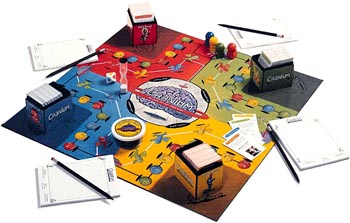
Spell a word backwards, hum a tune, answer a multiple-choice question, draw with your eyes closed, and more when you play Cranium. Unlike games that focus on only a few skills, Cranium offers 14 talent-tapping activities designed to bring out the best in you and your friends. Cards from four decks, color-coded to match each of the crazy characters--Star Performer, Creative Cat, Data Head, and Word Worm--describe activities that teams must complete in order to advance around the board. If you choose a Sculptorades card from the Creative Cat deck, for example, you might be asked to sculpt a hamburger from lemon-scented Cranium Clay while your teammates try to guess what you're creating. To win the game, teams have to make it to Cranium Central--the large purple brain in the center of the board--and then successfully complete one activity from each of the four decks. The result is that the team with the best combination of abilities comes out on top. With its wonderfully diverse set of activities and top-notch design (artwork by illustrator Gary Baseman decorates the colorful board and decks of cards), Cranium offers the best of all board game experiences--and it's a whole lot of fun, too. (For 4 or more players)
Cranium is a dynamic and engaging board game that challenges players to exercise their creativity, problem-solving skills, and diverse talents through a variety of entertaining activities. This thinking game offers a unique blend of challenges that cater to players' diverse strengths and encourage cooperative play. Here's an overview of what makes Cranium a captivating and entertaining experience:
Multi-Dimensional Gameplay: Cranium combines a wide range of activities, including wordplay, sketching, acting, and trivia. This multi-dimensional gameplay ensures that each player can contribute their expertise and enjoy a well-rounded experience.
Team Collaboration: Players divide into teams, fostering a collaborative atmosphere where everyone's skills come together to conquer challenges. It's a game that celebrates shared accomplishments and encourages teammates to support one another.
Four Categories: Cranium features four distinct categories—Creative Cat, Data Head, Star Performer, and Word Worm—each designed to showcase different aspects of players' abilities. This variety keeps the gameplay fresh and exciting.
Artistic Expression: Activities like sketching and sculpting encourage players to channel their inner artists, translating concepts and ideas into visual forms. This creative aspect adds a unique dimension to the game.
Quick Thinking: Some challenges in Cranium require fast thinking and quick responses, keeping players on their toes and challenging their ability to think on the spot.
Word Puzzles: Word-based challenges, riddles, and trivia questions test players' language skills, vocabulary, and general knowledge, providing a mental workout that's both entertaining and educational.
Physical Challenges: Acting out scenarios, miming, and completing physical tasks infuse energy and excitement into the game. These challenges encourage players to step out of their comfort zones and embrace a bit of silliness.
Unlocking Creativity: Cranium celebrates the power of imagination and creativity. Whether you're sculpting with clay, humming a tune, or spelling a tricky word backward, the game encourages players to approach challenges in inventive ways.
Laughs and Entertainment: The game's diverse activities often lead to hilarious and memorable moments, fostering laughter and creating lasting memories among players.
Family-Friendly Fun: Cranium's inclusive gameplay makes it suitable for a wide age range, ensuring that family and friends of all backgrounds can join in the fun and enjoy quality time together.
Strategic Decision-Making: Players must strategically choose their challenges based on their team's strengths, adding an element of tactical thinking to the game.
Cranium is a thinking game that invites players to showcase their diverse talents, work collaboratively, and celebrate the joy of creativity and imagination. It's an entertaining way to engage with friends and family, fostering laughter, camaraderie, and a healthy dose of friendly competition.
Sources and editorial notes
Reviewed October 15, 2026 against the original source and image. Hasbro’s product 16577 instructions describe Cranium 2.0 with an adjustable board and a single final activity, unlike the older account’s finishing sequence. They corroborate the broad team-and-category format, not the exact pictured edition’s movement, timing, inventory or endgame. Suggested participation changes are house rules. No physical game was tested.
- Hasbro: Cranium 16577 instructions (PDF) — Later adjustable-board edition; use its edition label when comparing rules.
Images and descriptions are retained as historical material. How Toysit covers toys.
Created for Toysit by Tabbloza — the artwork in our header.