
From the Toysit archive
Donkey Konga and DK Bongos
Two barrel-shaped DK Bongos turn hand taps and claps into rhythm-game input, with an original two-barrel echo greeting.
The play at a glance
Two little barrels invite a reply
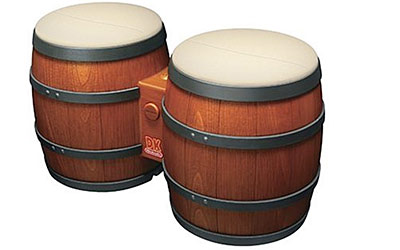
The paired drums sit side by side like a tiny percussion station. Pale heads stand out against dark rims and brown barrel shapes, with the DK mark between them. Their arrangement makes left and right feel like two voices that can answer each other.
Hands, a clap and a rhythm on screen
Donkey Konga pairs the game’s musical prompts with the DK Bongos controller. Nintendo’s hardware guide identifies a left drum head, a right drum head and a clap sensor between them. A light touch supplies the input; the controller does not need hard blows.
The guide calls for a stable surface or a comfortable position on the player’s lap, and the specified connection to compatible GameCube equipment. Use hands on the drum heads. Keep sticks and other hard objects away from this controller.
Invent a two-barrel echo greeting
With gameplay paused, imagine two neighbors calling across a little island harbor. Speak a short greeting with a clear rhythm: “Good morning, boat!” One player marks the greeting with gentle left and right hand taps, then leaves a space for an answer.
A companion answers with soft taps on their own knees and a new line: “The tide is low!” Try a quiet clap at the end of a greeting, followed by a pause. Agree on a comfortable volume and let the reply be as simple as the invitation.
After a few exchanges, draw the two neighbors and their boats. Add speech bubbles containing your own greetings. When you return to the game, let its prompts guide the controller again. Your harbor conversation remains an extra story you made together.
The historical record
Original Toysit coverage
The complete earlier product account and commentary are preserved below as historical coverage.
Nintendo Game Cube bongo drum music rhythm game is played to the beat through a drumming controller interface
Join Donkey Kong and Diddy Kong as they drum and clap their way through hits old and new in a Game Cube music and rhythm game. One day, DK and Diddy discover a pair of odd barrels on a deserted beach. They learn the barrels are really a legendary musical instrument that plays music not only when you drum on it, but also when you clap. Play along with your favorite tunes using the bongo drum controller. The simple controls incorporate both drumming and clapping for a unique experience that will appeal to gamers of all ages.
History of Bongo Drums
Bongo drums, also known simply as bongos, have a rich and vibrant history that spans cultures and continents. These small, hand-played drums have played a significant role in music and cultural expression over the years:
The roots of bongo drums can be traced back to various indigenous cultures in West Africa, particularly among the Bantu-speaking people. These cultures used small drums made from hollowed-out logs to accompany rituals, ceremonies, and social gatherings.
During the transatlantic slave trade, African rhythms and drumming traditions were carried to the Americas, where they merged with local music and cultural practices. In Cuba, bongo drums evolved from the traditional drums of the Yoruba and other African groups, adapting to the new environment and influences.
By the late 19th century, bongos had become an integral part of Afro-Cuban music, particularly in genres like rumba, son, and mambo. Bongos were played alongside other percussion instruments to create intricate rhythms that became the heartbeat of Cuban music.
In the mid-20th century, bongos gained international recognition and popularity as Latin music spread to the United States and beyond. Musicians like Desi Arnaz, Tito Puente, and Mongo Santamaría showcased the dynamic sounds of bongos in jazz, salsa, and other genres.
Bongo drums found their way into various styles of music, from rock 'n' roll to world music, as artists experimented with cross-cultural fusion. Their portable and expressive nature made them a versatile instrument in both traditional and contemporary settings.
Bongo drums' influence extended beyond music. They became symbols of cultural identity and pride, representing the rich heritage of Afro-Cuban traditions and their impact on global music.
Today, bongo drums continue to be used in a wide range of musical genres and contexts. Their distinctive sound adds depth and rhythm to compositions, and they remain a cherished instrument for both professional musicians and enthusiasts around the world. Bongo drums are a testament to the enduring power of music to transcend borders and connect cultures.
Sources and editorial notes
Nintendo’s complete two-page DK Bongos accessory guide was read and its diagrams reviewed. It supports light hand taps, the clap sensor and compatible Nintendo GameCube games. A separate Donkey Konga game-booklet download was blocked, so new copy does not rely on unverified mode or song-list details. The full beach story and bongo-history essay remain historical coverage. The echo greeting is an original Toysit activity; no physical testing was performed.
- Original Toysit image — Existing same-site image reviewed and retained unchanged.
- Nintendo DK Bongos accessory instructions (PDF) — Complete two-page multilingual hardware guide; English operation text, drum/clap diagrams and handling cautions reviewed.
- Original Toysit coverage — Complete historical account retained, including its original claims and wording.

Images and descriptions are retained as historical material. How Toysit covers toys.
Created for Toysit by Tabbloza — the artwork in our header.