
From the Toysit archive
e-kara Karaoke
A microphone-shaped karaoke player turns a compatible television into a lyric screen, with an original imaginary-venue introduction activity.
The play at a glance
The microphone carries the show
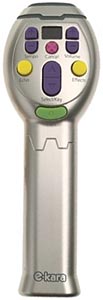
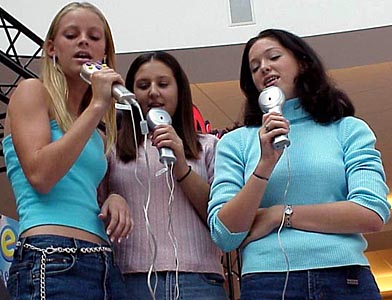
The long silver microphone puts a cluster of colorful controls beneath the singer’s hand. In the original photographs, performers gather around wired microphones or stand ready for a solo turn. The little unit suggests a living-room show with an announcer, a singer and someone waiting to applaud.
A song has a screen and a place to begin
The documented e-kara uses a song cartridge and a cable to a compatible television or video system. The screen supplies lyrics while the microphone carries the voice. The guide describes adjustments for tempo, key, echo and voice effects, giving a singer several ways to shape a turn.
Have an adult match the unit, cartridge, connections and display to the instructions before play. The guide specifically warns against connecting to projection televisions. Give the singer a clear place to stand, with cables out of the walking route.

Welcome everyone to an imaginary venue
Before selecting a song, invent a place for the show: the Lantern Theater, a rooftop garden or a stage on a friendly space station. Draw its name on a paper ticket and place it away from the equipment.
One person becomes the announcer and offers an original spoken welcome: “Tonight the garden lights are glowing, and our first singer is ready.” The singer can choose a stage name and decide how to greet the audience. Keep the introduction short so the song has its own entrance.
After the turn, the audience adds one remembered moment to the ticket: a cheerful greeting, a funny voice effect or a confident final bow. Switch announcer and singer for the next performance. The collection of tickets becomes a record of the venues you imagined together, without needing to record the singing.
The historical record
Original Toysit coverage
The complete earlier product account and commentary are preserved below as historical coverage.
Plug e-kara into your TV, pop in a cartridge and you can live out your Pop Diva fantasies every day
E-kara Karaoke by Hasbro - E-kara is the first truly portable handheld karaoke system that simply plugs into a television. This main unit includes everything needed to get started: a microphone with features, wires for fast and easy television hookup, and a cartridge featuring five songs from Britney Spears, Destiny's Child, Backstreet Boys, and the Beatles. The product offers great music quality and easy setup allows singers to start the fun right away--all you have to do is plug the E-kara microphone into a TV, pop in a cartridge, and pick your favorite song. Lyrics will appear on your TV screen while you belt out the tunes! E-kara also includes great features that let you add echoes (sing in the shower or from a mountain top), change tempo, and more. The best part is that you can take it anywhere.
The Evolution of Portable Karaoke Machines
The evolution of portable karaoke machines reflects the intersection of technology, entertainment, and the desire for interactive musical experiences. From humble beginnings to advanced digital systems, here's how these devices have transformed over the years:
Analog Beginnings: Portable karaoke machines trace back to the late 1970s and early 1980s, characterized by analog cassette tape players and basic microphone inputs. These early models often had built-in speakers and a simple microphone, allowing users to sing along to pre-recorded backing tracks.
Compact Disc Era: With the rise of compact discs (CDs) in the 1990s, portable karaoke machines incorporated CD players, offering improved sound quality and a wider range of song choices. Users could swap out CDs containing various karaoke tracks, expanding their repertoire.
Integrated Screens: In the late 1990s and early 2000s, portable karaoke machines began integrating small screens, typically monochrome, to display lyrics. This eliminated the need for external monitors or relying solely on printed lyric sheets, enhancing the user experience.
Digitization and MP3: As digital technology advanced, portable karaoke machines transitioned from CDs to digital formats like MP3s. Users could now load a variety of songs onto memory cards or internal storage, offering more convenience and reducing the need to carry multiple CDs.
Connectivity and Smart Features: The mid-2000s brought connectivity options to portable karaoke machines. Some models included USB ports, allowing users to connect to computers and download new songs. Some even had Bluetooth capabilities, enabling wireless connections to smartphones and tablets.
Touchscreens and App Integration: In recent years, portable karaoke machines have embraced touchscreen technology. Some models come with integrated touchscreens, while others allow users to connect their smartphones or tablets via apps. These apps provide access to vast song libraries and offer interactive features.
Wireless Microphones: Modern portable karaoke machines often come with wireless microphones, allowing performers more mobility and eliminating the constraints of cords. This innovation enhances the overall experience and encourages dynamic stage presence.
Multi-Functionality: Contemporary portable karaoke machines have evolved into multi-functional entertainment systems. They can function as speakers for playing music from various sources, such as smartphones and tablets. Some models even include built-in disco lights to create a complete party atmosphere.
Enhanced Audio and Effects: Advancements in audio technology have led to improved sound quality, built-in equalizers, and effects like reverb and echo. This enhances the vocal performance and offers users more control over their sound.
Compact and Stylish Designs: The evolution of portable karaoke machines has also brought about sleek, compact, and aesthetically pleasing designs. These devices are now highly portable and visually appealing, suitable for various settings and occasions.
From analog cassette players to digital touchscreens, the evolution of portable karaoke machines mirrors the progression of technology and the desire for immersive, interactive, and enjoyable musical experiences. As these devices continue to adapt to the digital age, they remain a popular source of entertainment for people of all ages.
Sources and editorial notes
Hasbro’s complete two-page Takara e-kara 11504 guide was read and its diagrams reviewed. It documents a cartridge-based microphone unit and compatible audio/video input connections; the older “any TV” wording should not be read as universal compatibility. Extra microphone functions depend on the appropriate accessories. The venue introduction is an original Toysit activity. No physical testing was performed.
- Original Toysit image — Existing same-site image reviewed and retained unchanged.
- Takara e-kara instructions, hosted by Hasbro (PDF) — Complete two-page 11504 guide: cartridge, controls, input connections and setup diagrams reviewed.
- Original Toysit coverage — Complete historical account retained, including its original claims and wording.

Images and descriptions are retained as historical material. How Toysit covers toys.
Created for Toysit by Tabbloza — the artwork in our header.