
From the Toysit archive
My Cheerios Learning Mats: letters and numbers across the table
Three bright yellow-bordered mats bring large letters, numbers and picture spaces to a tabletop, with room for a pretend menu of your own.
The play at a glance
A tabletop full of letters and numbers
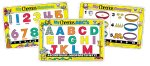
The small original image shows three mats with bright yellow borders: one filled with colorful uppercase letters, one with large numerals and one with outlined spaces and pictures. The repeated border gives the different pages the look of a little set.
Toysit’s earlier description identifies it as the My Cheerios Learning Mats 3-Pack, covering uppercase letters, counting and numbers. The large printed symbols make a starting point for pointing, naming and inventing a tabletop game together.
Pick a symbol and build a small scene
A letter or number can give a pretend table a purpose. A large A might become the first letter on an apple menu; a visible 3 might suggest drawing three cups for guests. Point to a symbol together, then decide what picture would go with it.
Keep the mat as a reference and make new drawings on a separate sheet. This gives the player room to invent a menu, change an order or add a guest while the printed letters and numbers stay in view.
Try a tabletop picture menu
An original Toysit activity: use a letter or number to begin a pretend order.
- Choose a clearly visible letter or number on a mat. Point to it and name it together.
- Make a paper menu with a matching picture: an apple for A, for example, or a small group of cups for a number.
- Invite a pretend customer to choose from the menu. Draw the order on another part of the paper and describe what is being served.
- Swap roles. The next customer might choose a different symbol or ask for a new picture.
All the food and cups in this game can be drawings. A handmade alphabet or number sheet works as the reference, too. For younger players, an adult can draw while the player points and chooses.
A place for an unhurried conversation
A single symbol is enough for a round. Let a player stay with a favorite picture or turn it into a story about the guests at the table. For writing or cleaning an original mat, follow its own product directions; the paper menu can hold all the new marks.
The historical record
Original Toysit coverage
The original product account and commentary are preserved below as historical coverage.
ABC, counting, and numbers place mats
My Cheerios Learning Mats 3-Pack includes uppercase ABC's, Counting and Numbers place mats that are interactive with Cheerios for fun, wholesome learning. These are a perfect vehicle for teaching children ages 2-6 to identify and write uppercase ABC's and numbers 1-20 and learn basic counting skills. Children can use Cheerios or washable markers and crayons to trace letters and numbers. These exciting 2 - sided reusable learning mats will encourage any child with their creative illustrations and activities. The high quality lamination make them durable, easy to clean and use over and over during breakfast, lunch, dinner or anytime. They also come with parent tips for added learning and value.
Educational Benefits of Placemats
Visual Learning: Placemats often feature vibrant images, maps, or diagrams that engage visual learners. These visuals can aid in understanding concepts, such as geography, anatomy, or the solar system, by providing visual cues and context.
Language Development: Placemats with letters, numbers, and words can enhance language skills. Children can practice reading, spelling, and vocabulary while interacting with the content during meals.
Math Skills: Placemats that incorporate math exercises, such as counting, addition, and subtraction, encourage children to practice their math skills in a relaxed setting. This makes learning math more enjoyable and relatable.
Geography Exploration: Placemats featuring maps and landmarks from around the world offer a fun way to introduce geography. Children can learn about countries, continents, and landmarks while enjoying their meals.
Cultural Awareness: Placemats showcasing different cultures, traditions, and cuisines foster cultural awareness and appreciation. Kids can learn about diversity and develop a global perspective while eating.
Nutrition Education: Placemats with images of food groups, portion sizes, and nutritional facts provide opportunities to teach children about healthy eating habits and balanced nutrition.
Problem-Solving: Some placemats include puzzles, mazes, or brain-teasers. These activities stimulate critical thinking and problem-solving skills as children work to solve challenges during mealtime.
Memory Improvement: Placemats with memory games, matching activities, or trivia questions can boost memory and cognitive skills as children recall information and facts while eating.
Environmental Awareness: Placemats featuring eco-friendly tips and messages can promote environmental consciousness and encourage discussions about sustainability.
Fine Motor Skills: Placemats with coloring activities, dot-to-dot drawings, or small puzzles support the development of fine motor skills and hand-eye coordination.
Social Interaction: Placemats with conversation starters, jokes, or riddles can facilitate family discussions, storytelling, and bonding during meals.
Time Management: Placemats that include a daily or weekly schedule help children understand routines and time management in a practical context.
Art Appreciation: Placemats showcasing famous artworks or artistic styles can introduce children to the world of art, encouraging discussions about colors, shapes, and artistic expression.
Learning Through Play: Ultimately, educational placemats make learning enjoyable and accessible. By integrating educational content into everyday activities like meals, children develop a positive attitude toward learning and explore a wide range of subjects in a relaxed manner.
Whether it's enhancing cognitive skills, fostering creativity, or promoting healthy habits, educational placemats offer a valuable way to incorporate learning into daily routines.
Sources and editorial notes
The original 150 × 66 image and complete earlier account were inspected. Exact packaging and maker instructions were not recovered, so the archive’s age, number range, two-sided construction, marker compatibility and cleaning claims remain attributed. Its broad essay covers educational placemats generally; maps, schedules and other examples are not established features of this set. No material, food-contact or learning-outcome testing was performed.
- Original Toysit image — Existing same-site photograph reviewed and retained unchanged.
- Original Toysit coverage — Complete original product account and historical commentary preserved.

Images and descriptions are retained as historical material. How Toysit covers toys.
Created for Toysit by Tabbloza — the artwork in our header.