
From the Toysit archive
Capitol Flyer electric free-flight airplane
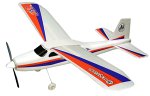
A small white Capitol Flyer with red-and-blue wings introduces electric free-flight play and an original flight-path postcard activity.
The play at a glance
A little plane for an open-ended journey
A white body, red-and-blue wing panels and small landing wheels give the Capitol Flyer the look of a miniature everyday airplane. Its black propeller sits at the nose, ahead of the high wing. Picture it as the mail plane in a paper landscape, with a village, a field and a distant destination waiting to be named.
The interest of free flight
The catalog places this small airplane in the electric free-flight family. The idea centers on preparing a model for its journey and then watching the route it takes after release. That makes the shape of the path an interesting thing to remember: a gentle arc, a changing direction or a landing somewhere different from the place imagined.
The original account names a belt-clip ChargePack and describes a compact aircraft. Use a surviving unit’s matching booklet for its setup, power equipment and required flying space. The activity below explores the journey through a drawing, with the aircraft’s balance and control surfaces left untouched.
Make flight-path postcards
Draw a small airfield on one side of a postcard-sized piece of paper. Add a destination on the other side of the picture: perhaps a lighthouse receiving its weekly newspaper or a bakery awaiting a secret recipe. Sketch a curving route between the two.
On the back, write a message from the imaginary pilot. Mention one landmark from the drawing and one surprise along the way. Another player can draw a return postcard, choosing a different route through the same landscape.
A paper silhouette can travel along the lines while someone reads the message aloud. If you later watch an ordinary flight arranged with the correct instructions, sketch its observed path on a separate card and label it “What we saw.” Keep the invented journey and the observation as two different postcards in the same collection.
Keep the model’s identity in view
The Capitol Flyer name also appears on larger Megatech aircraft. The small white, red-and-blue plane pictured here is the subject of this page; the preserved account and catalog reference give a starting point for identifying an older example.
The historical record
Original Toysit coverage
The complete earlier product account and commentary are preserved below as historical coverage.
Capitol Flyer Fun Flight Electric Airplane
Onboard battery recharges in minutes with included belt clip ChargePack. The wing span is 17 3/4 (46 Cm) and the length is 13 3/4 (35cm) Flies at high fast scale speeds 25MPH/40 KPH. It also has an adjustable flight pattern. Perfect for parks and school grounds.
The Early Flying Model Airplanes: Flying in a Pattern
In the early days of aviation and model aircraft, the first flying model airplanes were not equipped with remote control capabilities as we know them today. Instead, they were designed to fly in a predetermined pattern through various mechanical and aerodynamic mechanisms. Here's how these early flying models operated:
Control Lines: Early flying model airplanes were often controlled using control lines, also known as "control line flying." These models were connected to the operator via control lines made of wire or cords. The operator would stand in a central location and manipulate the lines to guide the model's flight path.
Simple Control Surfaces: These early models typically had simple control surfaces, such as elevators and rudders, that could be adjusted to influence the aircraft's pitch and direction. By manipulating the control lines, the operator could induce these control surfaces to alter the airplane's flight trajectory.
Maneuvering in a Pattern: Instead of remote control, the flying models were designed to follow a predetermined flight pattern. The operator's skill in controlling the lines would guide the aircraft through various maneuvers, loops, and figure-eight patterns within a confined airspace.
Fixed Engines: Early flying model airplanes often used fixed engines that provided a constant level of power. The operator's control over the control lines allowed for changes in pitch and yaw, enabling the model to perform basic aerobatic maneuvers.
Throttle Control: While the first flying models did not have remote throttle control, some models included mechanical mechanisms to control engine power. This allowed for adjustments in speed during flight, which could influence the model's behavior to some extent.
Operator Skill: Operating these early flying models required a high level of skill and coordination. The operator needed to anticipate the aircraft's movements and adjust the control lines accordingly to achieve the desired flight pattern and maneuvers.
Pattern Flying Contests: Pattern flying, where the model aircraft followed specific flight patterns and maneuvers, became a popular competitive activity among early enthusiasts. Pilots would showcase their skill in executing precise flight patterns and aerobatics with their flying models.
Advancements Over Time: As technology advanced, early flying models started to incorporate more sophisticated control mechanisms, including rudimentary radio control systems. This eventually paved the way for the development of true remote-controlled model airplanes with improved maneuverability and autonomy.
While these early flying model airplanes lacked the remote control capabilities of today's models, they represented a pioneering era in aviation and aeromodeling. They showcased the ingenuity and creativity of early aviation enthusiasts who found innovative ways to control and maneuver their model aircraft in captivating patterns and displays.
Sources and editorial notes
The Megatech manufacturer catalog identifies the red-and-blue MTC 8112 Capitol Flyer Jr. in its electric free-flight series and lists dimensions matching the earlier account. That catalog section was read as a transcription; its printed artwork and the exact operating booklet were not recovered. This is a model-family match, with the pictured unit’s label unconfirmed. The archive’s speed and adjustable-pattern claims remain historical wording. Its control-line essay concerns a separate flying method, not an instruction to tether this toy. The postcard activity is original to Toysit; no physical testing was performed.
- Original Toysit image — Existing same-site image reviewed and retained unchanged.
- Megatech product catalog — Manufacturer catalog reproduced by Doczz; the MTC 8112 electric free-flight entry and dimensions were reviewed through the web reader. Direct retrieval returned HTTP 403; printed-page artwork was not inspected.
- Original Toysit coverage — Complete historical account retained, including its original claims and wording.

Images and descriptions are retained as historical material. How Toysit covers toys.
Created for Toysit by Tabbloza — the artwork in our header.