
From the Toysit archive
Extreme Snowboard Game
A miniature mountain, a curved approach and tiny riders turn a snowy descent into a tabletop spectacle. Give each run a name and narrate its story.
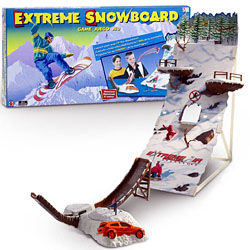
The play at a glance
A whole mountain on the tabletop
White slopes rise above little trees and projecting ledges. A curved approach waits below, ready to send a tiny rider toward the mountain. Extreme Snowboard compresses the drama of a winter sports scene into a compact game: a launch, a moment in the air and a landing that gives the commentator something to talk about.
Look for the landing places
The mountain is more than a backdrop. Its ledges give the riders places to finish, and the trees divide the slope into recognizable little scenes. Before playing, describe the mountain from bottom to top: the approach, the wooded patches and the higher landing spots.
Mattel’s guide shows a rider sliding down the approach into a motorized launcher aimed at the mountain. The printed scoring rewards riders that remain in scoring areas, with an upright landing doubling that area’s points. The picture of a successful run is easy to imagine: a quick start followed by a remarkably still finish.
For actual play, have an adult assemble and prepare the game using the matching instructions. Use only its supplied riders as projectiles, and aim away from people and animals. The story cards below sit beside the game, clear of its moving parts and flight path.
Make mountain commentator cards
Draw three large cards. On the first, invent a rider’s name and a simple emblem: Silver Pine might have a tiny tree, while Red Comet could have a bright curved tail. On the second, sketch a destination ledge. On the third, write a weather word for the imaginary scene, such as sparkling, misty or sunset.
Let one player introduce the rider while another points to the drawn destination. Try an opening like, “Silver Pine is waiting above the mist, looking for the ledge beside the trees.” The weather belongs to the story; it does not change the manufacturer’s game rules.
After a normal turn, describe what happened in a friendly commentator’s voice. A missed landing can become the start of the next scene: the rider studies the mountain, waves to a teammate and prepares to try again. Give every attempt one memorable detail.
Draw the evening sports report
Choose three moments for a short comic: waiting at the start, crossing the imagined sky and meeting the team afterward. Add a headline based on the story rather than a claimed speed or distance record.
The entire activity also works on paper. Draw the mountain and a rider in each scene, then have a second storyteller supply the commentary. Change the destination or weather card for another report from the same little mountain.
The historical record
Original Toysit coverage
The complete earlier coverage follows. Its product descriptions and broader claims remain part of the historical record; researched context and qualifications appear in Sources.
Snowboarding Game
Extreme Snowboard is the only game where kids can live out the fantasy of snowboarding all year long. Use the power ramp launcher to launch a snowboarder onto the 3-D mountain and score points. The more difficult the landing, the more points you score. Kids take turns launching their plastic snowboarders at the face of a hazard-strewn mountain, scoring points (or not) depending on where their guys end up. Land on a ledge? You've got points. Land in a tree? You've got trouble. These dudes really fly, and testers loved honing their aim and watching the spectacular wipeouts.
History of Snowboarding
Snowboarding, a popular winter sport that combines elements of skiing and surfing, has a rich and evolving history that traces back several decades. The sport's journey from its humble beginnings to becoming a global phenomenon is a testament to innovation, creativity, and the passion of its enthusiasts.
1960s and 1970s: The Early Years
The origins of snowboarding can be traced back to the 1960s, when individuals began experimenting with riding boards on snow. In the 1960s, Sherman Poppen created the "Snurfer," a rudimentary snowboard with a rope attached to the front for control. The Snurfer gained popularity as a toy, sparking interest in snowboarding as a recreational activity.
1980s: Rise of the Modern Snowboard
The 1980s marked a turning point for snowboarding, as advancements in design and technology transformed it into a legitimate sport. Jake Burton Carpenter, often referred to as the "father of snowboarding," played a pivotal role in developing modern snowboards. He founded Burton Snowboards in 1977 and worked to refine board shapes, bindings, and materials.
Despite initial resistance from ski resorts, snowboarding gained traction and recognition. The first National Snow Surfing Championship was held in 1982, and the FIS (Fédération Internationale de Ski) recognized snowboarding as an official sport in 1985. Snowboarders were no longer seen as outsiders; they had established a unique subculture and community of their own.
1990s: Mainstream Recognition
The 1990s marked the widespread acceptance and integration of snowboarding into winter sports culture. Major ski resorts began allowing snowboarders on their slopes, and snowboarding events were added to the Winter X Games. Snowboarding made its debut at the 1998 Winter Olympics in Nagano, Japan, further cementing its status as a mainstream sport.
2000s and Beyond: Evolution and Innovation
The 21st century brought continued innovation to snowboarding, with advancements in board shapes, bindings, and technologies. Freestyle and freeride snowboarding gained popularity, leading to the development of specialized boards for different riding styles. The sport also expanded to include terrain parks, halfpipes, and backcountry riding.
Professional snowboarders became household names, and snowboarding culture influenced fashion, music, and art. The sport embraced diversity, with riders of all backgrounds and ages participating in competitions and events around the world.
Today, snowboarding continues to evolve with a focus on sustainability, inclusivity, and pushing the boundaries of what's possible on the snow. It remains a dynamic and exciting sport that captures the spirit of adventure and creativity that fueled its early days.
The history of snowboarding is a testament to the passion and determination of those who pioneered the sport, transforming it from a backyard experiment to an international phenomenon enjoyed by millions of enthusiasts worldwide.
Sources and editorial notes
Mattel identifies the game as B2284, introduced in 2003. Both pages of its Spanish guide were reviewed; the filename ends 0520, while the sheet prints B2284-0725. Its 6+ label differs from the service record’s over-8 wording, so no universal age recommendation is supplied. A matching English guide was not recovered. The retained tester quotation belongs to the original account; its snowboarding-history essay has not been independently audited. The companion activity is an original Toysit suggestion. No physical toy testing was performed.
- Mattel: Extreme Snowboard B2284 — Official product identity and 2003 service record.
- Mattel: Spanish Extreme Snowboard instructions — Both pages reviewed for assembly, launching, scoring and warnings; revision and age differences noted above.
- Original Toysit coverage — Complete earlier text, raw SSI values and historical image preserved.
Images and descriptions are retained as historical material. How Toysit covers toys.
Created for Toysit by Tabbloza — the artwork in our header.