
From the Toysit archive
Play TV Snowboarder
A blue board controller opens a snowy television landscape, with an original three-panel mountain-run storyboard activity.
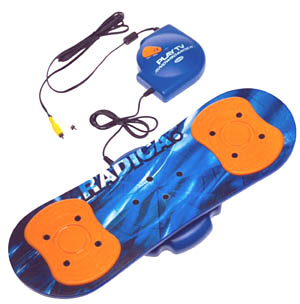
The play at a glance
A blue board at the edge of an imaginary mountain
Two orange foot areas mark a place on the blue board, and a cable leads to a small Play TV module. The snowy world is on the screen; the shaped controller makes that world feel like a destination waiting beyond the living room. A run can have its own beginning, memorable landmark and finish.Choose a kind of snowy journey
The older guide describes four modes: Free Ride, Slalom, Half Pipe and Big Air. Their names offer different ways to picture a session, from a downhill route to a course arranged around particular on-screen challenges. The board’s tilting controls connect the player to the rider’s direction.
Use the matching instructions for placement and operation. The older guide specifies ages eight and up and a maximum of 180 pounds, requires rubber-soled shoes and clear space away from people and the television, and says not to jump on the board or grab it while riding. On-screen jumps belong to the game; the paper activity below begins after stepping off.
Draw a mountain-run storyboard
At a natural stopping point, put play on hold and step off carefully as directed. Sit at a separate table and divide a sheet of paper into three panels. Draw a remembered start in the first, one landmark in the middle and the finish in the last. A few lines and a tiny rider are enough to tell the route.
Now invent a name for the resort on your paper: “Blue Lantern Mountain” or “Cloudcap Ridge.” Add a short caption beneath each panel, with one sound written into the scene if you like. Mark any invented scenery as part of your own version of the mountain.
A companion can supply a visitor’s postcard message for the back. Keep the board resting while you draw; the story grows through the scenery and words you add.
A controller from the composite-video era
The separate module uses the original yellow video and white audio connections. Match any surviving set to its own instructions and check the television’s inputs before setup.
The historical record
Original Toysit coverage
The original product account and commentary are preserved below as historical coverage.
Interactive Game by Radica Games.
Go in search for big air with Radica's Play TV Snowboard. Just connect the game to your TV or VCR. Get on your snowboard and start shreddin' the course. As you maneuver the snowboard, see the corresponding actions in full color and stereo sound on you TV screen. Choose from 4 exciting games. Free Ride/Trick Run, Timed Slalom Competition, Half-Pipe Trick Competition and Big-Air Competition. Compete for time and style points. If you want to win, avoid the obstacles and collect special power balls to increase your speed. In a very short period of time snowboarding has become as popular as skiing among winter sports enthusiasts. But while it can be a heck of a lot of fun, it's not exactly forgiving to novices. Fortunately, this living room version affords all the pleasure of boarding without any of the bruises or broken bones. The plastic board, which can hold up to 180 pounds, hooks up quite easily to any common TV. Once on board, riders can select one of four modes: half-pipe, slalom, big air, or freestyle. All selections are made using the board itself, and we found the interface to be a bit cumbersome at first. But once we got the hang of it, we were boarding our way down countless ski slopes and having a great time. While the graphics are not up to the quality of an Xbox game, playing a game while riding on an actual board is a hoot.
History of Snowboarding
The history of snowboarding is a fascinating journey that takes us back to the 1960s, when pioneers like Sherman Poppen created the "Snurfer," a rudimentary board designed for snowy slopes. The Snurfer was essentially two skis strapped together and offered a more surf-like experience on snow. Although primitive, it laid the foundation for what would become a global phenomenon.
By the 1970s, innovators like Jake Burton Carpenter and Tom Sims started experimenting with board designs and bindings, making snowboarding more similar to skateboarding and surfing. Burton, in particular, played a crucial role in popularizing the sport by creating Burton Snowboards, one of the first companies exclusively dedicated to snowboarding gear. Throughout the late '70s and '80s, snowboarding started gaining traction, but not without facing resistance from ski resorts, many of which initially banned the activity.
The sport really started to boom in the late '80s and early '90s when it began to receive mainstream attention. The first snowboarding World Championship took place in 1983, and by 1998, the sport had earned a spot in the Winter Olympics, held in Nagano, Japan. Since then, snowboarding has grown in popularity and technical complexity, giving rise to various styles like freestyle, freeride, and alpine snowboarding.
Today, snowboarding is not only a professional sport but also a popular recreational activity, enjoyed by millions of enthusiasts worldwide. The advancement in gear technology, training methods, and the inclusion in high-profile sporting events have solidified its status as a mainstream winter sport. Its counter-culture roots still play a big role in the sport's identity, but snowboarding has undoubtedly entered the global stage, continually pushing boundaries both in athletic achievement and in broadening its appeal.
Sources and editorial notes
Both complete Mattel-hosted Snowboarder guides were reviewed. The 71023 Rev. A guide, supplied as I1023, matches the pictured board and single-button module more closely than the later I6044/76044 edition. No readable model label appears in the original image, so this is a visual edition match. The preserved review’s first-person experiences and injury-free language are historical claims, not current testing or safety assurances. The storyboard is an original Toysit activity. No physical or modern-display compatibility testing was performed.
- Original Toysit image — Existing same-site photograph reviewed and retained unchanged.
- Radica Play TV Snowboarder 71023 instructions (PDF) — Complete two-page older guide and diagrams reviewed; closest visual match to the original image.
- Radica Play TV Snowboarder 76044 instructions (PDF) — Complete two-page later guide and diagrams compared; its different module and edition details were not transferred to this profile.
- Original Toysit coverage — Complete original product account and historical commentary preserved.

Images and descriptions are retained as historical material. How Toysit covers toys.
Created for Toysit by Tabbloza — the artwork in our header.