
From the Toysit archive
Fashion Snap Patti
Explore Fashion Snap Patti’s colorful wraparound clothing, long hair and mix-and-match accessories, then design two outfits with a paper collage.
The play at a glance
Colorful pieces that curl into a new outfit
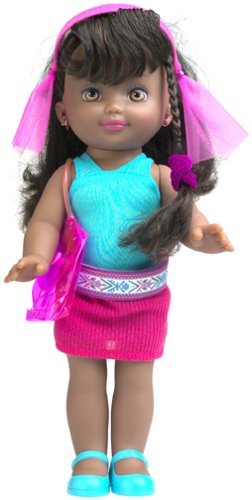
Fashion Snap Patti has long dark hair, a turquoise sleeveless top and a bright pink skirt in Toysit’s original photograph. Pink hair decorations and turquoise shoes repeat those colors. Her dressing play centers on clothing pieces that curl around the doll, allowing a player to change the shape and layers of an outfit.
Wrap a skirt and change the layers
The illustrated guide shows the player bending the ends of a skirt band back so it curls around the doll. A detachable belt joins its skirt with a fabric fastener, giving the player another piece to combine. The action is easiest to picture as a flat band becoming a curve around Patti’s waist.
The 89152 description lists a sheer long skirt, three short skirts, a boa, a poncho wrap, a comb and decorative stickers. Together, they offer changes in length, color and texture. A player can arrange the pieces beside the doll and choose the next layer.
Give the same piece a different role
The line guide illustrates a skirt rolled into a shoulder wrap, a scarf used around the head or neck, and several placements for the boa. These examples make the dressing play about experimenting with shapes as well as choosing colors.
Imagine Patti getting ready for two occasions: an afternoon visit and a small evening celebration. A short skirt could begin the first scene, while a longer layer could introduce the second. The player chooses a favorite detail to carry between the looks, then invents a greeting for each arrival.
Create two outfits from paper shapes
- Draw one character twice on a sheet of paper.
- Make colored paper shapes for a top, skirt, belt and wrap.
- Arrange one outfit for a daytime visit and another for a celebration.
- Repeat one color or pattern in both looks.
- Give each occasion a name and let the character introduce a favorite detail.
This original Toysit collage activity uses paper clothing shapes laid over a drawing. Rearrange them to begin another story.
The historical record
Original Toysit coverage
The original toy description and broader play discussion are preserved below as historical coverage.
Girls can change Patti's fashions over and over again with just a simple snap
Girls can change Patti's fashions over and over again with just a simple snap. This adorable approximately 13 doll wears a sleeveless dress and comes with cool fashion pieces, so girls can create lots of different looks. Girls can also decorate her fashions with glittery stickers. Fashion Snap comes with one sheer long skirt, three short skirts, a boa, poncho wrap, comb and a sheet of jewelry and make-up stickers. At just over 13 inches tall, she might be a tad short to model high fashion on the runway, but Mattel's Fashion Snap. Patty is definitely the queen of ready-to-wear. This kewpie cutie with blue eyes and long blonde tresses comes complete with an array of fashion accessories for mix-and-match dress-up play. The skirts, belts, and boa-like shoulder wrap are built around flexible coil, allowing a fastener-free fit. Some of the belts are also equipped with Velcro, enabling a change of underlying skirt, and these belts, as well as Patti's springy bracelets (which tend to shed their sparkles), can also be used as fashion accents: belts, bracelets, and hair bands, respectively.
History of Snaps in Fashion
Snaps, also known as press studs or poppers, have a rich history in the world of fashion, providing a functional and stylish way to fasten garments and accessories. These small, versatile closures have evolved over time and have become an integral part of clothing design. Here's a brief overview of the history of snaps in fashion:
19th Century: The concept of snaps dates back to the 19th century when various inventors began developing ways to create efficient and secure fasteners. One of the earliest patents for snap fasteners was granted to German inventor Heribert Bauer in 1885. These early versions were primarily used for practical purposes in work clothing and utilitarian garments.
Early 20th Century: The early 20th century saw the refinement and widespread adoption of snap fasteners in fashion. In 1903, German inventor Max Heilbronn patented a version of the snap fastener that resembled the modern snap design. As clothing styles evolved, snaps began to appear in various types of garments, including dresses, trousers, and outerwear.
Mid-20th Century: Snaps gained popularity during the mid-20th century, particularly after the introduction of new manufacturing techniques that allowed for mass production. They were embraced by designers and manufacturers for their convenience and ease of use, replacing traditional button closures in many instances. Snaps became a staple in casual wear, denim clothing, and children's apparel.
1960s-1970s: The counterculture movements of the 1960s and 1970s influenced fashion trends, and snaps became a symbol of rebellious and free-spirited style. Clothing items such as denim jackets and vests adorned with snaps gained popularity among the youth culture of the time.
1980s-1990s: Snaps continued to be used in various fashion applications, from clothing to accessories. In the 1980s and 1990s, snap closures were often incorporated into sportswear, casual clothing, and outdoor gear, enhancing the functionality and modern aesthetic of these garments.
21st Century: Snaps remain a prevalent feature in contemporary fashion. Advances in materials and technology have led to the development of innovative snap designs that are more durable, secure, and versatile than ever before. Snaps are used in a wide range of clothing items, including shirts, jackets, pants, skirts, and even footwear.
Design and Aesthetics: Snaps have evolved beyond their functional purpose and are now considered a design element in fashion. They come in various shapes, sizes, and materials, allowing designers to incorporate them creatively into garments. Decorative snaps with unique textures, colors, and finishes can add visual interest and contribute to the overall aesthetic of a piece.
Sustainability and Eco-Friendly Fashion: As the fashion industry embraces sustainability, snaps have adapted to align with eco-friendly practices. Some designers and brands are opting for snaps made from sustainable materials, ensuring that both form and function align with environmental considerations.
Timeless Appeal: Snaps continue to be valued for their convenience, durability, and ease of use. They offer a quick and efficient way to fasten clothing, making them a favorite choice for garments that require frequent opening and closing, such as jackets, shirts, and pants.
Modern Innovation: Snaps have kept up with technological advancements, including magnetic closures and snap designs that are compatible with touchscreen devices, allowing for seamless integration of technology into fashion.
Throughout history, snaps have undergone transformations to adapt to changing fashion trends, technological developments, and societal needs. Their enduring popularity is a testament to their practicality, versatility, and ability to enhance the functionality and aesthetic of clothing and accessories.
Sources and editorial notes
Mattel’s 89152 record identifies the dark-haired edition shown here. All three PDF pages of the 89151-0920 line guide were visually reviewed; they repeat the illustrated sheet and include photographs of several Patti editions. The guide supplies the wraparound-clothing directions. The original account also describes a blonde doll and includes an essay about conventional snap fasteners; those remain historical text. The collage activity is original; no physical testing was performed.
- Mattel Fashion Snap Patti 89152 record — Identification, manufacturer package image and clothing list for the dark-haired edition.
- Fashion Snap Patti line instructions (PDF) — All three PDF pages reviewed; repeated illustrated sheet shows wrapping, fabric fasteners and clothing combinations.
- Original Toysit coverage — Original doll image, product account and historical fastener essay preserved.
Images and descriptions are retained as historical material. How Toysit covers toys.
Created for Toysit by Tabbloza — the artwork in our header.