
From the Toysit archive
Fisher-Price Sparkling Symphony Stacker
Meet the Sparkling Symphony Stacker’s translucent stars and smiling topper, then share a gentle greeting for a favorite colored ring.
The play at a glance
A bright star gets a little hello
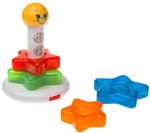
Red and green stars sit around a clear post, while orange and blue stars wait beside a white curved base. A yellow smiling face finishes the stack at the top. Fisher-Price’s Sparkling Symphony Stacker gives these simple shapes a musical response, inviting an adult and child to share a moment of placing, lifting and listening.
Look at the stars and the sunny face
The stars have broad points and large central openings. Their translucent colors stand out against the pale base, while the smiling face makes a recognizable finishing piece. The original photograph shows some stars stacked and others loose, suggesting several moments in the same play: choosing a piece, moving it, and looking again.
The matching 71989 guide describes lights and sounds when a ring slides up or down the post. It also shows the face placed on top and pressed to start a mixture of classical and nursery melodies. Those are two distinct responses to notice, with a pause between them so one small action can have its own moment.
Try a star’s greeting
- Choose a star to notice. Sit nearby during supervised play and name one visible color. A short “hello, blue star” is enough to begin.
- Wait for the child’s turn. Let the child handle an intended piece in their own way, placing or lifting it as they choose. Keep the greeting separate from any demand to make a complete stack.
- Listen and pause. Notice the toy’s response if a ring moves along the post. The adult can leave a little space after the sound.
- Welcome the color again. When that star returns to attention, repeat its greeting and hum two gentle, made-up notes.
- Follow the next interest. Greet another star, notice the smiling face, or finish. The child decides how long this little exchange lasts.
There is no required color order and no need to complete the stack. Without the toy, an adult can point to a star drawing held out of reach and supply the same brief greeting and two-note tune.
Keep one familiar phrase
A repeated greeting can give the adult a small part in the play without narrating every movement. Next time, keep the same words for the same color and see which piece attracts attention. The smiling face can receive a final hello when it appears, bringing the short scene to a gentle close.
The historical record
Original Toysit coverage
The original product account and commentary are preserved below as historical coverage.
The classic fisher price stacking toy with the addition of music.
Rather than the typical, uncomplicated tunes of friendly nursery songs, such as Baa, Baa Black Sheep, this sparkling star stacker plays the stimulating and sophisticated music of Beethoven and Mozart. Babies simply push down on the friendly yellow face that presides on top of this stack of stars, and a selection of classical melodies rings forth. And each time babies lift a shimmering plastic star from the stacking pole or replace one, they are rewarded with magical sweeps of music that gush from the pole, as twinkling lights flash on and off. The curved base makes the stacker (approximately 9 inches high) easy to rock, and helps prevent tip-overs. This colorful toy offers auditory stimulation and develops eye hand-eye coordination and sorting skills. With this new innovative musical toy, infants can not only stack the star shaped sparkling rings on the roly poly base, but also create a musical piece as they stack them. Plus when baby puts the smiling faced block on top it plays one of five songs, including classical music, or one of three sparkling sound effects.
Stacking toys with built-in musical features offer a multi-sensory experience that goes far beyond simple stacking activities. Here's why these toys are especially enjoyable and beneficial for babies:
- Visual and Auditory Stimulation: Combining the action of stacking with the joy of music offers a dual sensory experience. Babies get to appreciate various colors and shapes visually while also enjoying auditory stimulation from the musical elements.
- Motor Skills Development: Stacking toys in general help in developing fine motor skills and hand-eye coordination. Adding music to the mix makes the activity even more engaging, encouraging babies to continue stacking and rearranging, which further aids motor skills.
- Rhythmic Awareness: The musical features in these stacking toys introduce babies to the concept of rhythm and melody. This can be a foundational step toward a lifelong appreciation of music and may even enhance rhythmic and timing skills.
- Cognitive Development: The combination of stacking and music requires a level of cognitive coordination that challenges and thereby aids in the mental development of babies. It encourages them to think about sequencing, cause and effect, and problem-solving.
- Emotional Comfort: Many babies find music comforting or soothing. When a familiar tune plays as they successfully stack a piece, it serves as positive reinforcement that makes the experience emotionally rewarding.
- Social Skills: These musical stacking toys can also serve as a social activity. Parents or caregivers who sing along or dance to the music can make the playtime more interactive, helping babies develop social cues and bonding with them.
- Entertainment Value: Let's not forget the sheer joy and fun that music and stacking combined can bring to a baby. The vibrant colors, intriguing shapes, and delightful sounds can keep a baby entertained for long periods, providing much-needed respite for parents as well.
Musical stacking toys are a bundle of joy and learning rolled into one, offering a wide range of developmental benefits while ensuring babies are thoroughly entertained.
Sources and editorial notes
Mattel’s 71989 record and both complete instruction PDFs match the star rings, rounded base and smiling face in the original image. The instructions describe sounds/lights as rings move along the post and a mix of classical and nursery melodies when the topper is pressed; this qualifies the archive’s classical-versus-nursery contrast. Composer names, exact song/effect counts, durability and tip-over assurances are not established by this review. Broader developmental claims remain historical commentary. The greeting is original Toysit play, not a stacking test; no physical testing was performed.
- Original Toysit image — Existing same-site photograph reviewed and retained unchanged.
- Mattel: Sparkling Symphony Stacker 71989 — Official model record; kept separate from later stacker editions.
- Fisher-Price 71989 US instructions (PDF) — All four pages reviewed; page 3 shows ring and topper triggers and identifies both kinds of melody.
- Fisher-Price 71989 international instructions (PDF) — Six-page document reviewed in overview; English play directions confirm the same responses.
- Original Toysit coverage — Complete original product account and historical commentary preserved.

Images and descriptions are retained as historical material. How Toysit covers toys.
Created for Toysit by Tabbloza — the artwork in our header.