
From the Toysit archive
FriendChips
Two little readers and reusable message chips become a miniature post office, with an original invitation exchange for an imaginary town.
The play at a glance
A message you can hand to a friend
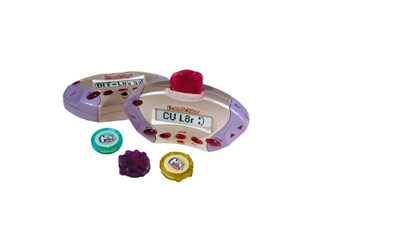
The two oval readers sit beside a handful of colorful chips. A chip stands in the top of one reader, as if a tiny letter has arrived at its mailbox. Writing, handing over and reading make a pleasing little sequence: a message travels across the table in a piece someone can hold.
Compose a greeting, then pass it along
The guide describes choosing letters, numbers, icons and punctuation, or using prepared sayings. A finished message is saved onto a chip and carried to the other reader. The recipient can watch it scroll and adjust the scrolling speed.
That physical handover makes the message feel like a delivery. Use short, friendly pretend notes everyone agrees to exchange, with made-up names and places. Follow the guide’s save step before the reader goes to sleep.
Invite a neighbor to your tiny town
Draw two places on a sheet of paper: perhaps a cloud bakery and a clockwork garden. Each player becomes the keeper of one place. Decide together on a small imaginary event, such as the garden’s first lantern evening.
Compose a short invitation: “Tea at the cloud cafe?” Save it as the guide describes, then pass the chip to the other player. Let the reply add one detail to the scene: a blue umbrella, a table for a visiting dragon or a cake shaped like the moon.
When both players have read the exchange, add those details to the paper town. Switch roles for the next invitation. A paper note can join the same game, and anyone who prefers drawing can make the event’s sign. The fun is in building a shared place one small message at a time.
The historical record
Original Toysit coverage
The complete earlier product account and commentary are preserved below as historical coverage.
Toy electronic message readers from Girl Tech Radica with encrypted messaging friend chips
Now you and your friends can pass electronic messages. Throw away the paper and have lots of fun as you send messages the high tech way. FriendChips has two main units and four friend chips that can be used again and again to pass those top secret messages with your friends. Just insert a chip to the main unit, write your message, record it to the chip and pass it to your friend. Contains two units and a selection of chips and stickers. Insert the chip and key in your message. Send the chips to your friends with your personalized message. Each chip can hold 22 indexes. Includes sounds, clues, sleep mode, and adjustable scrolling speed.
Secret messages hold a unique and captivating allure for children, sparking their imagination and sense of adventure. The idea of hidden communication and clandestine information taps into children's natural curiosity and desire for discovery. Here's why secret messages are so appealing to children:
- Intrigue: The element of mystery and secrecy instantly captures children's attention. The notion that there's something concealed or hidden encourages them to engage with the message and uncover its meaning.
- Empowerment: Creating or decoding secret messages makes children feel empowered and in control. It gives them a sense of agency as they navigate through puzzles and codes to reveal the hidden content.
- Problem-Solving: Secret messages often involve puzzles, ciphers, or codes that require problem-solving skills. Children enjoy the challenge of deciphering these codes, boosting their critical thinking and analytical abilities.
- Curiosity: Children are naturally curious and love exploring the unknown. Secret messages provide an opportunity to satisfy their curiosity and satisfy their need to uncover hidden information.
- Creative Expression: Designing and sharing secret messages encourages children to think creatively and express themselves in unique ways. They can experiment with different codes, symbols, and methods of communication.
- Social Interaction: Sharing secret messages becomes a fun and engaging social activity among friends. It fosters a sense of camaraderie and collaboration as children work together to crack codes or create messages.
- Sense of Adventure: Children have a natural sense of adventure, and secret messages add an exciting element to their play. Whether they're pretending to be spies, treasure hunters, or explorers, secret messages enhance the imaginative experience.
- Surprise and Delight: Revealing a secret message is accompanied by a sense of accomplishment and delight. Children's faces light up when they successfully decode a message or uncover a hidden surprise.
- Language and Literacy: Secret messages encourage children to engage with written language and literacy skills. Whether they're decoding letters, words, or symbols, they're actively interacting with text.
- Memory Enhancement: Remembering codes, patterns, and decoding methods exercises children's memory skills. It challenges them to recall information and apply it in a meaningful way.
The appeal of secret messages lies in their ability to capture children's intrigue, foster problem-solving skills, and ignite their imagination. Whether crafting their own messages or deciphering ones created by others, children are drawn to the thrill of discovery and the sense of accomplishment that comes with unlocking hidden meanings.
Sources and editorial notes
The complete Radica 74009 Rev. C guide and diagrams match the pictured two-reader set. It documents reusable chip messages, a phrase library and a three-icon passcode; it does not establish the old “22 indexes” wording as a character limit or substantiate modern encryption security. The broader developmental claims remain historical commentary. The town exchange is an original Toysit activity. No physical testing was performed.
- Original Toysit image — Existing same-site image reviewed and retained unchanged.
- Radica FriendChips instructions (PDF) — Complete two-page 74009 guide, P/N 82383600 Rev. C; text and reader/chip diagrams reviewed.
- Original Toysit coverage — Complete historical account retained, including its original claims and wording.

Images and descriptions are retained as historical material. How Toysit covers toys.
Created for Toysit by Tabbloza — the artwork in our header.