
From the Toysit archive
Geometric Shapes Puzzle
Explore a geometric knob puzzle through outlines, turning and picture clues, then try a paper challenge that separates shape from color.
The play at a glance
Find the outline, then turn the piece
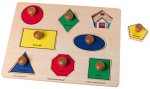
A geometric inset puzzle asks a small but interesting question: which opening matches this piece? Color and pictures can suggest where to look, while the outline determines whether it fits. Turning the piece adds another choice. The original Toysit image shows those clues together in a wooden board with large knobs.
Look at the edge before the color
Start with one piece and an uncovered opening. Trace their outlines with a finger, noticing straight edges, corners or a continuous curve. Hold the piece above the opening and turn it before trying to place it. A mismatch is another clue to inspect, not a reason to press harder.
For a quieter beginning, leave most pieces in the board and offer two choices. Add more when the child wants another challenge. This changes the amount to compare without introducing a timer or a score.
A turned shape keeps its identity
A square does not become a different shape simply because one corner points upward. Rotate a square drawn on paper and talk about what stayed the same: its four equal sides and four square corners. “Pointing this way” describes its position, rather than a new shape name.
The archived board also combines illustrations and colors with outlines. Ask which clue helped this time. Recognizing a picture, finding a matching color and comparing an edge are different ways into the same placement.
Keep the older board identifiable
The small image and original description belong to this historical page. A similar-looking product sold under a familiar name may have a different count or layout. Match a surviving board to its own packaging before using a newer listing for contents, age guidance or care directions.
Same shape, different color
Draw two circles, two squares and two triangles on a sheet, with one of each shape in blue and one in red. Ask the child to point to all the circles. Then change the rule and find everything red. Name the rule before each round.
For another version, rotate one square and draw one triangle taller than the other. Discuss why they still belong in their shape groups. This independent Toysit activity uses drawings to vary one clue at a time; it does not require the original puzzle.
The historical record
Original Toysit coverage
The original product description and developmental essay are preserved below. Their nine-piece count, construction claims and broad learning benefits remain historical statements, rather than results of testing by Toysit.
Geometric Shapes Jumbo Knob Puzzle
This puzzle includes nine extra thick pieces. Extra large knobs help children to easily remove each delightfully illustrated piece. A matching full color illustration can be found underneath each piece.
Engaging with a puzzle of geometric shapes offers a range of developmental and cognitive benefits for young children. As they fit the shapes into their respective slots, children are exercising their fine motor skills and hand-eye coordination. The act of grasping the shapes also enhances their dexterity. Cognitive skills such as problem-solving and spatial awareness are honed as children figure out which shape fits where, providing an early introduction to geometry. The task can also help them understand the concept of categorization, as they sort shapes based on attributes like the number of sides or angles. When geometric shape puzzles are color-coded, they add an extra layer of complexity and learning, aiding in color recognition and vocabulary. These puzzles can also serve as a social learning tool, encouraging children to take turns and communicate their thoughts and strategies. All in all, a geometric shapes puzzle is not just a source of entertainment; it’s a multifaceted educational tool that supports a child’s holistic development.
Sources and editorial notes
The original description and image are the evidence for this archived puzzle. Melissa & Doug’s current item 3390 describes an eight-piece geometric puzzle, while the old Toysit copy says nine. It is comparison evidence, not confirmation of the exact historical edition or its count. No physical puzzle or learning outcome was tested.
- Melissa & Doug geometric puzzle, item 3390 — Current eight-piece product listing; edition comparison only.
Images and descriptions are retained as historical material. How Toysit covers toys.
Created for Toysit by Tabbloza — the artwork in our header.