
From the Toysit archive
Heads Up
Heads Up: the face-shaped electronic reaction game, its solo and group rules, and age guidance from the original Hasbro manual.
The play at a glance
Notice which part of the face has changed
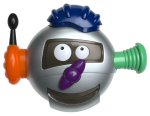
This Heads Up is a handheld electronic face with features that move out of position. Players return them to their places before time runs out. The visible change is the cue.Put the face back together
Hasbro’s guide shows the hat, side features, nose and mouth moving out of place. Depending on the feature, players press or turn it back. More than one may need attention. Begin with all features in their proper positions; the handle and rear controls are shown in the guide.
The useful distinction is between noticing and responding. First identify what changed, then choose how to restore it. The toy’s character gives those actions recognizable names instead of presenting an anonymous bank of buttons.
Solo scores and group turns
You and Me is the solo setting: restoring the features promptly earns points, and the game announces the score after the round. All of Us is the group setting: players sit around the game, follow its next-player cue and continue until one remains. Taking too long puts a player out of that round.
Choose the format before starting. For a group, explain the handover as well as the action; a newcomer should know when a turn ends. Competition is only one way to talk about the design—watching which feature moved is interesting in its own right.
Try a cue-naming warm-up
For an optional Toysit activity away from the electronics, draw a face with a hat, nose, mouth and ears. One person changes a detail in a second drawing, and the other names the difference.
- Start with one obvious change, such as a tilted hat.
- Describe it aloud before pointing to it.
- Swap drawings and roles. If desired, add a second change and discuss which was noticed first.
There is no timer or elimination. The aim is to share the observation, not to measure reaction speed or developmental progress. Use descriptions that make sense to the people playing; the drawing does not need to be realistic.
Check the game’s identity and condition
The documented toy is for ages 5 and up and uses four AA batteries. Keep its matching instructions for the handle attachment, battery access and reset procedure. An older unit with sticking features needs attention before ordinary play, not harder pressing.
The name alone is not enough to find the right rules. A mobile guessing app, a question game with cards and this mechanical face can all suggest “heads,” but they ask players to do very different things.
The historical record
Original Toysit coverage
The complete original coverage remains below. Its suggestion that toddlers are suitable players and its developmental-benefit claims are not adopted here: Hasbro’s guide labels the game ages 5 and up, and this article reports no developmental testing.
The heads up game unit itself is small and consists of a happy face with buttons that pop out of place.
Heads Up is similar to the phenomenally popular Bop-It series but designed with younger kids in mind. The game unit itself is small and consists of a happy face with buttons that pop out of place. The object, of course, is to put them back into place as quickly as possible. Though fast-paced, it's not overly complicated. Kids ages 5 and older should be able to have fun while avoiding the frustration of learning rules. Heads Up allows for solo or multiple player fun.
The appeal of Heads Up, a toy designed for younger children, lies in its simplicity, interactivity, and immediate feedback mechanism. Similar to Bop-It, Heads Up challenges children to quickly press buttons back into place, but does so with fewer, larger buttons that are easily manageable for little hands. This offers not only a fun, fast-paced game but also promotes the development of fine motor skills, hand-eye coordination, and quick reflexes. The game can be played solo or in a group, making it a versatile toy that is perfect for both individual play and family or friend gatherings. Because the concept is simple, even toddlers can grasp the game mechanics easily, yet the pace can be challenging enough to keep them engaged. The immediate feedback, often in the form of lights or sounds, adds an extra layer of excitement and helps in reinforcing the sense of achievement. All these elements come together to make Heads Up a highly engaging and educational toy that can provide hours of entertainment.
Sources and editorial notes
Hasbro’s complete four-page Heads Up guide, product 40058, was read visually, including the handle and control diagrams. This is the face-shaped reaction toy, not the phone guessing game. The naming activity is an original Toysit suggestion; no physical testing was performed.
- Hasbro: Heads Up instructions (PDF) — Age guidance, movable features, handle, two game settings and scoring.
Images and descriptions are retained as historical material. How Toysit covers toys.
Created for Toysit by Tabbloza — the artwork in our header.