
From the Toysit archive
Holey Moley Electronic Handheld
Holey Moley puts a tiny animated arcade inside a mallet-shaped handheld and inspires an original garden-lookout storytelling game.
The play at a glance
A tiny garden inside a bright yellow mallet
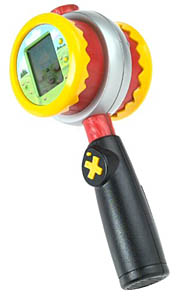
A yellow rim surrounds the little screen on Holey Moley’s mallet head. Red and gray bands wrap around the casing, while a black handle places a yellow control beneath the player’s thumb. The screen turns that bold shape into a miniature arcade, with moles appearing below and airborne visitors crossing above. Watching for the next arrival also suggests a gentler garden story, where every visitor brings something to say.Watch the ground and the sky
The guide describes moles, planes, parachuting moles and helmeted targets, with rabbits to leave alone. The player follows the scene and positions a small mallet symbol on the screen. Across ten levels, targets remain visible for shorter periods.
That arrangement gives the little display two places to watch: the holes below and the space above them. The next character may arrive somewhere different from the last. In the paper activity below, spotting a visitor begins a conversation.
Become a garden lookout
Draw a garden with five empty burrows. Add one large landmark beside each: a sunflower, a gate, a watering can, a bench and a small apple tree. Leave room above the garden for clouds or a passing balloon.
A storyteller points to a burrow and introduces a visitor. A mole might arrive at the sunflower with a letter tucked under one arm. A rabbit beside the gate could be carrying a carrot tied with a blue ribbon. The next player adds a sentence explaining why the visitor has come.
Give the lookout a question to ask: “Who is the letter for?” or “Where should we put the ribbon?” Players can answer aloud, point to a picture or draw the missing part of the scene. Everyone helps decide what happens.
Let a visitor change the picture
Suppose the letter invites the garden’s inhabitants to a picnic. Draw a blanket beside the bench, then let another visitor bring an imaginary contribution. A mole could deliver a tiny umbrella; a bird might announce which cloud looks like a teapot.
Return to a familiar burrow and ask what has changed since the first visit. The watering can may now hold flowers, or the gate might display a welcome sign. These small additions turn the same five places into a continuing story.
This original activity uses looking, pointing and storytelling. The paper garden supplies its own pace and can be enjoyed independently of the electronic game.
The historical record
Original Toysit coverage
The complete earlier coverage follows. Its opinions, promotional claims and broader historical commentary remain part of the archive; researched details and qualifications appear in Sources.
A toy that will be fun for the whole family.
Holey Moley! Mischevious moles popping out of their holes are making a mess of the landscape. Every time a plane flies by, more moles parachute out! Your mission: Hit the moles back down in their holes, and knock the planes and jumping moles out of the sky as fast as you can! Pesky diggers are popping up all over, but a good whack on the head should get rid of them. This electronic handheld version of the popular arcade game has players swinging the mallet and hitting moles for points. The mallet head has an LCD screen on one side and a plastic coating on the other-- offering minimum damage when smacked against most surfaces. The various sounds (hitting a mole, missing altogether, accidentally bopping a bunny) aren't too intrusive, but their volume cannot be controlled. The burrowers pop up often enough to keep players on their toes, but not so fast that they get easily frustrated. Keeping a firm grip on the handle while also trying to maneuver the button for mallet position can be tricky.
The Whack-a-Mole game is an arcade classic that has captivated players since its invention in the 1970s. Created by Aaron Fechter, the game challenges players to use a mallet to "whack" moles that pop up from holes in a cabinet, only to disappear quickly back into them. The game tests players' reaction time and hand-eye coordination, offering a straightforward yet addictive experience. Originally designed as a coin-operated arcade game, Whack-a-Mole quickly became a staple in amusement parks, carnivals, and arcades worldwide. Over the years, the game has been adapted into various formats, including home versions and digital apps, making it accessible to a broader audience. Its simple premise and engaging gameplay have made Whack-a-Mole a cultural icon, referenced in popular media and even used as a metaphor in discussions ranging from business strategies to healthcare. This timeless game continues to be a hit, enjoyed by players of all ages.
Sources and editorial notes
Hasbro’s 1999 guide was available as indexed text; its PDF download returned 403, so its diagrams were not visually verified. It supports the changing targets and timing described here. Exact button sequences are omitted. The earlier surface-impact, grip and volume opinions are retained as historical commentary, not Toysit tests or advice to strike furniture. The arcade-invention attribution in the later paragraph was not independently established by this handheld guide. The companion activity is original to Toysit; no physical toy or recorded sound was tested.
- Hasbro: Holey Moley handheld instructions — 1999 manufacturer-guide text reviewed for targets and levels; direct PDF access was blocked and diagrams remain unverified.
- Original Toysit coverage — Complete original text, SSI values and historical image inspected and preserved.
Images and descriptions are retained as historical material. How Toysit covers toys.
Created for Toysit by Tabbloza — the artwork in our header.