
From the Toysit archive
Simon 2 (Simon Square)
Find the four-lens and eight-lens sides, follow a short sequence and choose a game for the way you want to play Simon 2.
The play at a glance
One unit, two surfaces, several ways to follow a pattern
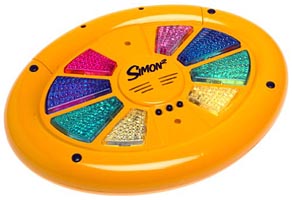
The yellow game pictured here is the reversible Simon 2, also called Simon Square in Toysit’s earlier coverage. One side has four colored lenses; the other has eight. The photograph shows the eight-lens side.
Begin with the familiar task of watching and repeating a sequence. Once that is clear, compare it with games that ask players to build a sequence or compete across the two sets of lenses.
Choose the surface first
The manual places three games on the four-lens Classic Simon side and four on the eight-lens Head-to-Head side. Set the chosen side facing up on a level surface. Its warning matters: both sides’ lenses remain active, so accidental presses underneath can affect play.
Before a session, locate the game and level controls in the matching diagram. Decide what you want to try before changing settings. Flipping the unit is a way to choose another play surface, not an instruction to turn it over during a sequence.
Watch, wait, then repeat
In the basic Simon game, the unit presents a signal, then extends the sequence as the player repeats it correctly. Begin with a short attempt and give the whole demonstration your attention before answering.
Afterward, describe how you followed it. Did you notice colors, positions, sounds or a mixture? There is no need to assume everyone uses the same cue. A second person can observe quietly and discuss the sequence after the attempt ends.
For a separate paper activity, draw four labeled spaces and point to a short pattern for a partner to repeat. Let the partner choose when they are ready. This is an untimed imitation exercise, not a built-in Simon mode or a claim about improving memory.
Repeating and adding are different tasks
Challenge Simon asks players to extend a sequence themselves after its first signal. The eight-lens side offers Double, Ultimate, Extreme and Counterattack. Their turn and scoring rules differ; eight lenses do not simply mean a longer version of the same game.
Read the chosen game’s instructions together and explain who acts next before starting. If one player is still learning the layout, watching a complete example can be more useful than switching modes after every mistake.
Use one game for a few attempts so the comparison is meaningful. You can change the mode later without presenting it as a required step up.
Keep the experience easy to describe
At the end, name the part you enjoyed: recognizing the beginning, adding a signal, or trying a shared challenge. A score records an attempt within a particular mode; it is not a general measure of someone’s memory.
When returning to an older unit, check its own labels and matching instructions for preparation and care. The Simon name covers many devices, and instructions for a current four-button model will not explain every feature of this reversible one.
The historical record
Original Toysit coverage
The original Simon 2 description and general Simon essay remain intact. The essay’s inventor attribution and broader history are retained as historical text rather than newly researched history; its cognitive-benefit claim is not an outcome established by this profile.
Classic electronic sequencing challenge
Simon says, Would you like to play a game? Or seven? With Simon 2, the next generation of the classic electronic sequencing game, players can play the traditional Simon challenges against the machine or they can turn over the unit for head-to-head play with a human opponent. All seven games are variations on the ingenious original: an ever-increasing sequence of signals, denoted by the flashing and beeping colored buttons, must be repeated by alternating opponents. Complete with nonscuff rubber feet, and powered by three AA batteries, Simon 2 features adjustable skill levels on most of the games (a sequence of as few as eight or as many as 31, for example). Players who desire a dash of recall and replication with their reflex action will enjoy getting Simon, too.
The Simon electronic game is a classic memory and sequencing game that debuted in the late 1970s, created by Ralph H. Baer and Howard J. Morrison. The game features four large, colored buttons—usually red, blue, yellow, and green—each associated with its own unique musical tone. The game lights up these buttons in a random sequence, and the player's task is to remember and repeat the sequence by pressing the buttons in the correct order. As the player successfully replicates sequences, they become increasingly complex and faster, challenging the player's memory and hand-eye coordination. Simon gained immense popularity for its simplicity yet addictive gameplay, and it has seen various versions and adaptations, including smartphone apps and more complex variants. The game is not only entertaining but also offers cognitive benefits, aiding in the improvement of memory skills and attention span.
Sources and editorial notes
Reviewed October 16, 2026 against the original image, ASIN B00005BY48 and Hasbro’s Simon 2 guide, model 41000, copyright 2000. All four PDF pages were visually reviewed; the reversible unit and eight-lens layout correspond to the photograph. Game descriptions below follow that edition. The observation activity is editorial guidance; no device or memory benefit was tested.
- Hasbro: Simon 2, 41000 instructions (PDF) — Both play surfaces, seven games, level selection and operation.
Images and descriptions are retained as historical material. How Toysit covers toys.
Created for Toysit by Tabbloza — the artwork in our header.