
From the Toysit archive
Hot Wheels Fireball Raceway
Explore the original Hot Wheels Fireball Raceway: its powered vertical track, meteor effect, model-specific instructions and a route-observation activity.
The play at a glance
A powered circuit built around crossings
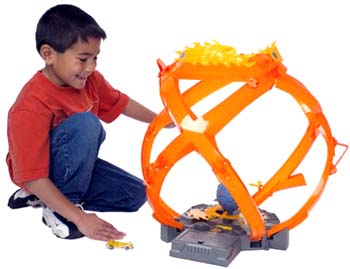
Fireball Raceway sends small cars around a vertical, globe-like track. A motorized booster keeps the action moving, while intersecting routes and a break-apart meteor give the circuit its crash-play theme.What makes the track different
A car on a simple downhill ramp starts with height and rolls toward the bottom. Fireball Raceway adds a powered booster to a circuit that curves up and around itself. Its overlapping routes make following one car more interesting than simply watching which car reaches a finish line first.
Toysit’s original coverage describes a quad booster, nine crash zones and two glow-in-the-dark cars. Mattel’s record also emphasizes nine crash zones. These are descriptions of the original package and play concept, not a guarantee that an incomplete secondhand set includes those cars or works with every later Hot Wheels vehicle.
The meteor is a resettable toy effect. The instructions show two halves held together around a central fitting; contact with the flame trigger releases them. There is no heat or combustion involved in the meteor story.
Start with the 29422 instructions
This is an ages 8+ set. Mattel requires adult assembly and warns that colliding cars may leave the track unexpectedly. Keep that warning in view when choosing where to operate and observe it. The historical photograph is not a clearance guide.
The assembly drawings identify lettered joints, correct track-tab positions, safety clips and three screwed-on base deflectors. Check those against the complete guide before use; a nearly assembled sphere is not enough. The booster calls for four D alkaline batteries, and its operating section says not to use rechargeable batteries.
Try a route detective activity
This original Toysit prompt begins with a drawing, so it can also be used while looking at the photograph without running the toy.
- Map three landmarks. Sketch the launch ramp, a high curve and the central meteor. Draw a predicted route between them.
- Follow one car. If a complete set has been assembled and checked for use, watch one compatible car from a suitable position. Leave the crash experiment out of this observation.
- Describe what happened. Did the car climb, cross, return to the booster or stop? If you lost sight of it, record that rather than guessing.
- Revise the sketch. Add only the connections you actually saw. A drawing with an unanswered question is more useful than an invented lap time.
Who might enjoy this kind of play?
The appeal is watching repeated motion through a compact three-dimensional route. A child who prefers arranging a quiet town or moving vehicles by hand may get more from a road-and-buildings playset. For a used Fireball set, identify the exact model and check its track, fittings and battery compartment against the manual before treating it as ready to run. Current car shapes and replacement parts should not be assumed to fit.
The historical record
Original Toysit coverage
The original description and later general discussion of booster tracks are preserved below. Promotional superlatives and broad learning claims belong to that earlier coverage.
The vertical, 360-degree track configuration challenges Hot Wheels cars as never before.
The vertical, 360-degree track configuration challenges Hot Wheels cars as never before. The motorized quad booster of the fire ball raceway blasts cars on a wild high-speed ride. Nine high-speed crash zones, any one can toss a car down into the meteor, blasting it to pieces! Comes with two exclusive glow-in-the-dark Hot Wheels vehicles with meteor decorations.
Diecast tracks with booster points add a whole new level of excitement to traditional car racing playsets. These tracks are not just passive pieces of molded plastic; they are interactive landscapes that alter the performance of the toy cars in real time. Booster points strategically placed along the course give cars a burst of speed, simulating the adrenaline-pumping dynamics of real-life races. Kids love the unpredictability and the skill involved in timing their cars to hit these boosters just right. The extra speed changes the game, offering new possibilities for overtaking opponents, flying off ramps, or performing spectacular tricks. And it's not just about fun; children also pick up on principles of motion, speed, and even some basic physics as they experiment with different cars and track configurations. The booster points turn each race into a high-stakes, high-speed adventure, adding layers of complexity and joy to a classic form of play.
Sources and editorial notes
Mattel identifies this set as 29422, released in 2001 and discontinued in 2002. Those are product dates. The route activity is a Toysit editorial suggestion, not a measured performance test; this renovation involved no physical testing.
- Mattel product record: Fireball Raceway 29422 — Product identity, historical dates, age range and crash-zone description.
- Fireball Raceway instructions (PDF) — Assembly diagrams, booster, meteor mechanism and operating cautions; all four pages reviewed.
Images and descriptions are retained as historical material. How Toysit covers toys.
Created for Toysit by Tabbloza — the artwork in our header.