
From the Toysit archive
Jammin’ Draw: give a drawing its own soundtrack
Meet the paper drawing toy that pairs marks with music, then try an original two-line soundtrack activity.
The play at a glance
A line to look at, a tune to listen to
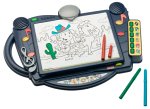
Jammin’ Draw puts a sheet of paper in the middle of a music-making frame. The small original photograph shows a handled unit with colorful controls around its drawing area and markers alongside. As a player draws, the toy supplies a musical response; playback gives that finished picture something to listen to. Imagine a winding river with a leisurely tune, then a page of little stepping-stones with a busier accompaniment.Drawing sets the pace
The controls make a small sequence of choices: pick a musical style, pick an instrument sound, begin a new song and draw. The guide connects slower drawing with a slower melody and faster drawing with a more upbeat result. A player might keep one sound for a whole picture, listening for how long sweeps and brief marks change its feel.
Clip paper over the drawing surface and use the marker or crayon described in the guide. Light drawing pressure is sufficient. Set a comfortable volume, then let the marks and music develop together. The picture remains on paper, ready to receive a title.
Try a two-line soundtrack
This original Toysit activity begins with two sheets and one simple contrast.
- Choose one style and instrument. Start a new song and draw a long, unhurried curve on the clipped sheet. Imagine it as a river, a ribbon or a sleepy creature’s tail.
- Play the song back while looking at the line. Give the pair a descriptive name, such as “Slow River.”
- Listen before starting the second take: beginning a new song replaces the current recording. Clip in the second sheet and draw a row of short marks, keeping the same musical choices.
- Play that version and invent its title. Put both sheets side by side and describe the difference you heard.
For another round, change just one gesture: make the curve loopier, or give the short marks longer pauses. Two players can take turns as artist and title-maker. The listener might imagine the marks as footsteps while the artist sees raindrops; both descriptions can belong beside the drawing.
Keep the picture and its story
Make a paper sleeve for the finished drawings and write their titles on it. A player could add a tiny scene around the original line later, turning the river into a map or the stepping-stones into a garden path. The song provides a moment of listening; the paper becomes a continuing invitation to draw.
The manual says the current song survives ordinary power-off and automatic shut-off. Use its playback and new-song instructions when choosing what to keep or replace, and recap the markers after drawing.
The historical record
Original Toysit coverage
The original product account and commentary are preserved below as historical coverage.
A great toy for those long drives.
This keyboard and easel combination offers children a creative leap between two art forms: drawing and music composition. The idea is to place a piece of paper on the drawing pad (it can be a blank sheet or one of the coloring book pictures included), turn on the music pad, and compose original music as the pressure from the moving markers magically projects an electronic tune. All the while, the keyboard plays an inspiring background melody. Young artists can choose from a variety of musical styles, including country, classical, rock, world music, and techno. Artists can even hear their spontaneous compositions using the playback button, and recorded songs stay in the memory banks even after the power is turned off. This toy is not as complicated as it may seem. In fact, it's an easy and playful way for children to channel their aural and visual senses into an inventive activity. The set comes with a musical pad, three felt-tipped markers, and drawing paper.
A playset that combines art and music taps into the universal languages of creativity and expression, offering children a rich, multi-sensory experience. Such a playset not only allows kids to explore different artistic media like drawing, painting, or crafting, but also lets them experiment with sounds, rhythms, and melodies. This dual engagement stimulates multiple areas of the brain, enhancing cognitive and motor skills. The interactive nature of combining art and music also makes learning more playful and enjoyable. Children can see their art come to life through music or create visual representations of the sounds they make, encouraging them to think outside the box and explore endless possibilities. This fosters a holistic understanding of how different forms of art can interact and complement each other, setting the foundation for a lifelong love of both music and visual arts.
Sources and editorial notes
Fisher-Price’s complete two-page 73895 guide was read and visually reviewed against the pictured layout. It confirms five styles, six instrument choices, songs up to five minutes and retention after power-off; this is documented behavior, not a test of a surviving unit. The older art-and-brain-development essay is preserved as historical commentary, not evidence of measured benefits. The activity is an original Toysit suggestion.
- Original Toysit image — Existing same-site photograph reviewed and retained unchanged.
- Fisher-Price 73895 product record — Manufacturer identification and description of drawing-controlled music.
- Jammin’ Draw 73895 instructions (PDF) — Complete two-page guide: paper, pressure, music choices, playback, memory and care.
- Original Toysit coverage — Complete original product account and historical commentary preserved.

Images and descriptions are retained as historical material. How Toysit covers toys.
Created for Toysit by Tabbloza — the artwork in our header.