
From the Toysit archive
K’NEX Electronic Arcade
Explore K’NEX Electronic Arcade as a physical construction game with pinball, Speedball and electronic scoring, then design a simple paper game layout.
The play at a glance
Build the playfield, then play on it
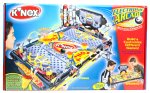
K’NEX Electronic Arcade turns construction pieces into a physical game board. The manufacturer guide matches the arcade design on Toysit’s retained package image and describes three modes: one-player pinball, two-player pinball and Speedball.
The interest is in the connection between the layout and the play. A bumper, an opening or a goal can change where a ball travels and what the player tries to do.
The ball moves in a physical space
This is not a video-game console: the ball, bumpers and constructed obstacles occupy a real playfield. The electronic scoreboard records events from that physical game.
The guide explains that scoring bumpers register hits in pinball and are inactive in Speedball. That distinction shows why changing a game mode matters: the same visible component need not have the same role in every game.
Pinball and Speedball ask different questions
Pinball directs attention toward keeping a ball in play and reaching scoring features. The manual provides both one-player and two-player pinball modes. Speedball instead pits two players against one another, using flippers to send the ball toward the opponent’s goal; its stated winning target is ten goals.
Use the illustrated guide for actual assembly, setup and controls. A brief description of the goal cannot replace the required model configuration or the manufacturer’s handling instructions.
Change a layout with a question in mind
The guide includes customization challenges after the main pinball construction. Before changing a model, identify what you want to observe: a clearer route, a harder target or a different place for a ball to return.
For a comparison, keep the starting point, number of attempts and scoring rule consistent. Record the old arrangement before making a permitted change. Otherwise, a new score can reflect several changes at once.
Design a paper arcade game
- Draw a rectangle with a start area, two obstacles and a goal. Leave a continuous route between start and goal.
- Invent a rule for moving a paper token, such as one short finger-width move per turn. Agree what counts as touching an obstacle.
- Try three turns or attempts and record the result using the same rule each time.
- Move one drawn obstacle in a second version. Predict how the route will change before trying it.
This independent tabletop design exercise has no electronics and does not simulate the toy’s sensors or recreate its official game rules.
The historical record
Original Toysit coverage
The original short description and full arcade-nostalgia essay remain below. The essay discusses video-game arcades broadly; it is not an account of this physical ball-game set or evidence of its player community.
Electronic Arcade by K'NEX
Build your own real working arcade! Electronic sound, sensors and scoring let you play solo or against a friend! Then customize for new building and playing challenges.
The nostalgia associated with arcades often evokes a sense of communal gaming, a departure from today's often solitary, online experience. For many, arcades symbolize an era when video gaming was a social activity that required physical presence, a pocket full of quarters, and the willingness to stand next to complete strangers for the chance to beat the high score on the leaderboard. The dim lighting punctuated by the glow of neon lights, the cacophony of digital melodies and sound effects, and the tactile sensation of joysticks and buttons form a sensory tapestry that is instantly recognizable to those who frequented these gaming havens.
Arcades were more than just a place to play video games; they were community centers for gamers, a rite of passage for young people, and an arena where reputations could be made or broken based on one's prowess at games like Pac-Man, Street Fighter, or Space Invaders. They were a staple of malls and boardwalks, a treat for birthdays, and an escape from everyday routine. The culture around arcades also gave rise to competitive gaming, laying the groundwork for the esports industry we know today.
While modern gaming offers its own set of joys and advantages, the nostalgia for arcades remains strong, encapsulating a specific form of togetherness and a particular brand of fun that is often sought after but rarely replicated. This nostalgia has led to a resurgence of arcade bars and retro gaming lounges, where adults can relive their youth while introducing new generations to the joys of coin-operated gaming.
Sources and editorial notes
The original manufacturer-authored Electronic Arcade manual, archived by KNEX Database under 63159, was downloaded. Its cover matches the retained packaging design. Component, mode, customization and Speedball-rule pages were visually inspected. The manual documents the scoreboard, scoring bumpers and three modes; this profile does not reconstruct the full build or prescribe a replacement power adapter. No electronics, sensors or physical game were tested.
- K’NEX Electronic Arcade instruction manual — Manufacturer-authored guide on the KNEX Database archive; component and game-rule pages checked.
Images and descriptions are retained as historical material. How Toysit covers toys.
Created for Toysit by Tabbloza — the artwork in our header.