
From the Toysit archive
Alphabet Pal
One caterpillar, several kinds of response: explore Alphabet Pal’s letter names, sounds, colors and music without confusing alphabet play with reading.
The play at a glance
The same button can answer a different question
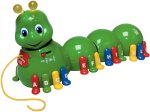
Alphabet Pal makes its alphabet into a row of colored feet. The selected mode determines what a press means: a letter name, a sound, a color or music. That change of purpose is the clearest way to understand the toy.
Four reasons to press a foot
The guide labels four modes on the butterfly selector: Letters, Phonics, Colors and Music. In those modes, pressing a foot gives a letter name, a letter sound, a color name or a short tune, respectively. Pulling the caterpillar plays the alphabet song.
Try one button in two modes before moving across all the letters. For example, first listen for its letter name, then change to Colors and listen for its color. The physical choice stays the same while the requested information changes.
Match the guide to the caterpillar
The item 19106 guide shows a high/low volume control and specifies three AA batteries. It describes automatic shutoff after 15 seconds without activity, with a button press or mode change restarting play. These details belong to that guide’s version; check the label and controls on a particular toy before applying them.
For a used unit, ask for a demonstration of the selector and several feet across the body. A song playing when the toy is pulled does not show that each individual letter button responds.
Separate the name from the sound
For a short spoken game away from the toy, choose a familiar letter such as M. Say its name, then make the opening sound in “moon.” Draw a moon and write M beside it. Let the child choose whether to point, repeat the sound or suggest another word.
Next, ask a deliberately different question about the drawing: what color is it? This keeps the focus on listening to the kind of question being asked. It is an optional shared activity, not a test or a substitute for reading together.
Enjoy the song without making it a reading score
Singing a familiar sequence, naming a printed letter and using sounds to read a new word are different tasks. The caterpillar offers recognizable actions and responses; noticing which ones a child enjoys is more useful here than treating a completed alphabet song as proof of reading ability. The historical essay’s broader claims remain available below with that distinction in mind.
The historical record
Original Toysit coverage
The original product description and alphabet-song essay remain below. Their educational claims and judgments about volume and durability are historical descriptions, not results of new testing.
Alphabet Pal by LeapFrog
Alphabet Pals silly giggle, flashing antennae and wobbly walk are sure to tickle your child's funny bone. Press one of twenty six legs to learn letter names, sounds, and colors or pull Alphabet Pal across the room to hear the ABC song! Teaches letter names sounds and colors. Here's a learning toy that offers kids a wonderful, interactive introduction to the world of letters, sounds, and colors. Alphabet Pal features several ways to play--pull the string and, antennae flashing, the jolly green caterpillar rolls happily along singing the alphabet song. When one of the caterpillar's 26 multicolored alphabet legs is pressed, kids hear the name of that color, letter, or letter sound depending on which mode they choose. Best of all, Alphabet Pal is a parent's friend, too--it's not too loud and turns off by itself when idle. It comes with three demonstration batteries, which should be replaced with regular AA batteries. Made of durable plastic, the toy is 7 by 11.5 inches long.
Songs, particularly those that are repetitive and catchy, have long been a cornerstone in early childhood education for teaching the alphabet. The rhythmic and melodic nature of songs can make learning the alphabet an enjoyable and memorable experience for children. The well-known "Alphabet Song," for example, provides a familiar tune and structure that help children remember the sequence of the letters. The melody aids in retention, while the repetitive structure encourages active participation, which is key for memory and learning. Additionally, songs engage multiple senses simultaneously—auditory, visual, and sometimes even tactile (through accompanying gestures or dance)—which can enhance learning and make the information stick. Because songs can be easily incorporated into daily routines, they also offer regular reinforcement that can be crucial for mastering the alphabet. Overall, using songs as an educational tool taps into the natural inclinations of children to sing, move, and have fun, making learning the alphabet a joyful and effective experience.
Sources and editorial notes
LeapFrog’s two-page guide for item 19106 was reviewed. Its caterpillar, pull cord, butterfly selector and letter-foot layout match the design in the Toysit photograph; confirm the item label for an individual unit. The spoken comparison activity is an original Toysit suggestion. No physical testing or literacy assessment was performed.
- LeapFrog Alphabet Pal parent guide (PDF) — Item 19106: illustrated controls, four modes, pull-along song, volume and battery information.
Images and descriptions are retained as historical material. How Toysit covers toys.
Created for Toysit by Tabbloza — the artwork in our header.